

The time dependence of mean cluster size s(t) at l < 1 follows:
sðtÞ / t
z
;
(55)
at l ¼ 1, it follows:
sðtÞ / exp at
ð Þ;
(56)
and for gelling systems:
sðtÞ / ð1 À t=t g Þ
b :
(57)
Here, a and b are constants and the following is a dynamic exponent:
z ¼ 1=ð1 À lÞ:
(58)
Note that continuous transition from z ¼ 1 (l ¼ 0) to z ¼ 1 (l ¼ 1)
corresponds to the transition from DLA to RLA model [150].
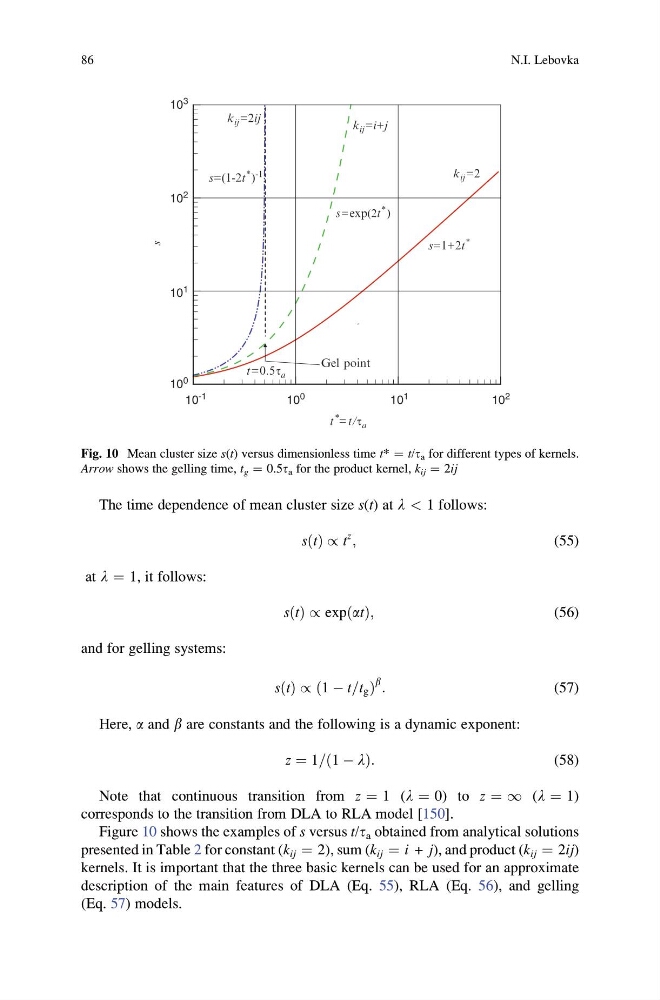
Figure 10 shows the examples of s versus t/t a obtained from analytical solutions
presented in Table 2 for constant (k ij ¼ 2), sum (k ij ¼ i + j), and product (k ij ¼ 2ij)
kernels. It is important that the three basic kernels can be used for an approximate
description of the main features of DLA (Eq. 55), RLA (Eq. 56), and gelling
(Eq. 57) models.
10
3
10
2
10
1
10 0
10
0
10
1
10
2
10
-1
t
* =t/τ a
s
k ij =2
k ij =i+j
k ij =2ij
t=0.5τ a
s=(1-2t
* )
-1
s=exp(2t
* )
s=1+2t
*
Gel point
Fig. 10 Mean cluster size s(t) versus dimensionless time t* ¼ t/t a for different types of kernels.
Arrow shows the gelling time, t g ¼ 0.5t a for the product kernel, k ij ¼ 2ij
86
N.I. Lebovka
sðtÞ / t
z
;
(55)
at l ¼ 1, it follows:
sðtÞ / exp at
ð Þ;
(56)
and for gelling systems:
sðtÞ / ð1 À t=t g Þ
b :
(57)
Here, a and b are constants and the following is a dynamic exponent:
z ¼ 1=ð1 À lÞ:
(58)
Note that continuous transition from z ¼ 1 (l ¼ 0) to z ¼ 1 (l ¼ 1)
corresponds to the transition from DLA to RLA model [150].
Figure 10 shows the examples of s versus t/t a obtained from analytical solutions
presented in Table 2 for constant (k ij ¼ 2), sum (k ij ¼ i + j), and product (k ij ¼ 2ij)
kernels. It is important that the three basic kernels can be used for an approximate
description of the main features of DLA (Eq. 55), RLA (Eq. 56), and gelling
(Eq. 57) models.
10
3
10
2
10
1
10 0
10
0
10
1
10
2
10
-1
t
* =t/τ a
s
k ij =2
k ij =i+j
k ij =2ij
t=0.5τ a
s=(1-2t
* )
-1
s=exp(2t
* )
s=1+2t
*
Gel point
Fig. 10 Mean cluster size s(t) versus dimensionless time t* ¼ t/t a for different types of kernels.
Arrow shows the gelling time, t g ¼ 0.5t a for the product kernel, k ij ¼ 2ij
86
N.I. Lebovka