

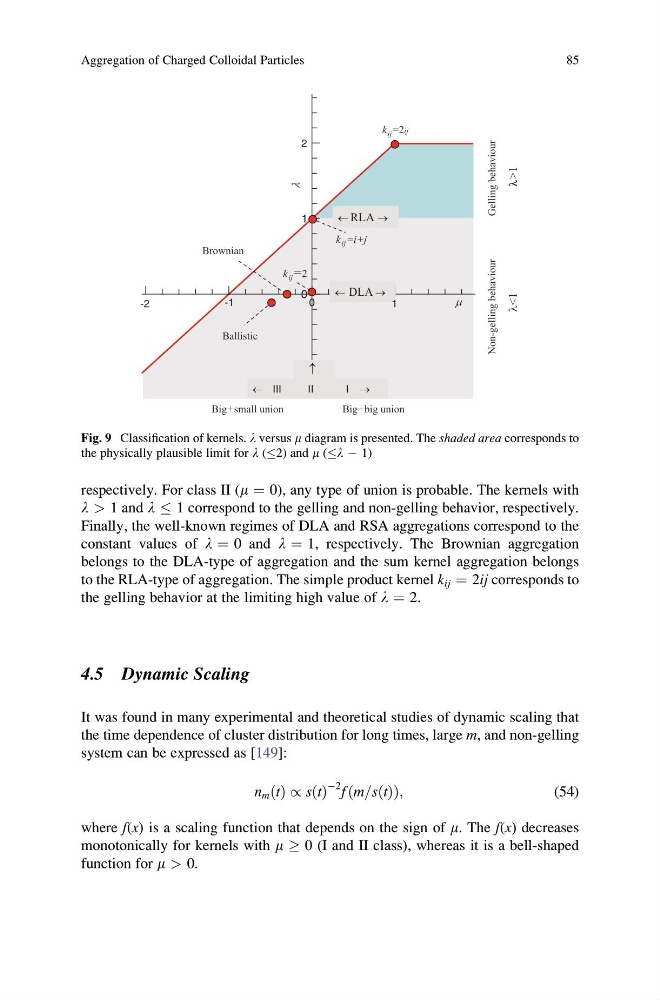
respectively. For class II (m ¼ 0), any type of union is probable. The kernels with
l > 1 and l 1 correspond to the gelling and non-gelling behavior, respectively.
Finally, the well-known regimes of DLA and RSA aggregations correspond to the
constant values of l ¼ 0 and l ¼ 1, respectively. The Brownian aggregation
belongs to the DLA-type of aggregation and the sum kernel aggregation belongs
to the RLA-type of aggregation. The simple product kernel k ij ¼ 2ij corresponds to
the gelling behavior at the limiting high value of l ¼ 2.
4.5 Dynamic Scaling
It was found in many experimental and theoretical studies of dynamic scaling that
the time dependence of cluster distribution for long times, large m, and non-gelling
system can be expressed as [149]:
n m ðtÞ / sðtÞ
À2 f ðm=sðtÞÞ;
(54)
where f(x) is a scaling function that depends on the sign of m. The f(x) decreases
monotonically for kernels with m ! 0 (I and II class), whereas it is a bell-shaped
function for m > 0.
-2
-1
0
-1
0
1
2
Gelling behaviour
Non-gelling behaviour
λ<1
λ
μ
← DLA →
k ij =2ij
k ij =i+j
k ij =2
← III
II
I →
↑
Big+small union
Big+big union
Ballistic
Brownian
← RLA →
1
l>1
Fig. 9 Classification of kernels. l versus m diagram is presented. The shaded area corresponds to
the physically plausible limit for l ( 2) and m ( l À 1)
Aggregation of Charged Colloidal Particles
85
l > 1 and l 1 correspond to the gelling and non-gelling behavior, respectively.
Finally, the well-known regimes of DLA and RSA aggregations correspond to the
constant values of l ¼ 0 and l ¼ 1, respectively. The Brownian aggregation
belongs to the DLA-type of aggregation and the sum kernel aggregation belongs
to the RLA-type of aggregation. The simple product kernel k ij ¼ 2ij corresponds to
the gelling behavior at the limiting high value of l ¼ 2.
4.5 Dynamic Scaling
It was found in many experimental and theoretical studies of dynamic scaling that
the time dependence of cluster distribution for long times, large m, and non-gelling
system can be expressed as [149]:
n m ðtÞ / sðtÞ
À2 f ðm=sðtÞÞ;
(54)
where f(x) is a scaling function that depends on the sign of m. The f(x) decreases
monotonically for kernels with m ! 0 (I and II class), whereas it is a bell-shaped
function for m > 0.
-2
-1
0
-1
0
1
2
Gelling behaviour
Non-gelling behaviour
λ<1
λ
μ
← DLA →
k ij =2ij
k ij =i+j
k ij =2
← III
II
I →
↑
Big+small union
Big+big union
Ballistic
Brownian
← RLA →
1
l>1
Fig. 9 Classification of kernels. l versus m diagram is presented. The shaded area corresponds to
the physically plausible limit for l ( 2) and m ( l À 1)
Aggregation of Charged Colloidal Particles
85