

cluster takes place for the product kernel within the finite time at t g ¼ 0.5t s . It
corresponds to the sol–gel transition. At time exceeding t g , the particles belong to
two different populations in the finite (sol phase) and infinite (gel phase) clusters
[145].
4.4 Classification of Kernels
For simple aggregation models, the kernel k ij is usually a homogeneous function:
k ai;aj ¼ a
l k ij ;
(52)
where a is a positive constant and may be presented for large-size clusters as the
product of powers i
m and j
n [148]:
k i;j ’ i
m j
n
:
(53)
Here, m and n are exponents, n ¼ l À m, i ( j, and i ) 1, and kernels with
l > 2 and l > 1 + m are unphysical. The values of l and m for different types of
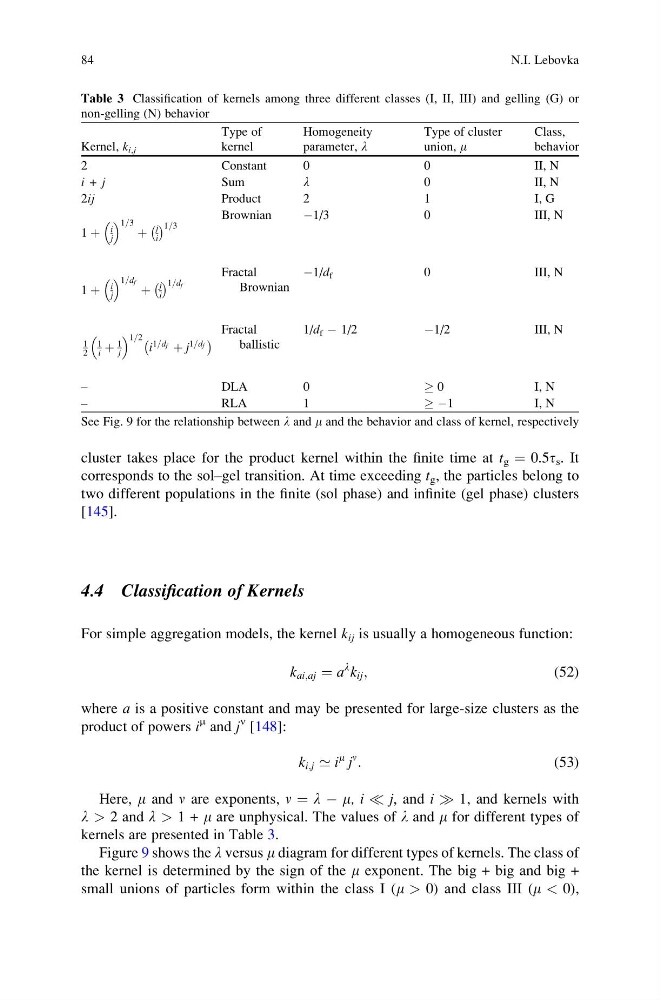
kernels are presented in Table 3.
Figure 9 shows the l versus m diagram for different types of kernels. The class of
the kernel is determined by the sign of the m exponent. The big + big and big +
small unions of particles form within the class I (m > 0) and class III (m < 0),
Table 3 Classification of kernels among three different classes (I, II, III) and gelling (G) or
non-gelling (N) behavior
Kernel, k i,j
Type of
kernel
Homogeneity
parameter, l
Type of cluster
union, m
Class,
behavior
2
Constant
0
0
II, N
i + j
Sum
l
0
II, N
2ij
Product
2
1
I, G
1 þ
i
j
1=3 þ
j
i
À Á 1=3
Brownian
À1/3
0
III, N
1 þ
i
j
1=df þ
j
i
À Á 1=df
Fractal
Brownian
À1/d f
0
III, N
1
2
1
i þ
1
j
1=2
i
1=df þ j
1=df
À
Á
Fractal
ballistic
1/d f À 1/2
À1/2
III, N
–
DLA
0
! 0
I , N
–
RLA
1
! À1
I , N
See Fig. 9 for the relationship between l and m and the behavior and class of kernel, respectively
84
N.I. Lebovka
corresponds to the sol–gel transition. At time exceeding t g , the particles belong to
two different populations in the finite (sol phase) and infinite (gel phase) clusters
[145].
4.4 Classification of Kernels
For simple aggregation models, the kernel k ij is usually a homogeneous function:
k ai;aj ¼ a
l k ij ;
(52)
where a is a positive constant and may be presented for large-size clusters as the
product of powers i
m and j
n [148]:
k i;j ’ i
m j
n
:
(53)
Here, m and n are exponents, n ¼ l À m, i ( j, and i ) 1, and kernels with
l > 2 and l > 1 + m are unphysical. The values of l and m for different types of
kernels are presented in Table 3.
Figure 9 shows the l versus m diagram for different types of kernels. The class of
the kernel is determined by the sign of the m exponent. The big + big and big +
small unions of particles form within the class I (m > 0) and class III (m < 0),
Table 3 Classification of kernels among three different classes (I, II, III) and gelling (G) or
non-gelling (N) behavior
Kernel, k i,j
Type of
kernel
Homogeneity
parameter, l
Type of cluster
union, m
Class,
behavior
2
Constant
0
0
II, N
i + j
Sum
l
0
II, N
2ij
Product
2
1
I, G
1 þ
i
j
1=3 þ
j
i
À Á 1=3
Brownian
À1/3
0
III, N
1 þ
i
j
1=df þ
j
i
À Á 1=df
Fractal
Brownian
À1/d f
0
III, N
1
2
1
i þ
1
j
1=2
i
1=df þ j
1=df
À
Á
Fractal
ballistic
1/d f À 1/2
À1/2
III, N
–
DLA
0
! 0
I , N
–
RLA
1
! À1
I , N
See Fig. 9 for the relationship between l and m and the behavior and class of kernel, respectively
84
N.I. Lebovka