

4.2 Population Balance Equations
In order to account for formation of dimers, trimers, and larger aggregates, von
Smoluchowski proposed in his pioneering work [73] the following system of
population balance equations (PBE):
dn m
dt à ¼
1
2
X mÀ1
i¼1
k i;mÀi n i ðtÞn mÀj ðtÞ À n m ðtÞ
X 1
i¼1
k m;i n i ðtÞ;
(42)
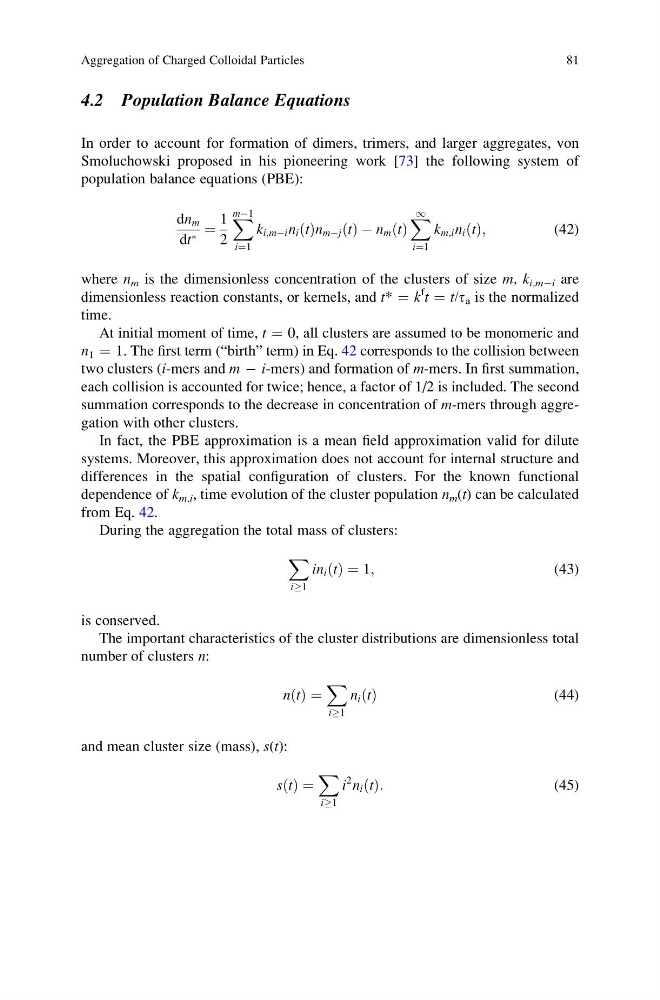
where n m is the dimensionless concentration of the clusters of size m, k i,mÀi are
dimensionless reaction constants, or kernels, and t* ¼ k
f t ¼ t/t a is the normalized
time.
At initial moment of time, t ¼ 0, all clusters are assumed to be monomeric and
n 1 ¼ 1. The first term (“birth” term) in Eq. 42 corresponds to the collision between
two clusters (i-mers and m À i-mers) and formation of m-mers. In first summation,
each collision is accounted for twice; hence, a factor of 1/2 is included. The second
summation corresponds to the decrease in concentration of m-mers through aggregation with other clusters.
In fact, the PBE approximation is a mean field approximation valid for dilute
systems. Moreover, this approximation does not account for internal structure and
differences in the spatial configuration of clusters. For the known functional
dependence of k m,i , time evolution of the cluster population n m (t) can be calculated
from Eq. 42.
During the aggregation the total mass of clusters:
X
i!1
in i ðtÞ ¼ 1;
(43)
is conserved.
The important characteristics of the cluster distributions are dimensionless total
number of clusters n:
nðtÞ ¼
X
i!1
n i ðtÞ
(44)
and mean cluster size (mass), s(t):
sðtÞ ¼
X
i!1
i
2 n i ðtÞ:
(45)
Aggregation of Charged Colloidal Particles
81
In order to account for formation of dimers, trimers, and larger aggregates, von
Smoluchowski proposed in his pioneering work [73] the following system of
population balance equations (PBE):
dn m
dt à ¼
1
2
X mÀ1
i¼1
k i;mÀi n i ðtÞn mÀj ðtÞ À n m ðtÞ
X 1
i¼1
k m;i n i ðtÞ;
(42)
where n m is the dimensionless concentration of the clusters of size m, k i,mÀi are
dimensionless reaction constants, or kernels, and t* ¼ k
f t ¼ t/t a is the normalized
time.
At initial moment of time, t ¼ 0, all clusters are assumed to be monomeric and
n 1 ¼ 1. The first term (“birth” term) in Eq. 42 corresponds to the collision between
two clusters (i-mers and m À i-mers) and formation of m-mers. In first summation,
each collision is accounted for twice; hence, a factor of 1/2 is included. The second
summation corresponds to the decrease in concentration of m-mers through aggregation with other clusters.
In fact, the PBE approximation is a mean field approximation valid for dilute
systems. Moreover, this approximation does not account for internal structure and
differences in the spatial configuration of clusters. For the known functional
dependence of k m,i , time evolution of the cluster population n m (t) can be calculated
from Eq. 42.
During the aggregation the total mass of clusters:
X
i!1
in i ðtÞ ¼ 1;
(43)
is conserved.
The important characteristics of the cluster distributions are dimensionless total
number of clusters n:
nðtÞ ¼
X
i!1
n i ðtÞ
(44)
and mean cluster size (mass), s(t):
sðtÞ ¼
X
i!1
i
2 n i ðtÞ:
(45)
Aggregation of Charged Colloidal Particles
81