

where W ij (!1) is the dimensionless Fuchs stability ratio, which can be considered
as the inverse sticking probability [142]:
w ij ¼
ð 1
0
exp u t ðxÞ=k B T
ð
Þ
x þ 2
ð
Þ
2
dx:
(39)
Here, x ¼ h=r ij ; r ij ¼ r i þ r j
À
Á =2; and u t is the total energy, i.e., the sum of the
attractive, u a , and repulsive, u r , parts.
It was shown that the value of W ij is mainly determined by the height of the
energy barrier u
max
t
located at h ffi l D and the following approximate relation was
obtained for equal sized particles, r ¼ r i ¼ r j , [143]:
W ij ¼
l D
2r
exp u
max
t
=k B T
À
Á :
(40)
Usually, it is assumed that fast and slow aggregations are controlled by attractive
and total interactions, respectively, and the equation used for estimation of W ij is
more complicated:
W ij ¼
Ð 1
0 dx exp u t =k B T
ð
Þ= x þ 2
ð
Þ
2
Ð 1
0 dx exp u a =k B T
ð
Þ=ðx þ 2Þ
2
:
(41)
10
3
10
1
10
-1
10
-3
10
-5
10
-7
10
0
10
1
10
2
10
3
r, nm
t
a , s
j=10
-3
j=10
-2
j=10
-1
j=10
-4
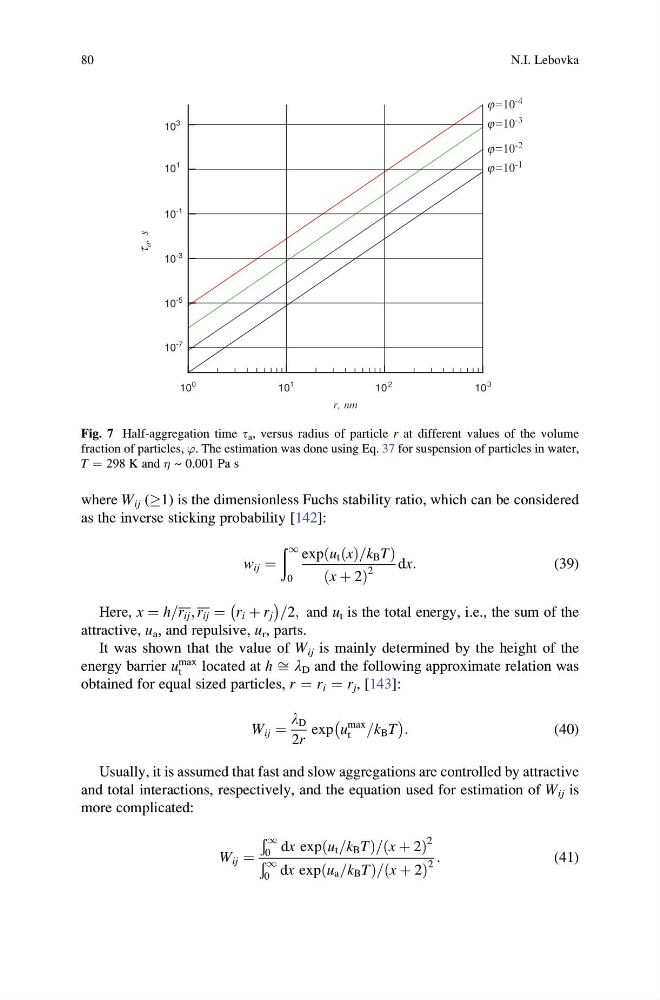
Fig. 7 Half-aggregation time t a , versus radius of particle r at different values of the volume
fraction of particles, ’. The estimation was done using Eq. 37 for suspension of particles in water,
T ¼ 298 K and ~ 0.001 Pa s
80
N.I. Lebovka
as the inverse sticking probability [142]:
w ij ¼
ð 1
0
exp u t ðxÞ=k B T
ð
Þ
x þ 2
ð
Þ
2
dx:
(39)
Here, x ¼ h=r ij ; r ij ¼ r i þ r j
À
Á =2; and u t is the total energy, i.e., the sum of the
attractive, u a , and repulsive, u r , parts.
It was shown that the value of W ij is mainly determined by the height of the
energy barrier u
max
t
located at h ffi l D and the following approximate relation was
obtained for equal sized particles, r ¼ r i ¼ r j , [143]:
W ij ¼
l D
2r
exp u
max
t
=k B T
À
Á :
(40)
Usually, it is assumed that fast and slow aggregations are controlled by attractive
and total interactions, respectively, and the equation used for estimation of W ij is
more complicated:
W ij ¼
Ð 1
0 dx exp u t =k B T
ð
Þ= x þ 2
ð
Þ
2
Ð 1
0 dx exp u a =k B T
ð
Þ=ðx þ 2Þ
2
:
(41)
10
3
10
1
10
-1
10
-3
10
-5
10
-7
10
0
10
1
10
2
10
3
r, nm
t
a , s
j=10
-3
j=10
-2
j=10
-1
j=10
-4
Fig. 7 Half-aggregation time t a , versus radius of particle r at different values of the volume
fraction of particles, ’. The estimation was done using Eq. 37 for suspension of particles in water,
T ¼ 298 K and ~ 0.001 Pa s
80
N.I. Lebovka