

4.1 Aggregation as a Second-Order Reaction
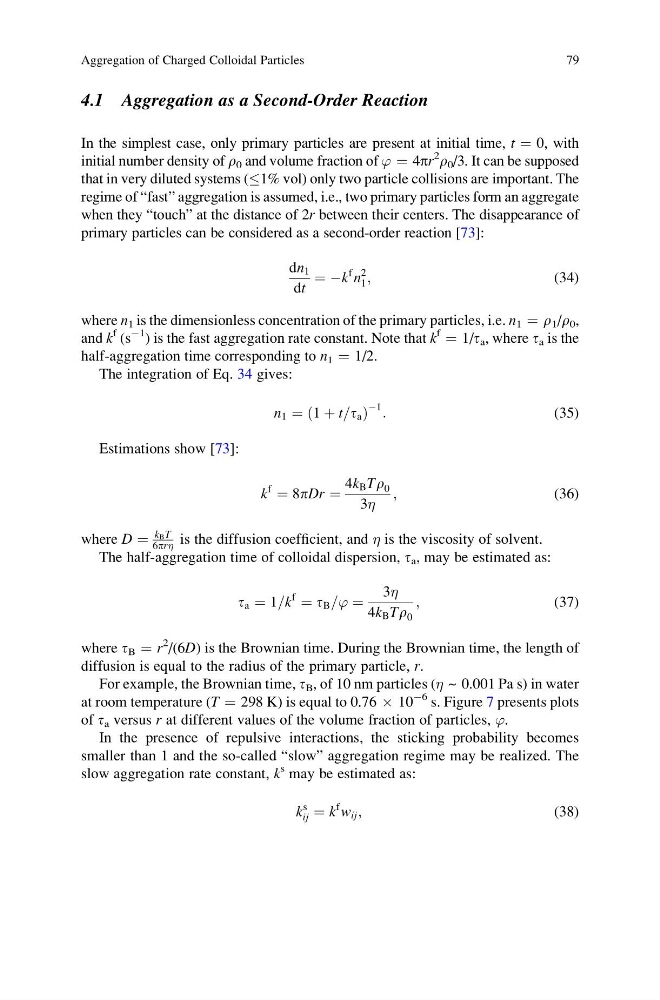
In the simplest case, only primary particles are present at initial time, t ¼ 0, with
initial number density of r 0 and volume fraction of ’ ¼ 4pr
2
r 0 /3. It can be supposed
that in very diluted systems ( 1% vol) only two particle collisions are important. The
regime of “fast” aggregation is assumed, i.e., two primary particles form an aggregate
when they “touch” at the distance of 2r between their centers. The disappearance of
primary particles can be considered as a second-order reaction [73]:
dn 1
dt
¼ Àk
f n
2
1 ;
(34)
where n 1 is the dimensionless concentration of the primary particles, i.e. n 1 ¼ r 1 /r 0 ,
and k
f (s
À1 ) is the fast aggregation rate constant. Note that k
f
¼ 1/t a , where t a is the
half-aggregation time corresponding to n 1 ¼ 1/2.
The integration of Eq. 34 gives:
n 1 ¼ 1 þ t=t a
ð
Þ
À1 :
(35)
Estimations show [73]:
k
f
¼ 8pDr ¼
4k B Tr 0
3
;
(36)
where D ¼
k B T
6pr is the diffusion coefficient, and is the viscosity of solvent.
The half-aggregation time of colloidal dispersion, t a , may be estimated as:
t a ¼ 1=k
f
¼ t B =’ ¼
3
4k B Tr 0
;
(37)
where t B ¼ r
2 /(6D) is the Brownian time. During the Brownian time, the length of
diffusion is equal to the radius of the primary particle, r.
For example, the Brownian time, t B , of 10 nm particles ( ~ 0.001 Pa s) in water
at room temperature (T ¼ 298 K) is equal to 0.76 Â 10
À6 s. Figure 7 presents plots
of t a versus r at different values of the volume fraction of particles, ’.
In the presence of repulsive interactions, the sticking probability becomes
smaller than 1 and the so-called “slow” aggregation regime may be realized. The
slow aggregation rate constant, k
s may be estimated as:
k
s
ij ¼ k
f w ij ;
(38)
Aggregation of Charged Colloidal Particles
79
In the simplest case, only primary particles are present at initial time, t ¼ 0, with
initial number density of r 0 and volume fraction of ’ ¼ 4pr
2
r 0 /3. It can be supposed
that in very diluted systems ( 1% vol) only two particle collisions are important. The
regime of “fast” aggregation is assumed, i.e., two primary particles form an aggregate
when they “touch” at the distance of 2r between their centers. The disappearance of
primary particles can be considered as a second-order reaction [73]:
dn 1
dt
¼ Àk
f n
2
1 ;
(34)
where n 1 is the dimensionless concentration of the primary particles, i.e. n 1 ¼ r 1 /r 0 ,
and k
f (s
À1 ) is the fast aggregation rate constant. Note that k
f
¼ 1/t a , where t a is the
half-aggregation time corresponding to n 1 ¼ 1/2.
The integration of Eq. 34 gives:
n 1 ¼ 1 þ t=t a
ð
Þ
À1 :
(35)
Estimations show [73]:
k
f
¼ 8pDr ¼
4k B Tr 0
3
;
(36)
where D ¼
k B T
6pr is the diffusion coefficient, and is the viscosity of solvent.
The half-aggregation time of colloidal dispersion, t a , may be estimated as:
t a ¼ 1=k
f
¼ t B =’ ¼
3
4k B Tr 0
;
(37)
where t B ¼ r
2 /(6D) is the Brownian time. During the Brownian time, the length of
diffusion is equal to the radius of the primary particle, r.
For example, the Brownian time, t B , of 10 nm particles ( ~ 0.001 Pa s) in water
at room temperature (T ¼ 298 K) is equal to 0.76 Â 10
À6 s. Figure 7 presents plots
of t a versus r at different values of the volume fraction of particles, ’.
In the presence of repulsive interactions, the sticking probability becomes
smaller than 1 and the so-called “slow” aggregation regime may be realized. The
slow aggregation rate constant, k
s may be estimated as:
k
s
ij ¼ k
f w ij ;
(38)
Aggregation of Charged Colloidal Particles
79