

dependence of the structural solvation potential may be approximated as was first
described by Marcelja and Radic [13, 51]:
u s ðhÞ ¼ u
0
s exp Àh=l s
ð
Þ;
(21)
where u
0
s ¼ rp s l
2
s ; p s is the structural pressure constant, and l s (approximately
0.2–2 nm) is the solvation decay length. Usually, the monotonic exponential decay
superimposes on an oscillatory profile.
2.5 Hydrophobic Interactions
Hydrophobic interactions are rather typical for organic colloidal particles (e.g., the
particles of latex) dissolved in water. They produce a net attractive contribution. The
hydrophobic potential for two equal spherical colloidal particles is expressed as [13]:
u h ðhÞ ¼ Àu
0
h exp Àh l h
=
ð
Þ;
(22)
where u
0
h ¼ 2prgl h ; g $ 10 À 50 mJ=m
2
Þ and l h $ 1 À 2 nm
ð
Þ
ð
are empirical
parameters.
This contribution is rather short-ranged and reduces only the height of the DLVO
potential barrier without modifying the depth of the secondary minimum [52].
2.6 Effect of Polymers
2.6.1 Adsorbing Polymer
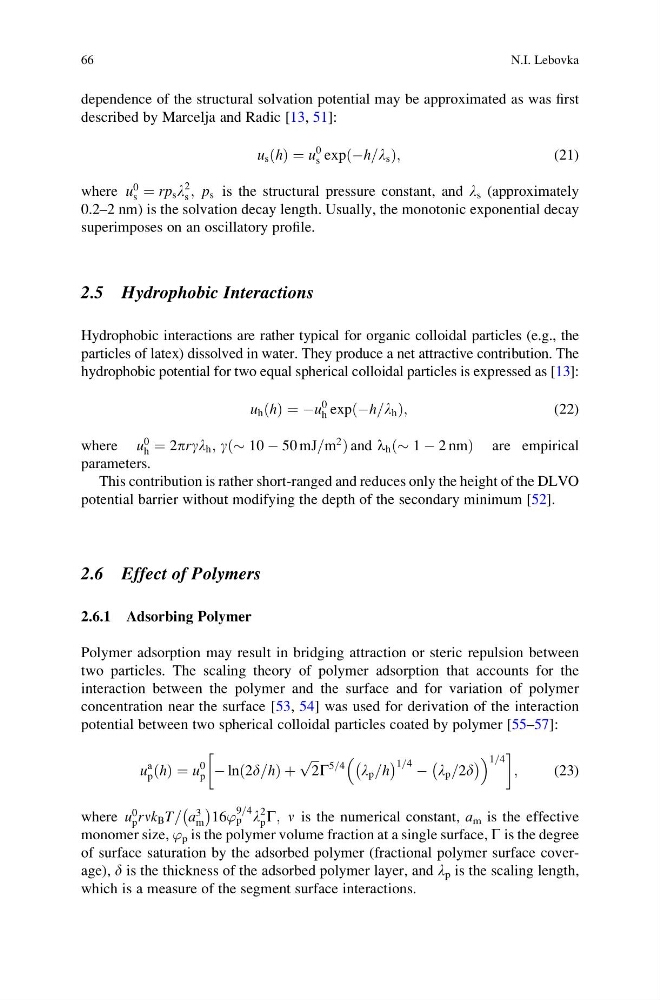
Polymer adsorption may result in bridging attraction or steric repulsion between
two particles. The scaling theory of polymer adsorption that accounts for the
interaction between the polymer and the surface and for variation of polymer
concentration near the surface [53, 54] was used for derivation of the interaction
potential between two spherical colloidal particles coated by polymer [55–57]:
u
a
p ðhÞ ¼ u
0
p À ln 2d=h
ð
Þþ
ffiffi ffi
2
p G
5=4
l p =h
À
Á 1=4 À l p =2d
À
Á
1=4
!
;
(23)
where u
0
p rnk B T= a
3
m
À Á
16’
9=4
p l
2
p G; n is the numerical constant, a m is the effective
monomer size, ’ p is the polymer volume fraction at a single surface, G is the degree
of surface saturation by the adsorbed polymer (fractional polymer surface coverage), d is the thickness of the adsorbed polymer layer, and l p is the scaling length,
which is a measure of the segment surface interactions.
66
N.I. Lebovka
described by Marcelja and Radic [13, 51]:
u s ðhÞ ¼ u
0
s exp Àh=l s
ð
Þ;
(21)
where u
0
s ¼ rp s l
2
s ; p s is the structural pressure constant, and l s (approximately
0.2–2 nm) is the solvation decay length. Usually, the monotonic exponential decay
superimposes on an oscillatory profile.
2.5 Hydrophobic Interactions
Hydrophobic interactions are rather typical for organic colloidal particles (e.g., the
particles of latex) dissolved in water. They produce a net attractive contribution. The
hydrophobic potential for two equal spherical colloidal particles is expressed as [13]:
u h ðhÞ ¼ Àu
0
h exp Àh l h
=
ð
Þ;
(22)
where u
0
h ¼ 2prgl h ; g $ 10 À 50 mJ=m
2
Þ and l h $ 1 À 2 nm
ð
Þ
ð
are empirical
parameters.
This contribution is rather short-ranged and reduces only the height of the DLVO
potential barrier without modifying the depth of the secondary minimum [52].
2.6 Effect of Polymers
2.6.1 Adsorbing Polymer
Polymer adsorption may result in bridging attraction or steric repulsion between
two particles. The scaling theory of polymer adsorption that accounts for the
interaction between the polymer and the surface and for variation of polymer
concentration near the surface [53, 54] was used for derivation of the interaction
potential between two spherical colloidal particles coated by polymer [55–57]:
u
a
p ðhÞ ¼ u
0
p À ln 2d=h
ð
Þþ
ffiffi ffi
2
p G
5=4
l p =h
À
Á 1=4 À l p =2d
À
Á
1=4
!
;
(23)
where u
0
p rnk B T= a
3
m
À Á
16’
9=4
p l
2
p G; n is the numerical constant, a m is the effective
monomer size, ’ p is the polymer volume fraction at a single surface, G is the degree
of surface saturation by the adsorbed polymer (fractional polymer surface coverage), d is the thickness of the adsorbed polymer layer, and l p is the scaling length,
which is a measure of the segment surface interactions.
66
N.I. Lebovka