

Note that this type of potential was used in Brownian-dynamics simulations of
charged colloidal suspensions, where gas, liquid-droplet, and crystal-droplet phases
were identified [44].
2.2.3 Effect of Charge Nonuniformity
The charge nonuniformity on the surface of colloidal particles may also significantly contribute to the electrostatic interactions. It can arise from selective ion
adsorption on the surface of colloidal particles and distribution of z potential [45,
46]. The surface charge nonuniformity can lead to attractive electrostatic and
hydrophobic interactions between particles and cause suspension instability
[47–49]. An extension of the HHF model for the randomly charged surfaces gives
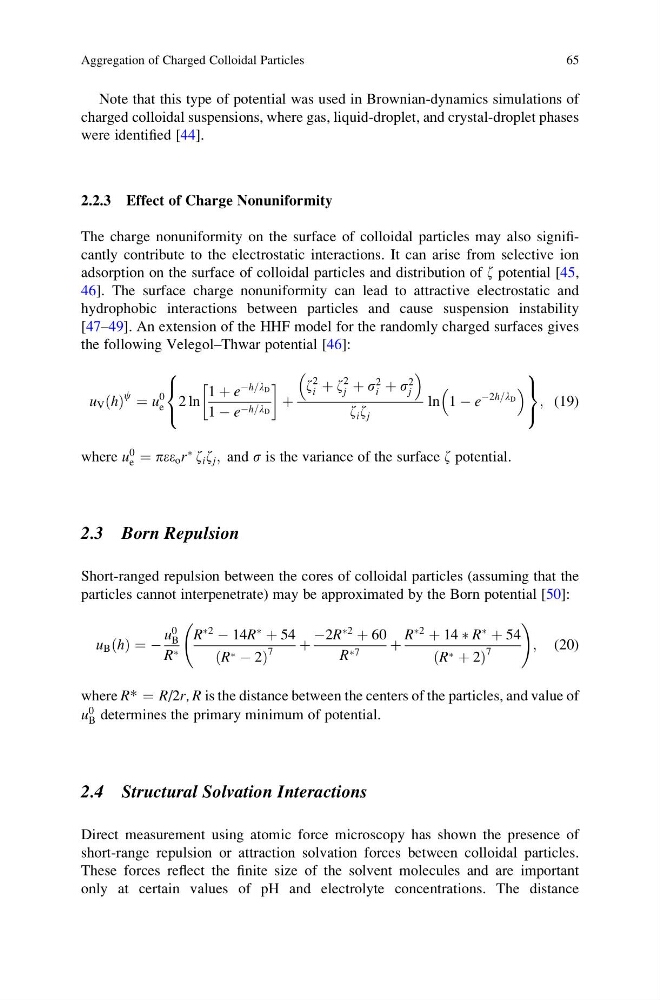
the following Velegol–Thwar potential [46]:
u V ðhÞ
c ¼ u
0
e 2 ln
1 þ e
Àh=l D
1 À e Àh=l D
!
þ
z
2
i þ z
2
j þ s
2
i þ s
2
j
z i z j
ln 1 À e
À2h=l D
8
<
:
9
=
;
; (19)
where u
0
e ¼ pee o r
à z i z j ; and s is the variance of the surface z potential.
2.3 Born Repulsion
Short-ranged repulsion between the cores of colloidal particles (assuming that the
particles cannot interpenetrate) may be approximated by the Born potential [50]:
u B ðhÞ ¼ À
u
0
B
R Ã
R
Ã2
À 14R
Ã
þ 54
R Ã À 2
ð
Þ
7
þ
À2R
Ã2
þ 60
R Ã7
þ
R
Ã2
þ 14 Ã R
Ã
þ 54
R Ã þ 2
ð
Þ
7
!
; (20)
where R* ¼ R/2r, R is the distance between the centers of the particles, and value of
u
0
B determines the primary minimum of potential.
2.4 Structural Solvation Interactions
Direct measurement using atomic force microscopy has shown the presence of
short-range repulsion or attraction solvation forces between colloidal particles.
These forces reflect the finite size of the solvent molecules and are important
only at certain values of pH and electrolyte concentrations. The distance
Aggregation of Charged Colloidal Particles
65
charged colloidal suspensions, where gas, liquid-droplet, and crystal-droplet phases
were identified [44].
2.2.3 Effect of Charge Nonuniformity
The charge nonuniformity on the surface of colloidal particles may also significantly contribute to the electrostatic interactions. It can arise from selective ion
adsorption on the surface of colloidal particles and distribution of z potential [45,
46]. The surface charge nonuniformity can lead to attractive electrostatic and
hydrophobic interactions between particles and cause suspension instability
[47–49]. An extension of the HHF model for the randomly charged surfaces gives
the following Velegol–Thwar potential [46]:
u V ðhÞ
c ¼ u
0
e 2 ln
1 þ e
Àh=l D
1 À e Àh=l D
!
þ
z
2
i þ z
2
j þ s
2
i þ s
2
j
z i z j
ln 1 À e
À2h=l D
8
<
:
9
=
;
; (19)
where u
0
e ¼ pee o r
à z i z j ; and s is the variance of the surface z potential.
2.3 Born Repulsion
Short-ranged repulsion between the cores of colloidal particles (assuming that the
particles cannot interpenetrate) may be approximated by the Born potential [50]:
u B ðhÞ ¼ À
u
0
B
R Ã
R
Ã2
À 14R
Ã
þ 54
R Ã À 2
ð
Þ
7
þ
À2R
Ã2
þ 60
R Ã7
þ
R
Ã2
þ 14 Ã R
Ã
þ 54
R Ã þ 2
ð
Þ
7
!
; (20)
where R* ¼ R/2r, R is the distance between the centers of the particles, and value of
u
0
B determines the primary minimum of potential.
2.4 Structural Solvation Interactions
Direct measurement using atomic force microscopy has shown the presence of
short-range repulsion or attraction solvation forces between colloidal particles.
These forces reflect the finite size of the solvent molecules and are important
only at certain values of pH and electrolyte concentrations. The distance
Aggregation of Charged Colloidal Particles
65