

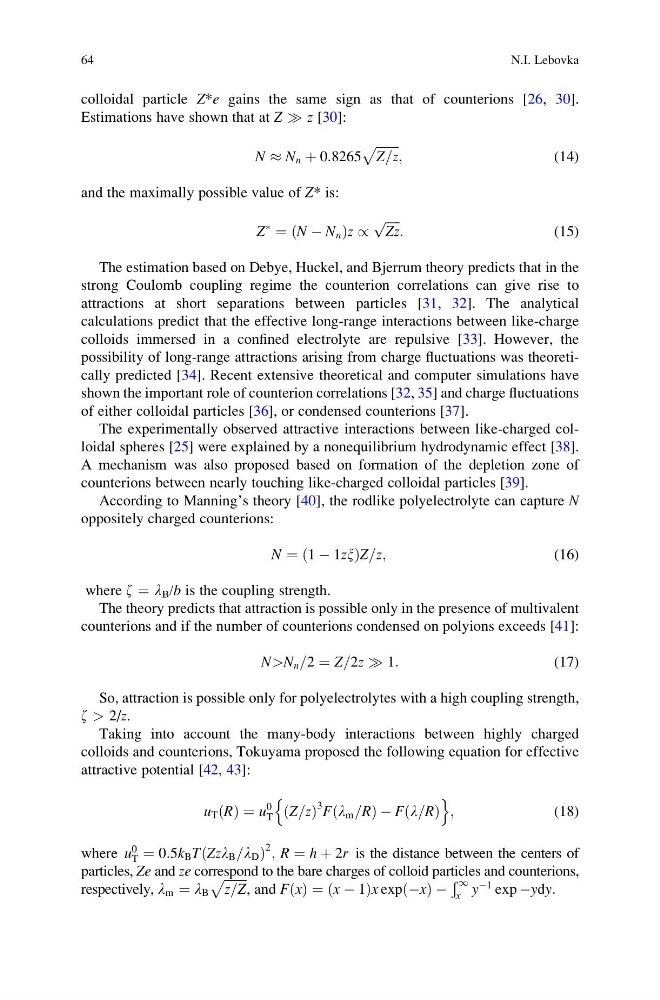
colloidal particle Z*e gains the same sign as that of counterions [26, 30].
Estimations have shown that at Z ) z [30]:
N % N n þ 0:8265
ffiffiffiffiffiffiffi ffi
Z=z
p ;
(14)
and the maximally possible value of Z* is:
Z
Ã
¼ N À N n
ð
Þz /
ffiffiffiffiffi
Zz
p :
(15)
The estimation based on Debye, Huckel, and Bjerrum theory predicts that in the
strong Coulomb coupling regime the counterion correlations can give rise to
attractions at short separations between particles [31, 32]. The analytical
calculations predict that the effective long-range interactions between like-charge
colloids immersed in a confined electrolyte are repulsive [33]. However, the
possibility of long-range attractions arising from charge fluctuations was theoretically predicted [34]. Recent extensive theoretical and computer simulations have
shown the important role of counterion correlations [32, 35] and charge fluctuations
of either colloidal particles [36], or condensed counterions [37].
The experimentally observed attractive interactions between like-charged colloidal spheres [25] were explained by a nonequilibrium hydrodynamic effect [38].
A mechanism was also proposed based on formation of the depletion zone of
counterions between nearly touching like-charged colloidal particles [39].
According to Manning’s theory [40], the rodlike polyelectrolyte can capture N
oppositely charged counterions:
N ¼ 1 À 1zx
ð
Þ Z=z;
(16)
where z ¼ l B /b is the coupling strength.
The theory predicts that attraction is possible only in the presence of multivalent
counterions and if the number of counterions condensed on polyions exceeds [41]:
N>N n =2 ¼ Z=2z ) 1:
(17)
So, attraction is possible only for polyelectrolytes with a high coupling strength,
z > 2/z.
Taking into account the many-body interactions between highly charged
colloids and counterions, Tokuyama proposed the following equation for effective
attractive potential [42, 43]:
u T ðRÞ ¼ u
0
T
Z=z
ð Þ
3 F l m =R
ð
ÞÀF l=R
ð
Þ
n
o
;
(18)
where u
0
T ¼ 0:5k B T Zzl B l D
=
ð
Þ
2 ; R ¼ h þ 2r is the distance between the centers of
particles, Ze and ze correspond to the bare charges of colloid particles and counterions,
respectively, l m ¼ l B
ffiffiffiffiffiffiffi ffi
z=Z
p
, and FðxÞ ¼ ðx À 1Þx expðÀxÞ À
Ð 1
x y
À1 exp Àydy:
64
N.I. Lebovka
Estimations have shown that at Z ) z [30]:
N % N n þ 0:8265
ffiffiffiffiffiffiffi ffi
Z=z
p ;
(14)
and the maximally possible value of Z* is:
Z
Ã
¼ N À N n
ð
Þz /
ffiffiffiffiffi
Zz
p :
(15)
The estimation based on Debye, Huckel, and Bjerrum theory predicts that in the
strong Coulomb coupling regime the counterion correlations can give rise to
attractions at short separations between particles [31, 32]. The analytical
calculations predict that the effective long-range interactions between like-charge
colloids immersed in a confined electrolyte are repulsive [33]. However, the
possibility of long-range attractions arising from charge fluctuations was theoretically predicted [34]. Recent extensive theoretical and computer simulations have
shown the important role of counterion correlations [32, 35] and charge fluctuations
of either colloidal particles [36], or condensed counterions [37].
The experimentally observed attractive interactions between like-charged colloidal spheres [25] were explained by a nonequilibrium hydrodynamic effect [38].
A mechanism was also proposed based on formation of the depletion zone of
counterions between nearly touching like-charged colloidal particles [39].
According to Manning’s theory [40], the rodlike polyelectrolyte can capture N
oppositely charged counterions:
N ¼ 1 À 1zx
ð
Þ Z=z;
(16)
where z ¼ l B /b is the coupling strength.
The theory predicts that attraction is possible only in the presence of multivalent
counterions and if the number of counterions condensed on polyions exceeds [41]:
N>N n =2 ¼ Z=2z ) 1:
(17)
So, attraction is possible only for polyelectrolytes with a high coupling strength,
z > 2/z.
Taking into account the many-body interactions between highly charged
colloids and counterions, Tokuyama proposed the following equation for effective
attractive potential [42, 43]:
u T ðRÞ ¼ u
0
T
Z=z
ð Þ
3 F l m =R
ð
ÞÀF l=R
ð
Þ
n
o
;
(18)
where u
0
T ¼ 0:5k B T Zzl B l D
=
ð
Þ
2 ; R ¼ h þ 2r is the distance between the centers of
particles, Ze and ze correspond to the bare charges of colloid particles and counterions,
respectively, l m ¼ l B
ffiffiffiffiffiffiffi ffi
z=Z
p
, and FðxÞ ¼ ðx À 1Þx expðÀxÞ À
Ð 1
x y
À1 exp Àydy:
64
N.I. Lebovka