

where g ¼ exp rl D
ð Þ= 1 þ rl D
ð
Þis the geometric factor that reflects the absence of
screening inside the particle exclusion region.
Equation 11 is only valid in the weak Coulomb coupling regime. For highly
charged colloidal particles, strong electrostatic coupling between colloidal particles
and ions results in additional screening of Ze. In a general case, the functional
dependence of effective charge Z*e on real charge Ze may be rather complex [18]
and can be determined by geometry of particles, distribution of charges on their
surface, and concentration of ions.
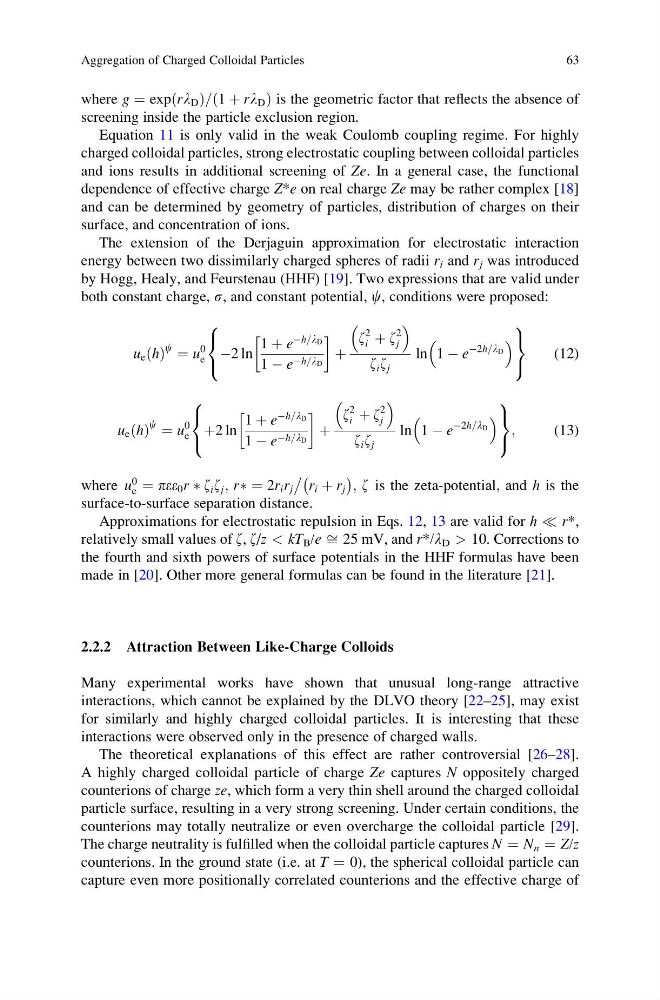
The extension of the Derjaguin approximation for electrostatic interaction
energy between two dissimilarly charged spheres of radii r i and r j was introduced
by Hogg, Healy, and Feurstenau (HHF) [19]. Two expressions that are valid under
both constant charge, s, and constant potential, c, conditions were proposed:
u e ðhÞ
c ¼ u
0
e À2 ln
1 þ e
Àh=l D
1 À e Àh=l D
!
þ
z
2
i þ z
2
j
z i z j
ln 1 À e
À2h=l D
8
<
:
9
=
;
(12)
u e ðhÞ
c ¼ u
0
e þ2 ln
1 þ e
Àh=l D
1 À e Àh=l D
!
þ
z
2
i þ z
2
j
z i z j
ln 1 À e
À2h=l D
8
<
:
9
=
;
;
(13)
where u
0
e ¼ pee 0 r à z i z j ; rà ¼ 2r i r j r i þ r j
À
Á
; z is the zeta-potential, and h is the
surface-to-surface separation distance.
Approximations for electrostatic repulsion in Eqs. 12, 13 are valid for h ( r*,
relatively small values of z, z/z < kT B /e ffi 25 mV, and r*/l D > 10. Corrections to
the fourth and sixth powers of surface potentials in the HHF formulas have been
made in [20]. Other more general formulas can be found in the literature [21].
2.2.2 Attraction Between Like-Charge Colloids
Many experimental works have shown that unusual long-range attractive
interactions, which cannot be explained by the DLVO theory [22–25], may exist
for similarly and highly charged colloidal particles. It is interesting that these
interactions were observed only in the presence of charged walls.
The theoretical explanations of this effect are rather controversial [26–28].
A highly charged colloidal particle of charge Ze captures N oppositely charged
counterions of charge ze, which form a very thin shell around the charged colloidal
particle surface, resulting in a very strong screening. Under certain conditions, the
counterions may totally neutralize or even overcharge the colloidal particle [29].
The charge neutrality is fulfilled when the colloidal particle captures N ¼ N n ¼ Z/z
counterions. In the ground state (i.e. at T ¼ 0), the spherical colloidal particle can
capture even more positionally correlated counterions and the effective charge of
Aggregation of Charged Colloidal Particles
63
ð Þ= 1 þ rl D
ð
Þis the geometric factor that reflects the absence of
screening inside the particle exclusion region.
Equation 11 is only valid in the weak Coulomb coupling regime. For highly
charged colloidal particles, strong electrostatic coupling between colloidal particles
and ions results in additional screening of Ze. In a general case, the functional
dependence of effective charge Z*e on real charge Ze may be rather complex [18]
and can be determined by geometry of particles, distribution of charges on their
surface, and concentration of ions.
The extension of the Derjaguin approximation for electrostatic interaction
energy between two dissimilarly charged spheres of radii r i and r j was introduced
by Hogg, Healy, and Feurstenau (HHF) [19]. Two expressions that are valid under
both constant charge, s, and constant potential, c, conditions were proposed:
u e ðhÞ
c ¼ u
0
e À2 ln
1 þ e
Àh=l D
1 À e Àh=l D
!
þ
z
2
i þ z
2
j
z i z j
ln 1 À e
À2h=l D
8
<
:
9
=
;
(12)
u e ðhÞ
c ¼ u
0
e þ2 ln
1 þ e
Àh=l D
1 À e Àh=l D
!
þ
z
2
i þ z
2
j
z i z j
ln 1 À e
À2h=l D
8
<
:
9
=
;
;
(13)
where u
0
e ¼ pee 0 r à z i z j ; rà ¼ 2r i r j r i þ r j
À
Á
; z is the zeta-potential, and h is the
surface-to-surface separation distance.
Approximations for electrostatic repulsion in Eqs. 12, 13 are valid for h ( r*,
relatively small values of z, z/z < kT B /e ffi 25 mV, and r*/l D > 10. Corrections to
the fourth and sixth powers of surface potentials in the HHF formulas have been
made in [20]. Other more general formulas can be found in the literature [21].
2.2.2 Attraction Between Like-Charge Colloids
Many experimental works have shown that unusual long-range attractive
interactions, which cannot be explained by the DLVO theory [22–25], may exist
for similarly and highly charged colloidal particles. It is interesting that these
interactions were observed only in the presence of charged walls.
The theoretical explanations of this effect are rather controversial [26–28].
A highly charged colloidal particle of charge Ze captures N oppositely charged
counterions of charge ze, which form a very thin shell around the charged colloidal
particle surface, resulting in a very strong screening. Under certain conditions, the
counterions may totally neutralize or even overcharge the colloidal particle [29].
The charge neutrality is fulfilled when the colloidal particle captures N ¼ N n ¼ Z/z
counterions. In the ground state (i.e. at T ¼ 0), the spherical colloidal particle can
capture even more positionally correlated counterions and the effective charge of
Aggregation of Charged Colloidal Particles
63