

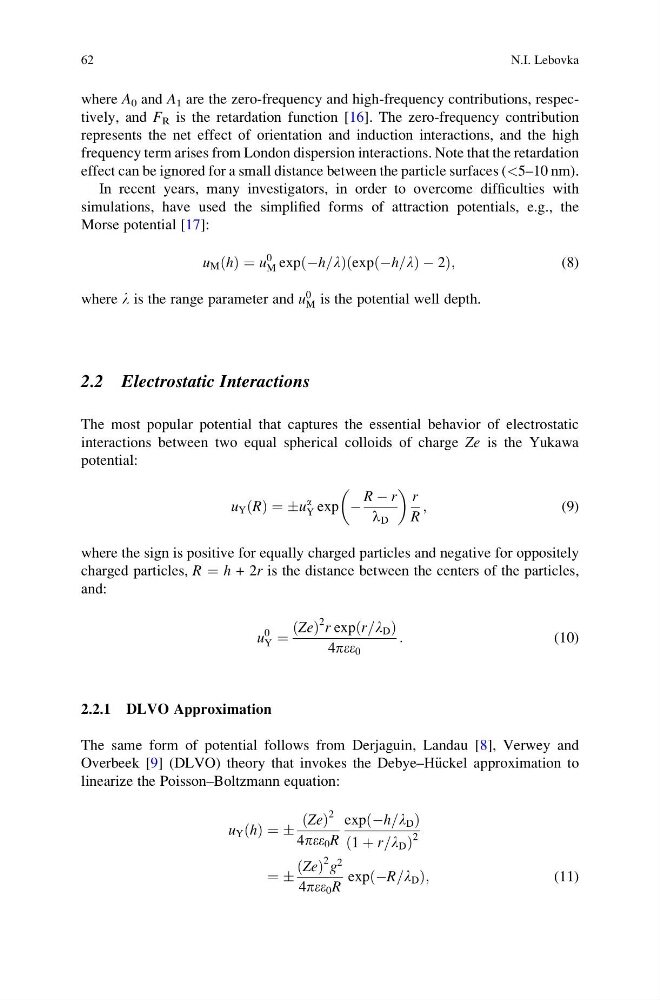
where A 0 and A 1 are the zero-frequency and high-frequency contributions, respectively, and F R is the retardation function [16]. The zero-frequency contribution
represents the net effect of orientation and induction interactions, and the high
frequency term arises from London dispersion interactions. Note that the retardation
effect can be ignored for a small distance between the particle surfaces (<5–10 nm).
In recent years, many investigators, in order to overcome difficulties with
simulations, have used the simplified forms of attraction potentials, e.g., the
Morse potential [17]:
u M ðhÞ ¼ u
0
M exp Àh=l
ð
Þ expðÀh=lÞ À 2
ð
Þ ;
(8)
where l is the range parameter and u
0
M is the potential well depth.
2.2 Electrostatic Interactions
The most popular potential that captures the essential behavior of electrostatic
interactions between two equal spherical colloids of charge Ze is the Yukawa
potential:
u Y ðRÞ ¼ Æu
a
Y exp À
R À r
l D
r
R
;
(9)
where the sign is positive for equally charged particles and negative for oppositely
charged particles, R ¼ h + 2r is the distance between the centers of the particles,
and:
u
0
Y ¼
ðZeÞ
2 r expðr=l D Þ
4pee 0
:
(10)
2.2.1 DLVO Approximation
The same form of potential follows from Derjaguin, Landau [8], Verwey and
Overbeek [9] (DLVO) theory that invokes the Debye–H€ uckel approximation to
linearize the Poisson–Boltzmann equation:
u Y ðhÞ ¼ Æ
Ze
ð Þ
2
4pee 0 R
exp Àh l D
=
ð
Þ
1 þ r l D
=
ð
Þ
2
¼ Æ
Ze
ð Þ
2 g
2
4pee 0 R
exp ÀR l D
=
ð
Þ;
(11)
62
N.I. Lebovka
represents the net effect of orientation and induction interactions, and the high
frequency term arises from London dispersion interactions. Note that the retardation
effect can be ignored for a small distance between the particle surfaces (<5–10 nm).
In recent years, many investigators, in order to overcome difficulties with
simulations, have used the simplified forms of attraction potentials, e.g., the
Morse potential [17]:
u M ðhÞ ¼ u
0
M exp Àh=l
ð
Þ expðÀh=lÞ À 2
ð
Þ ;
(8)
where l is the range parameter and u
0
M is the potential well depth.
2.2 Electrostatic Interactions
The most popular potential that captures the essential behavior of electrostatic
interactions between two equal spherical colloids of charge Ze is the Yukawa
potential:
u Y ðRÞ ¼ Æu
a
Y exp À
R À r
l D
r
R
;
(9)
where the sign is positive for equally charged particles and negative for oppositely
charged particles, R ¼ h + 2r is the distance between the centers of the particles,
and:
u
0
Y ¼
ðZeÞ
2 r expðr=l D Þ
4pee 0
:
(10)
2.2.1 DLVO Approximation
The same form of potential follows from Derjaguin, Landau [8], Verwey and
Overbeek [9] (DLVO) theory that invokes the Debye–H€ uckel approximation to
linearize the Poisson–Boltzmann equation:
u Y ðhÞ ¼ Æ
Ze
ð Þ
2
4pee 0 R
exp Àh l D
=
ð
Þ
1 þ r l D
=
ð
Þ
2
¼ Æ
Ze
ð Þ
2 g
2
4pee 0 R
exp ÀR l D
=
ð
Þ;
(11)
62
N.I. Lebovka