

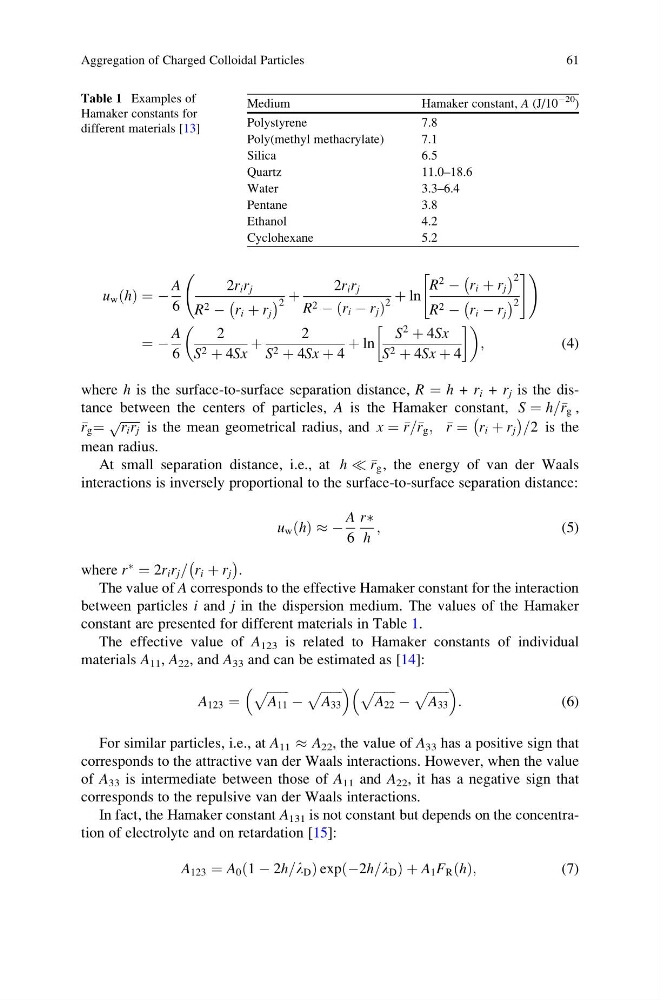
u w ðhÞ ¼ À
A
6
2r i r j
R 2 À r i þ r j
À
Á 2 þ
2r i r j
R 2 À ðr i À r j Þ
2
þ ln
R
2
À r i þ r j
À
Á 2
R 2 À r i À r j
À
Á 2
"
# !
¼ À
A
6
2
S 2 þ 4Sx
þ
2
S 2 þ 4Sx þ 4
þ ln
S
2
þ 4Sx
S 2 þ 4Sx þ 4
!
;
(4)
where h is the surface-to-surface separation distance, R ¼ h + r i + r j is the distance between the centers of particles, A is the Hamaker constant, S ¼ h= r g ,
r g ¼
ffiffiffiffiffiffi ffi
r i r j
p
is the mean geometrical radius, and x ¼
r= r g ;
r ¼ r i þ r j
À
Á =2 is the
mean radius.
At small separation distance, i.e., at h (
r g , the energy of van der Waals
interactions is inversely proportional to the surface-to-surface separation distance:
u w ðhÞ % À
A
6
rÃ
h
;
(5)
where r
Ã
¼ 2r i r j = r i þ r j
À
Á
.
The value of A corresponds to the effective Hamaker constant for the interaction
between particles i and j in the dispersion medium. The values of the Hamaker
constant are presented for different materials in Table 1.
The effective value of A 123 is related to Hamaker constants of individual
materials A 11 , A 22 , and A 33 and can be estimated as [14]:
A 123 ¼
ffiffiffiffiffiffiffi
A 11
p
À
ffiffiffiffiffiffiffi
A 33
p
ffiffiffiffiffiffiffi
A 22
p
À
ffiffiffiffiffiffiffi
A 33
p
:
(6)
For similar particles, i.e., at A 11 % A 22 , the value of A 33 has a positive sign that
corresponds to the attractive van der Waals interactions. However, when the value
of A 33 is intermediate between those of A 11 and A 22 , it has a negative sign that
corresponds to the repulsive van der Waals interactions.
In fact, the Hamaker constant A 131 is not constant but depends on the concentration of electrolyte and on retardation [15]:
A 123 ¼ A 0 1 À 2h=l D
ð
ÞexpðÀ2h=l D Þ þ A 1 F R ðhÞ;
(7)
Table 1 Examples of
Hamaker constants for
different materials [13]
Medium
Hamaker constant, A (J/10
À20
)
Polystyrene
7.8
Poly(methyl methacrylate)
7.1
Silica
6.5
Quartz
11.0–18.6
Water
3.3–6.4
Pentane
3.8
Ethanol
4.2
Cyclohexane
5.2
Aggregation of Charged Colloidal Particles
61
A
6
2r i r j
R 2 À r i þ r j
À
Á 2 þ
2r i r j
R 2 À ðr i À r j Þ
2
þ ln
R
2
À r i þ r j
À
Á 2
R 2 À r i À r j
À
Á 2
"
# !
¼ À
A
6
2
S 2 þ 4Sx
þ
2
S 2 þ 4Sx þ 4
þ ln
S
2
þ 4Sx
S 2 þ 4Sx þ 4
!
;
(4)
where h is the surface-to-surface separation distance, R ¼ h + r i + r j is the distance between the centers of particles, A is the Hamaker constant, S ¼ h= r g ,
r g ¼
ffiffiffiffiffiffi ffi
r i r j
p
is the mean geometrical radius, and x ¼
r= r g ;
r ¼ r i þ r j
À
Á =2 is the
mean radius.
At small separation distance, i.e., at h (
r g , the energy of van der Waals
interactions is inversely proportional to the surface-to-surface separation distance:
u w ðhÞ % À
A
6
rÃ
h
;
(5)
where r
Ã
¼ 2r i r j = r i þ r j
À
Á
.
The value of A corresponds to the effective Hamaker constant for the interaction
between particles i and j in the dispersion medium. The values of the Hamaker
constant are presented for different materials in Table 1.
The effective value of A 123 is related to Hamaker constants of individual
materials A 11 , A 22 , and A 33 and can be estimated as [14]:
A 123 ¼
ffiffiffiffiffiffiffi
A 11
p
À
ffiffiffiffiffiffiffi
A 33
p
ffiffiffiffiffiffiffi
A 22
p
À
ffiffiffiffiffiffiffi
A 33
p
:
(6)
For similar particles, i.e., at A 11 % A 22 , the value of A 33 has a positive sign that
corresponds to the attractive van der Waals interactions. However, when the value
of A 33 is intermediate between those of A 11 and A 22 , it has a negative sign that
corresponds to the repulsive van der Waals interactions.
In fact, the Hamaker constant A 131 is not constant but depends on the concentration of electrolyte and on retardation [15]:
A 123 ¼ A 0 1 À 2h=l D
ð
ÞexpðÀ2h=l D Þ þ A 1 F R ðhÞ;
(7)
Table 1 Examples of
Hamaker constants for
different materials [13]
Medium
Hamaker constant, A (J/10
À20
)
Polystyrene
7.8
Poly(methyl methacrylate)
7.1
Silica
6.5
Quartz
11.0–18.6
Water
3.3–6.4
Pentane
3.8
Ethanol
4.2
Cyclohexane
5.2
Aggregation of Charged Colloidal Particles
61