

of k B T and the ionic pair is unstable. However, such an ionic pair may be stable in
less polar solvent.
The Debye length, l D , at room temperature may be estimated as l D ¼ 0:308=
ffiffiffi ffi
C
p
nm, where C is the molar concentration of salt (1 M ¼ 10
3 mol m
À3
). Note that when
the volume fraction of colloidal particles ’ is not low, the Debye length l D becomes
dependent on ’, colloidal particle radius, r, and colloidal particle surface charge
density, s [11]:
l D ð’Þ ¼ l D ð0Þ
ffiffiffiffiffiffiffiffiffiffiffiffiffiffiffiffiffiffiffiffiffiffiffiffiffiffiffiffiffiffiffiffiffiffiffi ffi
1 À ’
1 þ 1:5s’=ðerrÞ
:
s
(3)
The l D (’) dependence becomes important when the volume fraction of
particles, ’, is large, or the concentration of salt C is very low. Moreover, the
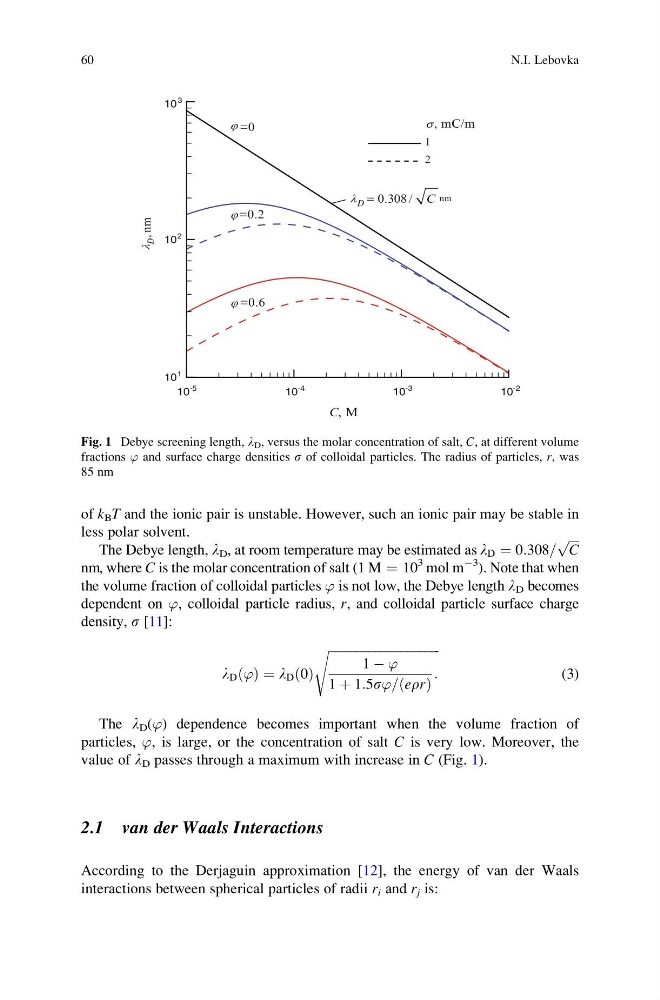
value of l D passes through a maximum with increase in C (Fig. 1).
2.1 van der Waals Interactions
According to the Derjaguin approximation [12], the energy of van der Waals
interactions between spherical particles of radii r i and r j is:
10
3
10
2
10
1
10
-5
10
-4
10
-3
10
-2
C, M
l
D , nm
s, mC/m
1
2
j
j =0.2
j =0.6
0.308 /
D
C nm
l =
=0
Fig. 1 Debye screening length, l D , versus the molar concentration of salt, C, at different volume
fractions ’ and surface charge densities s of colloidal particles. The radius of particles, r, was
85 nm
60
N.I. Lebovka
less polar solvent.
The Debye length, l D , at room temperature may be estimated as l D ¼ 0:308=
ffiffiffi ffi
C
p
nm, where C is the molar concentration of salt (1 M ¼ 10
3 mol m
À3
). Note that when
the volume fraction of colloidal particles ’ is not low, the Debye length l D becomes
dependent on ’, colloidal particle radius, r, and colloidal particle surface charge
density, s [11]:
l D ð’Þ ¼ l D ð0Þ
ffiffiffiffiffiffiffiffiffiffiffiffiffiffiffiffiffiffiffiffiffiffiffiffiffiffiffiffiffiffiffiffiffiffiffi ffi
1 À ’
1 þ 1:5s’=ðerrÞ
:
s
(3)
The l D (’) dependence becomes important when the volume fraction of
particles, ’, is large, or the concentration of salt C is very low. Moreover, the
value of l D passes through a maximum with increase in C (Fig. 1).
2.1 van der Waals Interactions
According to the Derjaguin approximation [12], the energy of van der Waals
interactions between spherical particles of radii r i and r j is:
10
3
10
2
10
1
10
-5
10
-4
10
-3
10
-2
C, M
l
D , nm
s, mC/m
1
2
j
j =0.2
j =0.6
0.308 /
D
C nm
l =
=0
Fig. 1 Debye screening length, l D , versus the molar concentration of salt, C, at different volume
fractions ’ and surface charge densities s of colloidal particles. The radius of particles, r, was
85 nm
60
N.I. Lebovka