

biomedicine [7]. Formation of the secondary PEC aggregates and their final size,
stability, and polydispersity are controlled by Coulomb interactions between
charged primary PEC nanoparticles. Computer simulation techniques can be particularly useful for study of such processes.
This chapter is organized as follows: Section 2 reviews the main equations
describing important interactions between dissimilar colloidal particles. The
contributions of Born repulsion, van der Waals, electrostatic, structural solvation,
and hydrophobic hydrodynamic interactions, as well as the effects of attraction
between like-charge colloids, charge nonuniformity, and adsorbed polymer are
analyzed. Section 3 presents the main types of computer models used for simulation
of cluster morphology and results for different interacting species (similarly and
oppositely charged particles and polyelectrolytes) and different models (DLA-like,
Eden-like). Section 4 considers the classical Smoluchowski model, the theoretical
approach of population balance equations (PBE), classification of kernels, and the
main types of scaling in aggregation behavior. The recent data on aggregations
kinetics of charged PEC particles are also presented.
2 Interactions Between Colloidal Particles
The Derjaguin–Landau–Verwey–Overbeek (DLVO) theory is commonly used to
describe interactions of charged surfaces across liquids [8, 9]. The DLVO theory
models the interparticle interactions by superposing van der Waals attractions and
electrostatic double layer repulsion forces. The direct force measurements have
confirmed this theory down to surface separations of few nanometers [10].
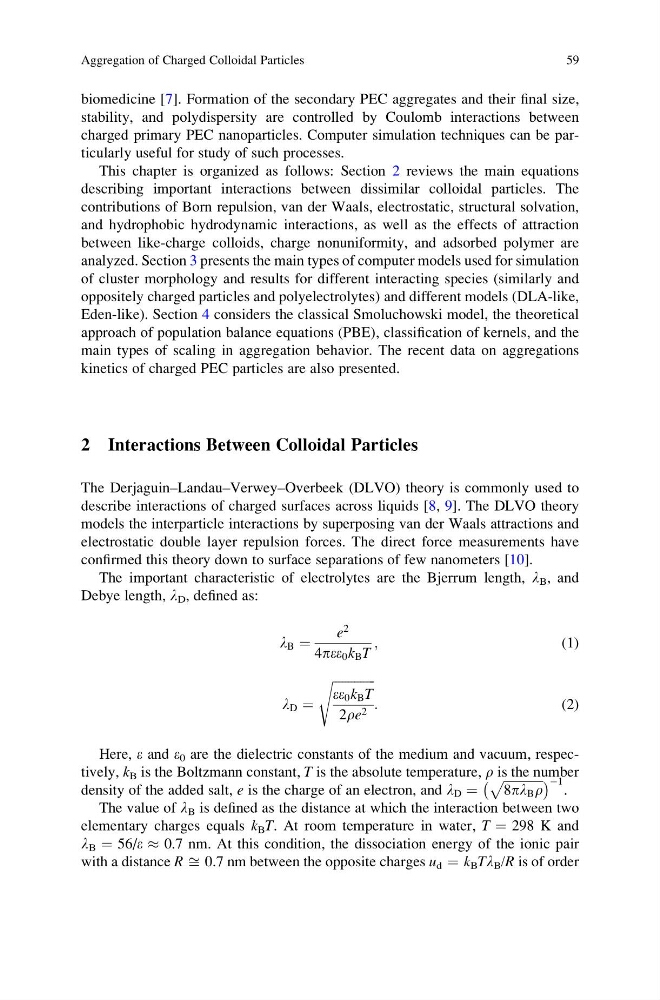
The important characteristic of electrolytes are the Bjerrum length, l B , and
Debye length, l D , defined as:
l B ¼
e
2
4pee 0 k B T
;
(1)
l D ¼
ffiffiffiffiffiffiffiffiffiffiffiffiffi ffi
ee 0 k B T
2re 2
s
:
(2)
Here, e and e 0 are the dielectric constants of the medium and vacuum, respectively, k B is the Boltzmann constant, T is the absolute temperature, r is the number
density of the added salt, e is the charge of an electron, and l D ¼
ffiffiffiffiffiffiffiffiffiffiffiffiffi
8pl B r
p
À
Á À1 .
The value of l B is defined as the distance at which the interaction between two
elementary charges equals k B T. At room temperature in water, T ¼ 298 K and
l B ¼ 56/e % 0.7 nm. At this condition, the dissociation energy of the ionic pair
with a distance R ffi 0.7 nm between the opposite charges u d ¼ k B Tl B /R is of order
Aggregation of Charged Colloidal Particles
59
stability, and polydispersity are controlled by Coulomb interactions between
charged primary PEC nanoparticles. Computer simulation techniques can be particularly useful for study of such processes.
This chapter is organized as follows: Section 2 reviews the main equations
describing important interactions between dissimilar colloidal particles. The
contributions of Born repulsion, van der Waals, electrostatic, structural solvation,
and hydrophobic hydrodynamic interactions, as well as the effects of attraction
between like-charge colloids, charge nonuniformity, and adsorbed polymer are
analyzed. Section 3 presents the main types of computer models used for simulation
of cluster morphology and results for different interacting species (similarly and
oppositely charged particles and polyelectrolytes) and different models (DLA-like,
Eden-like). Section 4 considers the classical Smoluchowski model, the theoretical
approach of population balance equations (PBE), classification of kernels, and the
main types of scaling in aggregation behavior. The recent data on aggregations
kinetics of charged PEC particles are also presented.
2 Interactions Between Colloidal Particles
The Derjaguin–Landau–Verwey–Overbeek (DLVO) theory is commonly used to
describe interactions of charged surfaces across liquids [8, 9]. The DLVO theory
models the interparticle interactions by superposing van der Waals attractions and
electrostatic double layer repulsion forces. The direct force measurements have
confirmed this theory down to surface separations of few nanometers [10].
The important characteristic of electrolytes are the Bjerrum length, l B , and
Debye length, l D , defined as:
l B ¼
e
2
4pee 0 k B T
;
(1)
l D ¼
ffiffiffiffiffiffiffiffiffiffiffiffiffi ffi
ee 0 k B T
2re 2
s
:
(2)
Here, e and e 0 are the dielectric constants of the medium and vacuum, respectively, k B is the Boltzmann constant, T is the absolute temperature, r is the number
density of the added salt, e is the charge of an electron, and l D ¼
ffiffiffiffiffiffiffiffiffiffiffiffiffi
8pl B r
p
À
Á À1 .
The value of l B is defined as the distance at which the interaction between two
elementary charges equals k B T. At room temperature in water, T ¼ 298 K and
l B ¼ 56/e % 0.7 nm. At this condition, the dissociation energy of the ionic pair
with a distance R ffi 0.7 nm between the opposite charges u d ¼ k B Tl B /R is of order
Aggregation of Charged Colloidal Particles
59