

The first term within the square brackets in Eq. 23 corresponds to the short-range
bridging attraction and the second term is for steric (excluded volume) repulsion.
2.6.2 Non-adsorbing Polymer
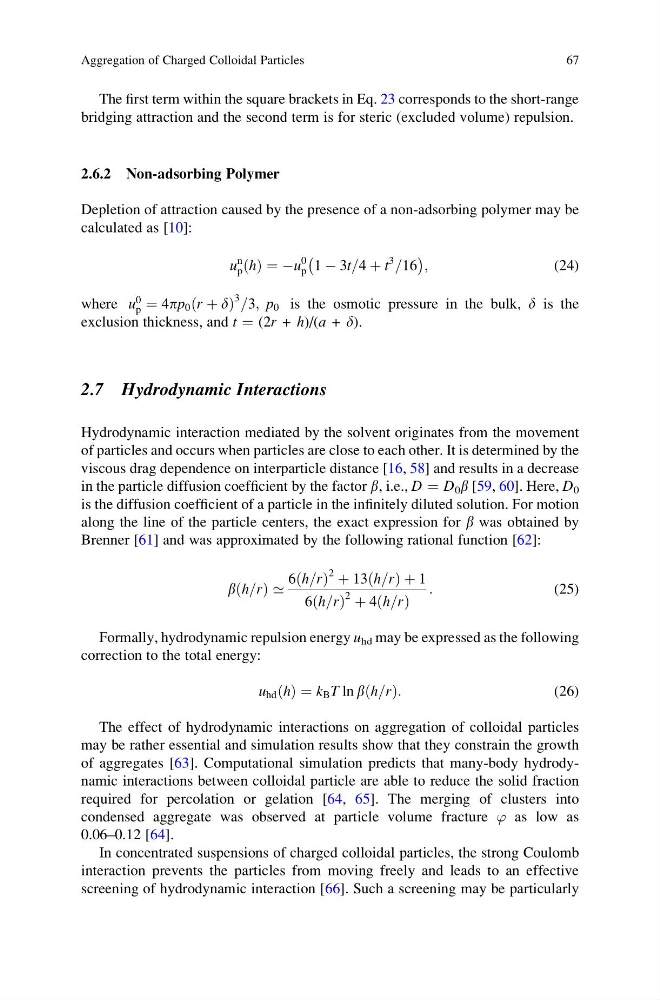
Depletion of attraction caused by the presence of a non-adsorbing polymer may be
calculated as [10]:
u
n
p ðhÞ ¼ Àu
0
p 1 À 3t=4 þ t
3
=16
À
Á ;
(24)
where u
0
p ¼ 4pp 0 r þ d
ð
Þ
3 =3; p 0 is the osmotic pressure in the bulk, d is the
exclusion thickness, and t ¼ (2r + h)/(a + d).
2.7 Hydrodynamic Interactions
Hydrodynamic interaction mediated by the solvent originates from the movement
of particles and occurs when particles are close to each other. It is determined by the
viscous drag dependence on interparticle distance [16, 58] and results in a decrease
in the particle diffusion coefficient by the factor b, i.e., D ¼ D 0 b [59, 60]. Here, D 0
is the diffusion coefficient of a particle in the infinitely diluted solution. For motion
along the line of the particle centers, the exact expression for b was obtained by
Brenner [61] and was approximated by the following rational function [62]:
b h=r
ð Þ ’
6 h=r
ð Þ
2 þ 13 h=r
ð Þþ1
6 h=r
ð Þ
2 þ 4 h=r
ð Þ
:
(25)
Formally, hydrodynamic repulsion energy u hd may be expressed as the following
correction to the total energy:
u hd ðhÞ ¼ k B T ln b h=r
ð Þ:
(26)
The effect of hydrodynamic interactions on aggregation of colloidal particles
may be rather essential and simulation results show that they constrain the growth
of aggregates [63]. Computational simulation predicts that many-body hydrodynamic interactions between colloidal particle are able to reduce the solid fraction
required for percolation or gelation [64, 65]. The merging of clusters into
condensed aggregate was observed at particle volume fracture ’ as low as
0.06–0.12 [64].
In concentrated suspensions of charged colloidal particles, the strong Coulomb
interaction prevents the particles from moving freely and leads to an effective
screening of hydrodynamic interaction [66]. Such a screening may be particularly
Aggregation of Charged Colloidal Particles
67
bridging attraction and the second term is for steric (excluded volume) repulsion.
2.6.2 Non-adsorbing Polymer
Depletion of attraction caused by the presence of a non-adsorbing polymer may be
calculated as [10]:
u
n
p ðhÞ ¼ Àu
0
p 1 À 3t=4 þ t
3
=16
À
Á ;
(24)
where u
0
p ¼ 4pp 0 r þ d
ð
Þ
3 =3; p 0 is the osmotic pressure in the bulk, d is the
exclusion thickness, and t ¼ (2r + h)/(a + d).
2.7 Hydrodynamic Interactions
Hydrodynamic interaction mediated by the solvent originates from the movement
of particles and occurs when particles are close to each other. It is determined by the
viscous drag dependence on interparticle distance [16, 58] and results in a decrease
in the particle diffusion coefficient by the factor b, i.e., D ¼ D 0 b [59, 60]. Here, D 0
is the diffusion coefficient of a particle in the infinitely diluted solution. For motion
along the line of the particle centers, the exact expression for b was obtained by
Brenner [61] and was approximated by the following rational function [62]:
b h=r
ð Þ ’
6 h=r
ð Þ
2 þ 13 h=r
ð Þþ1
6 h=r
ð Þ
2 þ 4 h=r
ð Þ
:
(25)
Formally, hydrodynamic repulsion energy u hd may be expressed as the following
correction to the total energy:
u hd ðhÞ ¼ k B T ln b h=r
ð Þ:
(26)
The effect of hydrodynamic interactions on aggregation of colloidal particles
may be rather essential and simulation results show that they constrain the growth
of aggregates [63]. Computational simulation predicts that many-body hydrodynamic interactions between colloidal particle are able to reduce the solid fraction
required for percolation or gelation [64, 65]. The merging of clusters into
condensed aggregate was observed at particle volume fracture ’ as low as
0.06–0.12 [64].
In concentrated suspensions of charged colloidal particles, the strong Coulomb
interaction prevents the particles from moving freely and leads to an effective
screening of hydrodynamic interaction [66]. Such a screening may be particularly
Aggregation of Charged Colloidal Particles
67