

C lm ¼ À
4p
Ek l
ð 2p
0
ð p
0
sð’; #ÞY
Ã
lm ð’; #Þ sin# d# d’;
(86)
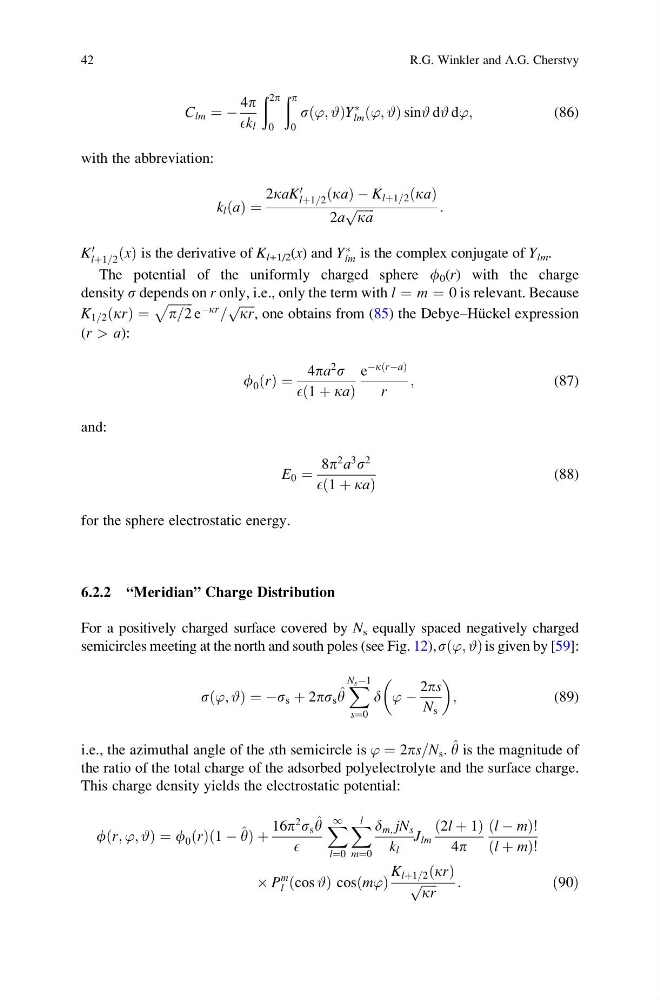
with the abbreviation:
k l ðaÞ ¼
2kaK
0
lþ1=2 ðkaÞ À K lþ1=2 ðkaÞ
2a
ffiffiffiffiffi ffi
ka
p
:
K
0
lþ1=2 ðxÞ is the derivative of K l+1/2 (x) and Y
Ã
lm is the complex conjugate of Y lm .
The potential of the uniformly charged sphere f 0 (r) with the charge
density s depends on r only, i.e., only the term with l ¼ m ¼ 0 is relevant. Because
K 1=2 ðkrÞ ¼
ffiffiffiffiffiffiffi ffi
p=2
p
e
Àkr
ffiffiffiffiffi
kr
p
=
, one obtains from (85) the Debye–Hu ¨ckel expression
(r > a):
f 0 ðrÞ ¼
4pa
2 s
Eð1 þ kaÞ
e
ÀkðrÀaÞ
r
;
(87)
and:
E 0 ¼
8p
2 a
3 s
2
Eð1 þ kaÞ
(88)
for the sphere electrostatic energy.
6.2.2 “Meridian” Charge Distribution
For a positively charged surface covered by N s equally spaced negatively charged
semicircles meeting at the north and south poles (see Fig. 12), sð’; #Þ is given by [59]:
sð’; #Þ ¼ Às s þ 2ps s ^
y
X
N s À1
s¼0
d ’ À
2ps
N s
;
(89)
i.e., the azimuthal angle of the sth semicircle is ’ ¼ 2ps=N s . ^
y is the magnitude of
the ratio of the total charge of the adsorbed polyelectrolyte and the surface charge.
This charge density yields the electrostatic potential:
fðr; ’; #Þ ¼ f 0 ðrÞð1 À ^ yÞ þ
16p
2 s s ^
y
E
X 1
l¼0
X l
m¼0
d m; jN s
k l
J lm
ð2l þ 1Þ
4p
ðl À mÞ!
ðl þ mÞ!
 P
m
l ðcos #Þ cosðm’Þ
K lþ1=2 ðkrÞ
ffiffiffiffiffi
kr
p
:
ð90Þ
42
R.G. Winkler and A.G. Cherstvy
4p
Ek l
ð 2p
0
ð p
0
sð’; #ÞY
Ã
lm ð’; #Þ sin# d# d’;
(86)
with the abbreviation:
k l ðaÞ ¼
2kaK
0
lþ1=2 ðkaÞ À K lþ1=2 ðkaÞ
2a
ffiffiffiffiffi ffi
ka
p
:
K
0
lþ1=2 ðxÞ is the derivative of K l+1/2 (x) and Y
Ã
lm is the complex conjugate of Y lm .
The potential of the uniformly charged sphere f 0 (r) with the charge
density s depends on r only, i.e., only the term with l ¼ m ¼ 0 is relevant. Because
K 1=2 ðkrÞ ¼
ffiffiffiffiffiffiffi ffi
p=2
p
e
Àkr
ffiffiffiffiffi
kr
p
=
, one obtains from (85) the Debye–Hu ¨ckel expression
(r > a):
f 0 ðrÞ ¼
4pa
2 s
Eð1 þ kaÞ
e
ÀkðrÀaÞ
r
;
(87)
and:
E 0 ¼
8p
2 a
3 s
2
Eð1 þ kaÞ
(88)
for the sphere electrostatic energy.
6.2.2 “Meridian” Charge Distribution
For a positively charged surface covered by N s equally spaced negatively charged
semicircles meeting at the north and south poles (see Fig. 12), sð’; #Þ is given by [59]:
sð’; #Þ ¼ Às s þ 2ps s ^
y
X
N s À1
s¼0
d ’ À
2ps
N s
;
(89)
i.e., the azimuthal angle of the sth semicircle is ’ ¼ 2ps=N s . ^
y is the magnitude of
the ratio of the total charge of the adsorbed polyelectrolyte and the surface charge.
This charge density yields the electrostatic potential:
fðr; ’; #Þ ¼ f 0 ðrÞð1 À ^ yÞ þ
16p
2 s s ^
y
E
X 1
l¼0
X l
m¼0
d m; jN s
k l
J lm
ð2l þ 1Þ
4p
ðl À mÞ!
ðl þ mÞ!
 P
m
l ðcos #Þ cosðm’Þ
K lþ1=2 ðkrÞ
ffiffiffiffiffi
kr
p
:
ð90Þ
42
R.G. Winkler and A.G. Cherstvy