

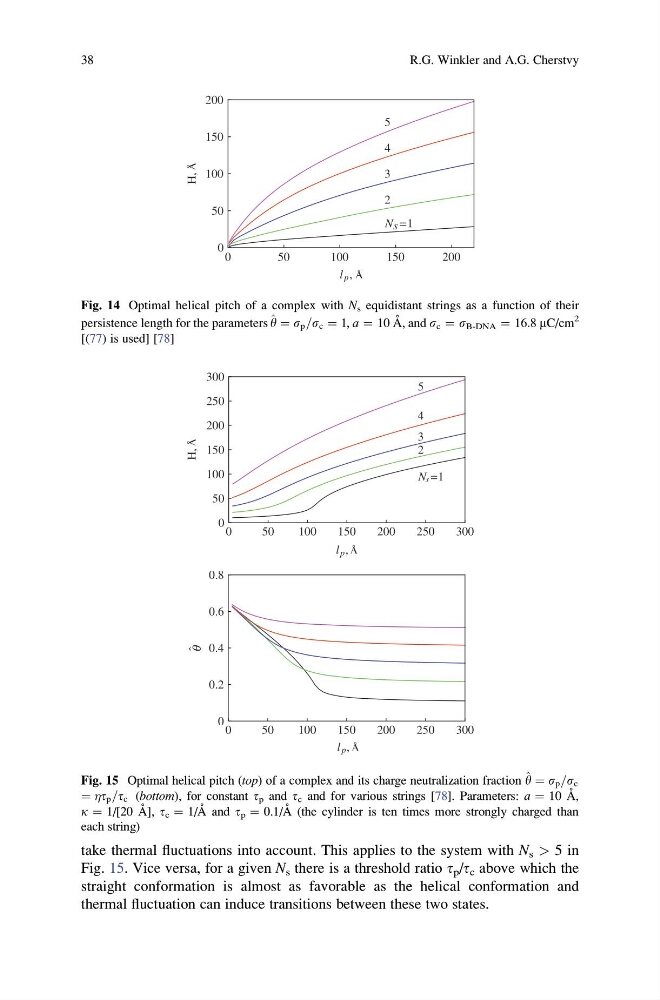
take thermal fluctuations into account. This applies to the system with N s > 5 in
Fig. 15. Vice versa, for a given N s there is a threshold ratio t p /t c above which the
straight conformation is almost as favorable as the helical conformation and
thermal fluctuation can induce transitions between these two states.
N s 1
2
3
4
5
0
50
100
150
200
0
50
100
150
200
l p ,
H,
Fig. 14 Optimal helical pitch of a complex with N s equidistant strings as a function of their
persistence length for the parameters ^ y ¼ s p =s c ¼ 1, a ¼ 10 A ˚ , and s c ¼ s B-DNA ¼ 16.8 mC/cm
2
[(77) is used] [78]
N s 1
2
3
4
5
0
50
100
150
200
250
300
0
50
100
150
200
250
300
l p ,
H,
0
50
100
150
200
250
300
0
0.2
0.4
0.6
0.8
l p ,
q
Fig. 15 Optimal helical pitch (top) of a complex and its charge neutralization fraction ^ y ¼ s p =s c
¼ t p =t c (bottom), for constant t p and t c and for various strings [78]. Parameters: a ¼ 10 A ˚ ,
k ¼ 1/[20 A ˚ ], t c ¼ 1/A ˚ and t p ¼ 0.1/A ˚ (the cylinder is ten times more strongly charged than
each string)
38
R.G. Winkler and A.G. Cherstvy
Fig. 15. Vice versa, for a given N s there is a threshold ratio t p /t c above which the
straight conformation is almost as favorable as the helical conformation and
thermal fluctuation can induce transitions between these two states.
N s 1
2
3
4
5
0
50
100
150
200
0
50
100
150
200
l p ,
H,
Fig. 14 Optimal helical pitch of a complex with N s equidistant strings as a function of their
persistence length for the parameters ^ y ¼ s p =s c ¼ 1, a ¼ 10 A ˚ , and s c ¼ s B-DNA ¼ 16.8 mC/cm
2
[(77) is used] [78]
N s 1
2
3
4
5
0
50
100
150
200
250
300
0
50
100
150
200
250
300
l p ,
H,
0
50
100
150
200
250
300
0
0.2
0.4
0.6
0.8
l p ,
q
Fig. 15 Optimal helical pitch (top) of a complex and its charge neutralization fraction ^ y ¼ s p =s c
¼ t p =t c (bottom), for constant t p and t c and for various strings [78]. Parameters: a ¼ 10 A ˚ ,
k ¼ 1/[20 A ˚ ], t c ¼ 1/A ˚ and t p ¼ 0.1/A ˚ (the cylinder is ten times more strongly charged than
each string)
38
R.G. Winkler and A.G. Cherstvy