

will lead to a larger pitch than that given by the first term alone. As a consequence,
the complex will at best be neutral or its effective charge s eff ¼ s c À s p
will exhibit the same sign as the cylinder, in contrast to the findings of Kunze
and Netz [77].
Bending Energy
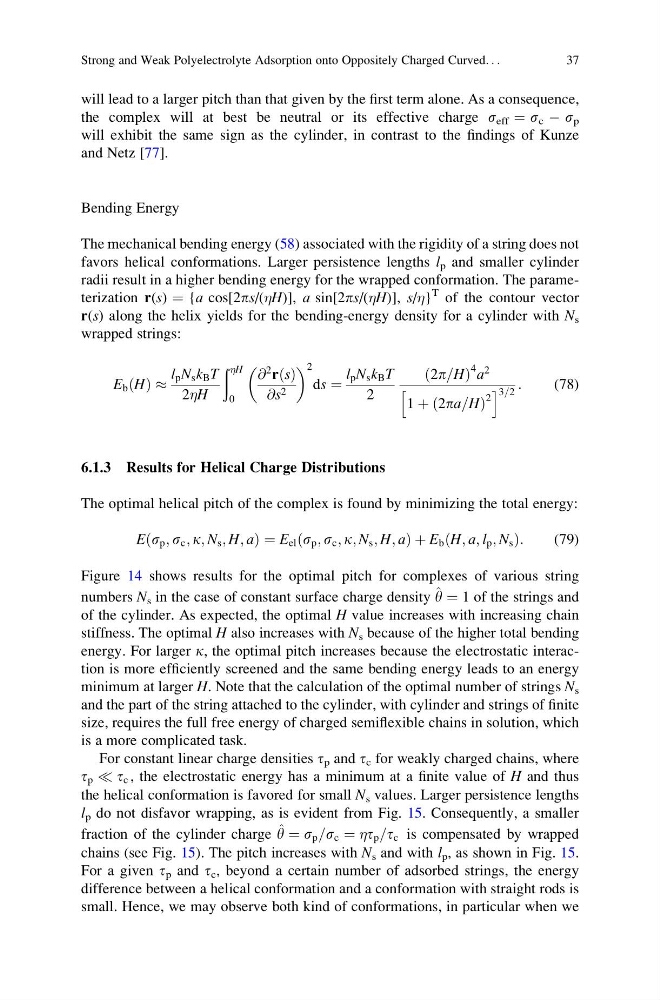
The mechanical bending energy (58) associated with the rigidity of a string does not
favors helical conformations. Larger persistence lengths l p and smaller cylinder
radii result in a higher bending energy for the wrapped conformation. The parameterization r(s) ¼ {a cos[2ps/(H)], a sin[2ps/(H)], s/}
T of the contour vector
r(s) along the helix yields for the bending-energy density for a cylinder with N s
wrapped strings:
E b ðHÞ %
l p N s k B T
2H
ð H
0
@
2 rðsÞ
@s 2
2
ds ¼
l p N s k B T
2
ð2p=HÞ
4 a
2
1 þ ð2pa=HÞ
2
h
i 3=2 :
(78)
6.1.3 Results for Helical Charge Distributions
The optimal helical pitch of the complex is found by minimizing the total energy:
Eðs p ; s c ; k; N s ; H; aÞ ¼ E el ðs p ; s c ; k; N s ; H; aÞ þ E b ðH; a; l p ; N s Þ:
(79)
Figure 14 shows results for the optimal pitch for complexes of various string
numbers N s in the case of constant surface charge density ^ y ¼ 1 of the strings and
of the cylinder. As expected, the optimal H value increases with increasing chain
stiffness. The optimal H also increases with N s because of the higher total bending
energy. For larger k, the optimal pitch increases because the electrostatic interaction is more efficiently screened and the same bending energy leads to an energy
minimum at larger H. Note that the calculation of the optimal number of strings N s
and the part of the string attached to the cylinder, with cylinder and strings of finite
size, requires the full free energy of charged semiflexible chains in solution, which
is a more complicated task.
For constant linear charge densities t p and t c for weakly charged chains, where
t p ( t c , the electrostatic energy has a minimum at a finite value of H and thus
the helical conformation is favored for small N s values. Larger persistence lengths
l p do not disfavor wrapping, as is evident from Fig. 15. Consequently, a smaller
fraction of the cylinder charge ^
y ¼ s p =s c ¼ t p =t c is compensated by wrapped
chains (see Fig. 15). The pitch increases with N s and with l p , as shown in Fig. 15.
For a given t p and t c , beyond a certain number of adsorbed strings, the energy
difference between a helical conformation and a conformation with straight rods is
small. Hence, we may observe both kind of conformations, in particular when we
Strong and Weak Polyelectrolyte Adsorption onto Oppositely Charged Curved. . .
37
the complex will at best be neutral or its effective charge s eff ¼ s c À s p
will exhibit the same sign as the cylinder, in contrast to the findings of Kunze
and Netz [77].
Bending Energy
The mechanical bending energy (58) associated with the rigidity of a string does not
favors helical conformations. Larger persistence lengths l p and smaller cylinder
radii result in a higher bending energy for the wrapped conformation. The parameterization r(s) ¼ {a cos[2ps/(H)], a sin[2ps/(H)], s/}
T of the contour vector
r(s) along the helix yields for the bending-energy density for a cylinder with N s
wrapped strings:
E b ðHÞ %
l p N s k B T
2H
ð H
0
@
2 rðsÞ
@s 2
2
ds ¼
l p N s k B T
2
ð2p=HÞ
4 a
2
1 þ ð2pa=HÞ
2
h
i 3=2 :
(78)
6.1.3 Results for Helical Charge Distributions
The optimal helical pitch of the complex is found by minimizing the total energy:
Eðs p ; s c ; k; N s ; H; aÞ ¼ E el ðs p ; s c ; k; N s ; H; aÞ þ E b ðH; a; l p ; N s Þ:
(79)
Figure 14 shows results for the optimal pitch for complexes of various string
numbers N s in the case of constant surface charge density ^ y ¼ 1 of the strings and
of the cylinder. As expected, the optimal H value increases with increasing chain
stiffness. The optimal H also increases with N s because of the higher total bending
energy. For larger k, the optimal pitch increases because the electrostatic interaction is more efficiently screened and the same bending energy leads to an energy
minimum at larger H. Note that the calculation of the optimal number of strings N s
and the part of the string attached to the cylinder, with cylinder and strings of finite
size, requires the full free energy of charged semiflexible chains in solution, which
is a more complicated task.
For constant linear charge densities t p and t c for weakly charged chains, where
t p ( t c , the electrostatic energy has a minimum at a finite value of H and thus
the helical conformation is favored for small N s values. Larger persistence lengths
l p do not disfavor wrapping, as is evident from Fig. 15. Consequently, a smaller
fraction of the cylinder charge ^
y ¼ s p =s c ¼ t p =t c is compensated by wrapped
chains (see Fig. 15). The pitch increases with N s and with l p , as shown in Fig. 15.
For a given t p and t c , beyond a certain number of adsorbed strings, the energy
difference between a helical conformation and a conformation with straight rods is
small. Hence, we may observe both kind of conformations, in particular when we
Strong and Weak Polyelectrolyte Adsorption onto Oppositely Charged Curved. . .
37