

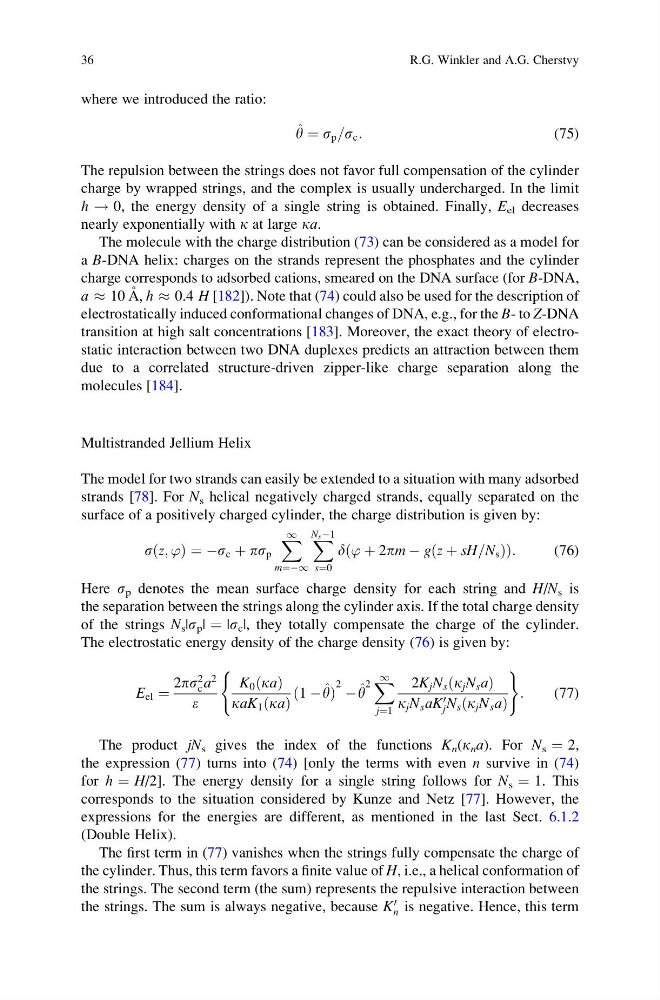
where we introduced the ratio:
^
y ¼ s p =s c :
(75)
The repulsion between the strings does not favor full compensation of the cylinder
charge by wrapped strings, and the complex is usually undercharged. In the limit
h ! 0, the energy density of a single string is obtained. Finally, E el decreases
nearly exponentially with k at large ka.
The molecule with the charge distribution (73) can be considered as a model for
a B-DNA helix: charges on the strands represent the phosphates and the cylinder
charge corresponds to adsorbed cations, smeared on the DNA surface (for B-DNA,
a % 10 A ˚ , h % 0.4 H [182]). Note that (74) could also be used for the description of
electrostatically induced conformational changes of DNA, e.g., for the B- to Z-DNA
transition at high salt concentrations [183]. Moreover, the exact theory of electrostatic interaction between two DNA duplexes predicts an attraction between them
due to a correlated structure-driven zipper-like charge separation along the
molecules [184].
Multistranded Jellium Helix
The model for two strands can easily be extended to a situation with many adsorbed
strands [78]. For N s helical negatively charged strands, equally separated on the
surface of a positively charged cylinder, the charge distribution is given by:
sðz; ’Þ ¼ Às c þ ps p
X 1
m¼À1
X
N s À1
s¼0
dð’ þ 2pm À gðz þ sH=N s ÞÞ:
(76)
Here s p denotes the mean surface charge density for each string and H/N s is
the separation between the strings along the cylinder axis. If the total charge density
of the strings N s |s p | ¼ |s c |, they totally compensate the charge of the cylinder.
The electrostatic energy density of the charge density (76) is given by:
E el ¼
2ps
2
c a
2
e
K 0 ðkaÞ
kaK 1 ðkaÞ
ð1 À ^
yÞ
2 À ^
y
2 X 1
j¼1
2K j N s ðk j N s aÞ
k j N s aK 0
j N s ðk j N s aÞ
(
)
:
(77)
The product jN s gives the index of the functions K n (k n a). For N s ¼ 2,
the expression (77) turns into (74) [only the terms with even n survive in (74)
for h ¼ H/2]. The energy density for a single string follows for N s ¼ 1. This
corresponds to the situation considered by Kunze and Netz [77]. However, the
expressions for the energies are different, as mentioned in the last Sect. 6.1.2
(Double Helix).
The first term in (77) vanishes when the strings fully compensate the charge of
the cylinder. Thus, this term favors a finite value of H, i.e., a helical conformation of
the strings. The second term (the sum) represents the repulsive interaction between
the strings. The sum is always negative, because K
0
n is negative. Hence, this term
36
R.G. Winkler and A.G. Cherstvy
^
y ¼ s p =s c :
(75)
The repulsion between the strings does not favor full compensation of the cylinder
charge by wrapped strings, and the complex is usually undercharged. In the limit
h ! 0, the energy density of a single string is obtained. Finally, E el decreases
nearly exponentially with k at large ka.
The molecule with the charge distribution (73) can be considered as a model for
a B-DNA helix: charges on the strands represent the phosphates and the cylinder
charge corresponds to adsorbed cations, smeared on the DNA surface (for B-DNA,
a % 10 A ˚ , h % 0.4 H [182]). Note that (74) could also be used for the description of
electrostatically induced conformational changes of DNA, e.g., for the B- to Z-DNA
transition at high salt concentrations [183]. Moreover, the exact theory of electrostatic interaction between two DNA duplexes predicts an attraction between them
due to a correlated structure-driven zipper-like charge separation along the
molecules [184].
Multistranded Jellium Helix
The model for two strands can easily be extended to a situation with many adsorbed
strands [78]. For N s helical negatively charged strands, equally separated on the
surface of a positively charged cylinder, the charge distribution is given by:
sðz; ’Þ ¼ Às c þ ps p
X 1
m¼À1
X
N s À1
s¼0
dð’ þ 2pm À gðz þ sH=N s ÞÞ:
(76)
Here s p denotes the mean surface charge density for each string and H/N s is
the separation between the strings along the cylinder axis. If the total charge density
of the strings N s |s p | ¼ |s c |, they totally compensate the charge of the cylinder.
The electrostatic energy density of the charge density (76) is given by:
E el ¼
2ps
2
c a
2
e
K 0 ðkaÞ
kaK 1 ðkaÞ
ð1 À ^
yÞ
2 À ^
y
2 X 1
j¼1
2K j N s ðk j N s aÞ
k j N s aK 0
j N s ðk j N s aÞ
(
)
:
(77)
The product jN s gives the index of the functions K n (k n a). For N s ¼ 2,
the expression (77) turns into (74) [only the terms with even n survive in (74)
for h ¼ H/2]. The energy density for a single string follows for N s ¼ 1. This
corresponds to the situation considered by Kunze and Netz [77]. However, the
expressions for the energies are different, as mentioned in the last Sect. 6.1.2
(Double Helix).
The first term in (77) vanishes when the strings fully compensate the charge of
the cylinder. Thus, this term favors a finite value of H, i.e., a helical conformation of
the strings. The second term (the sum) represents the repulsive interaction between
the strings. The sum is always negative, because K
0
n is negative. Hence, this term
36
R.G. Winkler and A.G. Cherstvy