

E el ¼
2ps
2
p a
2
E
K 0 ðkaÞ
kaK 1 ðkaÞ
À 2
X 1
n¼1
K n ðk n aÞ
k n aK 0
n ðk n aÞ
(
)
:
(72)
This corresponds to the situation considered by Kunze and Netz [77]. The energy
terms are, however, different. The authors find E el ~ t p ( À 1), where t p is the
linear charge density per pitch and ¼
ffiffiffiffiffiffiffiffiffiffiffiffiffiffiffiffiffiffiffiffiffiffiffiffiffiffiffi ffi
1 þ 2pa=H
ð
Þ
2
q
[77], whereas our solution
of the Poisson–Boltzmann equation yields E el ~ t p
2 . This difference has severe
consequences on overcharging of cylinders, as we will discuss in the next section.
Double-Stranded Jellium Helix
We now consider two negatively charged helical strings adsorbed on the surfaces
of a positively charged cylinder. Because the cylinder charges are distributed
homogeneously on its surface, we refer to this system as the “jellium” helix.
The charge density is now given by:
sð’; zÞ ¼ Às c þ ps p
X 1
n¼À1
½dð’ þ 2pn À gzÞ þ dð’ þ 2pn À gðz þ hÞÞ; (73)
where s c is the surface charge density. The corresponding electrostatic energy density is:
E el ¼
2ps
2
c a
2
E
K 0 ðkaÞ
kaK 1 ðkaÞ
ð1 À ^
yÞ
2 À ^ y
2 X 1
n¼1
½1 þ cosðnghÞK n ðk n aÞ
k n aK 0
n ðk n aÞ
(
)
;
(74)
r 20
r 15
r 12
0
10
20
30
40
50
60
0
1
2
3
4
5
z,
z
k
B T
e
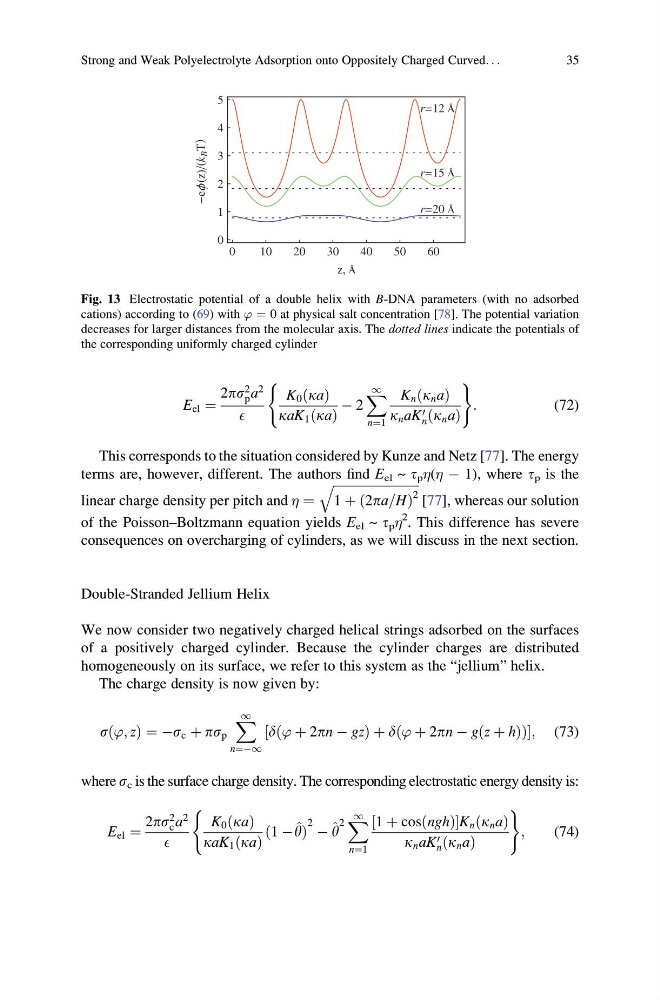
Fig. 13 Electrostatic potential of a double helix with B-DNA parameters (with no adsorbed
cations) according to (69) with ’ ¼ 0 at physical salt concentration [78]. The potential variation
decreases for larger distances from the molecular axis. The dotted lines indicate the potentials of
the corresponding uniformly charged cylinder
Strong and Weak Polyelectrolyte Adsorption onto Oppositely Charged Curved. . .
35
2ps
2
p a
2
E
K 0 ðkaÞ
kaK 1 ðkaÞ
À 2
X 1
n¼1
K n ðk n aÞ
k n aK 0
n ðk n aÞ
(
)
:
(72)
This corresponds to the situation considered by Kunze and Netz [77]. The energy
terms are, however, different. The authors find E el ~ t p ( À 1), where t p is the
linear charge density per pitch and ¼
ffiffiffiffiffiffiffiffiffiffiffiffiffiffiffiffiffiffiffiffiffiffiffiffiffiffiffi ffi
1 þ 2pa=H
ð
Þ
2
q
[77], whereas our solution
of the Poisson–Boltzmann equation yields E el ~ t p
2 . This difference has severe
consequences on overcharging of cylinders, as we will discuss in the next section.
Double-Stranded Jellium Helix
We now consider two negatively charged helical strings adsorbed on the surfaces
of a positively charged cylinder. Because the cylinder charges are distributed
homogeneously on its surface, we refer to this system as the “jellium” helix.
The charge density is now given by:
sð’; zÞ ¼ Às c þ ps p
X 1
n¼À1
½dð’ þ 2pn À gzÞ þ dð’ þ 2pn À gðz þ hÞÞ; (73)
where s c is the surface charge density. The corresponding electrostatic energy density is:
E el ¼
2ps
2
c a
2
E
K 0 ðkaÞ
kaK 1 ðkaÞ
ð1 À ^
yÞ
2 À ^ y
2 X 1
n¼1
½1 þ cosðnghÞK n ðk n aÞ
k n aK 0
n ðk n aÞ
(
)
;
(74)
r 20
r 15
r 12
0
10
20
30
40
50
60
0
1
2
3
4
5
z,
z
k
B T
e
Fig. 13 Electrostatic potential of a double helix with B-DNA parameters (with no adsorbed
cations) according to (69) with ’ ¼ 0 at physical salt concentration [78]. The potential variation
decreases for larger distances from the molecular axis. The dotted lines indicate the potentials of
the corresponding uniformly charged cylinder
Strong and Weak Polyelectrolyte Adsorption onto Oppositely Charged Curved. . .
35