

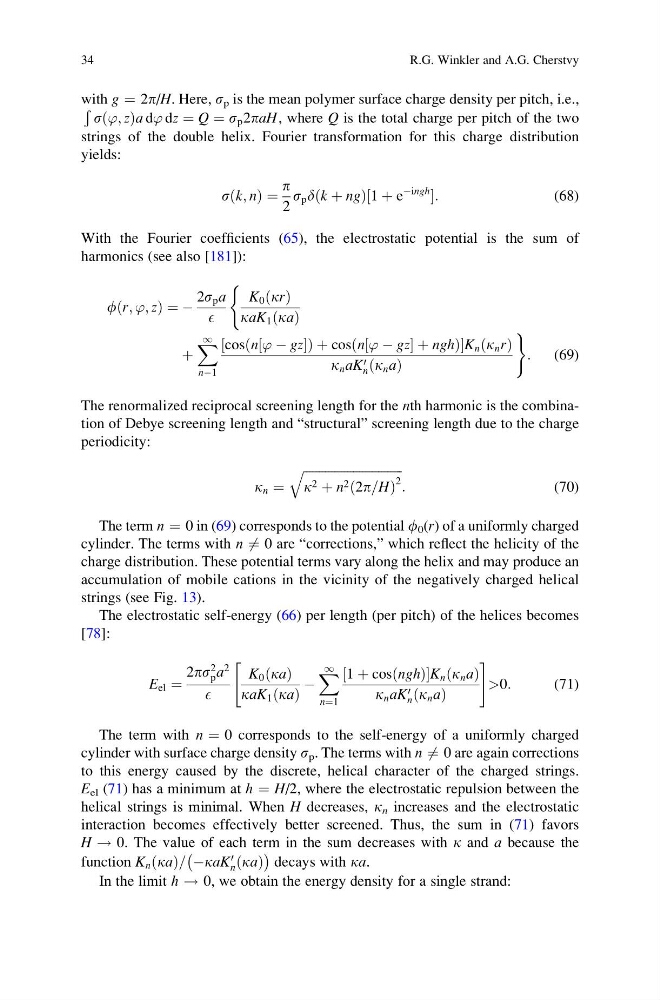
with g ¼ 2p/H. Here, s p is the mean polymer surface charge density per pitch, i.e.,
Ð
sð’; zÞa d’ dz ¼ Q ¼ s p 2paH, where Q is the total charge per pitch of the two
strings of the double helix. Fourier transformation for this charge distribution
yields:
sðk; nÞ ¼
p
2
s p dðk þ ngÞ½1 þ e
Àingh
:
(68)
With the Fourier coefficients (65), the electrostatic potential is the sum of
harmonics (see also [181]):
fðr; ’; zÞ ¼ À
2s p a
E
(
K 0 ðkrÞ
kaK 1 ðkaÞ
þ
X 1
nÀ1
cosðn½’ À gzÞ þ cosðn½’ À gz þ nghÞ
½
K n ðk n rÞ
k n aK 0
n ðk n aÞ
)
:
(69)
The renormalized reciprocal screening length for the nth harmonic is the combination of Debye screening length and “structural” screening length due to the charge
periodicity:
k n ¼
ffiffiffiffiffiffiffiffiffiffiffiffiffiffiffiffiffiffiffiffiffiffiffiffiffiffiffiffiffiffiffi ffi
k 2 þ n 2 ð2p=HÞ
2
q
:
(70)
The term n ¼ 0 in (69) corresponds to the potential f 0 (r) of a uniformly charged
cylinder. The terms with n 6 ¼ 0 are “corrections,” which reflect the helicity of the
charge distribution. These potential terms vary along the helix and may produce an
accumulation of mobile cations in the vicinity of the negatively charged helical
strings (see Fig. 13).
The electrostatic self-energy (66) per length (per pitch) of the helices becomes
[78]:
E el ¼
2ps
2
p a
2
E
K 0 ðkaÞ
kaK 1 ðkaÞ
À
X 1
n¼1
½1 þ cosðnghÞK n ðk n aÞ
k n aK 0
n ðk n aÞ
"
#
>0:
(71)
The term with n ¼ 0 corresponds to the self-energy of a uniformly charged
cylinder with surface charge density s p . The terms with n 6 ¼ 0 are again corrections
to this energy caused by the discrete, helical character of the charged strings.
E el (71) has a minimum at h ¼ H/2, where the electrostatic repulsion between the
helical strings is minimal. When H decreases, k n increases and the electrostatic
interaction becomes effectively better screened. Thus, the sum in (71) favors
H ! 0. The value of each term in the sum decreases with k and a because the
function K n ðkaÞ= ÀkaK
0
n ðkaÞ
À
Á
decays with ka.
In the limit h ! 0, we obtain the energy density for a single strand:
34
R.G. Winkler and A.G. Cherstvy
Ð
sð’; zÞa d’ dz ¼ Q ¼ s p 2paH, where Q is the total charge per pitch of the two
strings of the double helix. Fourier transformation for this charge distribution
yields:
sðk; nÞ ¼
p
2
s p dðk þ ngÞ½1 þ e
Àingh
:
(68)
With the Fourier coefficients (65), the electrostatic potential is the sum of
harmonics (see also [181]):
fðr; ’; zÞ ¼ À
2s p a
E
(
K 0 ðkrÞ
kaK 1 ðkaÞ
þ
X 1
nÀ1
cosðn½’ À gzÞ þ cosðn½’ À gz þ nghÞ
½
K n ðk n rÞ
k n aK 0
n ðk n aÞ
)
:
(69)
The renormalized reciprocal screening length for the nth harmonic is the combination of Debye screening length and “structural” screening length due to the charge
periodicity:
k n ¼
ffiffiffiffiffiffiffiffiffiffiffiffiffiffiffiffiffiffiffiffiffiffiffiffiffiffiffiffiffiffiffi ffi
k 2 þ n 2 ð2p=HÞ
2
q
:
(70)
The term n ¼ 0 in (69) corresponds to the potential f 0 (r) of a uniformly charged
cylinder. The terms with n 6 ¼ 0 are “corrections,” which reflect the helicity of the
charge distribution. These potential terms vary along the helix and may produce an
accumulation of mobile cations in the vicinity of the negatively charged helical
strings (see Fig. 13).
The electrostatic self-energy (66) per length (per pitch) of the helices becomes
[78]:
E el ¼
2ps
2
p a
2
E
K 0 ðkaÞ
kaK 1 ðkaÞ
À
X 1
n¼1
½1 þ cosðnghÞK n ðk n aÞ
k n aK 0
n ðk n aÞ
"
#
>0:
(71)
The term with n ¼ 0 corresponds to the self-energy of a uniformly charged
cylinder with surface charge density s p . The terms with n 6 ¼ 0 are again corrections
to this energy caused by the discrete, helical character of the charged strings.
E el (71) has a minimum at h ¼ H/2, where the electrostatic repulsion between the
helical strings is minimal. When H decreases, k n increases and the electrostatic
interaction becomes effectively better screened. Thus, the sum in (71) favors
H ! 0. The value of each term in the sum decreases with k and a because the
function K n ðkaÞ= ÀkaK
0
n ðkaÞ
À
Á
decays with ka.
In the limit h ! 0, we obtain the energy density for a single strand:
34
R.G. Winkler and A.G. Cherstvy