

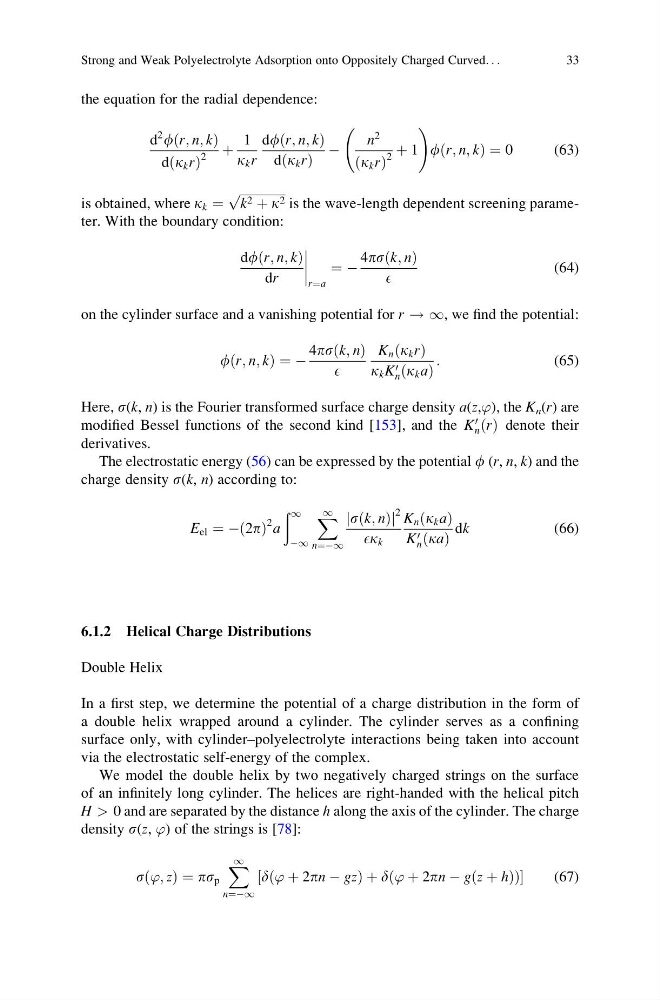
the equation for the radial dependence:
d
2 fðr; n; kÞ
dðk k rÞ
2
þ
1
k k r
dfðr; n; kÞ
dðk k rÞ
À
n
2
ðk k rÞ
2
þ 1
!
fðr; n; kÞ ¼ 0
(63)
is obtained, where k k ¼
ffiffiffiffiffiffiffiffiffiffiffiffiffiffiffi
k 2 þ k 2
p
is the wave-length dependent screening parameter. With the boundary condition:
dfðr; n; kÞ
dr
r¼a
¼ À
4psðk; nÞ
E
(64)
on the cylinder surface and a vanishing potential for r ! 1, we find the potential:
fðr; n; kÞ ¼ À
4psðk; nÞ
E
K n ðk k rÞ
k k K 0
n ðk k aÞ
:
(65)
Here, s(k, n) is the Fourier transformed surface charge density a(z,’), the K n (r) are
modified Bessel functions of the second kind [153], and the K
0
n ðrÞ denote their
derivatives.
The electrostatic energy (56) can be expressed by the potential f (r, n, k) and the
charge density s(k, n) according to:
E el ¼ Àð2pÞ
2 a
ð 1
À1
X 1
n¼À1
sðk; nÞ
j
j
2
Ek k
K n ðk k aÞ
K 0
n ðkaÞ
dk
(66)
6.1.2 Helical Charge Distributions
Double Helix
In a first step, we determine the potential of a charge distribution in the form of
a double helix wrapped around a cylinder. The cylinder serves as a confining
surface only, with cylinder–polyelectrolyte interactions being taken into account
via the electrostatic self-energy of the complex.
We model the double helix by two negatively charged strings on the surface
of an infinitely long cylinder. The helices are right-handed with the helical pitch
H > 0 and are separated by the distance h along the axis of the cylinder. The charge
density s(z, ’) of the strings is [78]:
sð’; zÞ ¼ ps p
X 1
n¼À1
½dð’ þ 2pn À gzÞ þ dð’ þ 2pn À gðz þ hÞÞ
(67)
Strong and Weak Polyelectrolyte Adsorption onto Oppositely Charged Curved. . .
33
d
2 fðr; n; kÞ
dðk k rÞ
2
þ
1
k k r
dfðr; n; kÞ
dðk k rÞ
À
n
2
ðk k rÞ
2
þ 1
!
fðr; n; kÞ ¼ 0
(63)
is obtained, where k k ¼
ffiffiffiffiffiffiffiffiffiffiffiffiffiffiffi
k 2 þ k 2
p
is the wave-length dependent screening parameter. With the boundary condition:
dfðr; n; kÞ
dr
r¼a
¼ À
4psðk; nÞ
E
(64)
on the cylinder surface and a vanishing potential for r ! 1, we find the potential:
fðr; n; kÞ ¼ À
4psðk; nÞ
E
K n ðk k rÞ
k k K 0
n ðk k aÞ
:
(65)
Here, s(k, n) is the Fourier transformed surface charge density a(z,’), the K n (r) are
modified Bessel functions of the second kind [153], and the K
0
n ðrÞ denote their
derivatives.
The electrostatic energy (56) can be expressed by the potential f (r, n, k) and the
charge density s(k, n) according to:
E el ¼ Àð2pÞ
2 a
ð 1
À1
X 1
n¼À1
sðk; nÞ
j
j
2
Ek k
K n ðk k aÞ
K 0
n ðkaÞ
dk
(66)
6.1.2 Helical Charge Distributions
Double Helix
In a first step, we determine the potential of a charge distribution in the form of
a double helix wrapped around a cylinder. The cylinder serves as a confining
surface only, with cylinder–polyelectrolyte interactions being taken into account
via the electrostatic self-energy of the complex.
We model the double helix by two negatively charged strings on the surface
of an infinitely long cylinder. The helices are right-handed with the helical pitch
H > 0 and are separated by the distance h along the axis of the cylinder. The charge
density s(z, ’) of the strings is [78]:
sð’; zÞ ¼ ps p
X 1
n¼À1
½dð’ þ 2pn À gzÞ þ dð’ þ 2pn À gðz þ hÞÞ
(67)
Strong and Weak Polyelectrolyte Adsorption onto Oppositely Charged Curved. . .
33