

Hence, the volume charge density r is related to the surface charge density
according to:
rðrÞ ¼ rðr; ’; zÞ ¼ dðr À aÞsðz; ’Þ:
(59)
The surface charge density is modulated by adsorbed polyelectrolytes.
6.1.1 Electrostatic Potential
In terms of cylindrical coordinates, the Poisson–Boltzmann equation (57) turns into
[78]:
@
2 f
@r 2 þ
1
r
@f
@r
þ
1
r 2
@
2 f
@’ 2 þ
@
2 f
@z 2 ¼ k
2 f:
(60)
Applying the Fourier transformation of the potential:
fðr; ’; zÞ ¼
1
2p
ð 1
À1
e
ikz
X 1
n¼À1
e
in’ fðr; n; kÞ dk;
(61)
with:
fðr; n; kÞ ¼
1
2p
ð 1
À1
ð 2p
0
e
Àikz e
Àin’ fðr; ’; zÞ d’ dz;
(62)
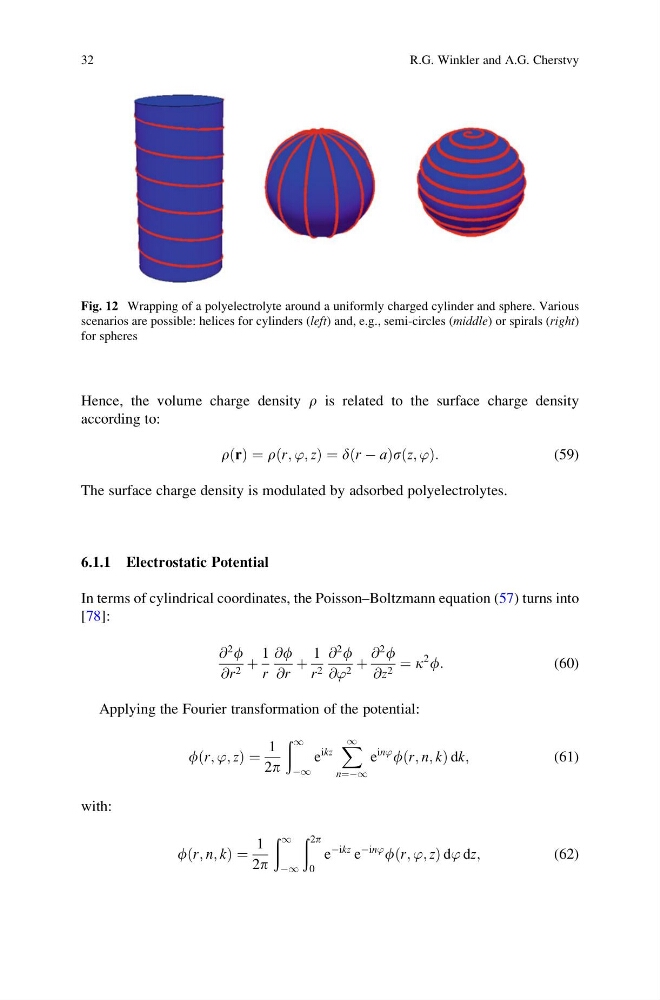
Fig. 12 Wrapping of a polyelectrolyte around a uniformly charged cylinder and sphere. Various
scenarios are possible: helices for cylinders (left) and, e.g., semi-circles (middle) or spirals (right)
for spheres
32
R.G. Winkler and A.G. Cherstvy
according to:
rðrÞ ¼ rðr; ’; zÞ ¼ dðr À aÞsðz; ’Þ:
(59)
The surface charge density is modulated by adsorbed polyelectrolytes.
6.1.1 Electrostatic Potential
In terms of cylindrical coordinates, the Poisson–Boltzmann equation (57) turns into
[78]:
@
2 f
@r 2 þ
1
r
@f
@r
þ
1
r 2
@
2 f
@’ 2 þ
@
2 f
@z 2 ¼ k
2 f:
(60)
Applying the Fourier transformation of the potential:
fðr; ’; zÞ ¼
1
2p
ð 1
À1
e
ikz
X 1
n¼À1
e
in’ fðr; n; kÞ dk;
(61)
with:
fðr; n; kÞ ¼
1
2p
ð 1
À1
ð 2p
0
e
Àikz e
Àin’ fðr; ’; zÞ d’ dz;
(62)
Fig. 12 Wrapping of a polyelectrolyte around a uniformly charged cylinder and sphere. Various
scenarios are possible: helices for cylinders (left) and, e.g., semi-circles (middle) or spirals (right)
for spheres
32
R.G. Winkler and A.G. Cherstvy