

as an infinitely thin uniformly charged string, which assumes a definite conformation on the adsorbing surface. For simplicity, no distribution of charges underneath
the surface is considered, but only a uniformly charged surface. Moreover, the
dielectric constant of the surface bulk material is the same as the dielectric constant
of the solution (namely that of water, E % 80) to avoid complications emerging from
the appearance of image charges underneath the surface [50]. No effects of charge
fluctuations on the polymer and on the surface are taken into account and neither are
charge–charge correlations (see [178, 179] for more results).
The total energy of an adsorbed polyelectrolyte comprises several contributions.
The most important of these are the electrostatic energy E el of the polyelectrolyte in
the electrostatic potential of the surface f and the bending energy E b due to possible
conformational changes. We will not explicitly take into account polyelectrolyte
charge–charge or excluded-volume interactions; they are instead implicitly considered by specific charge distributions r(r).
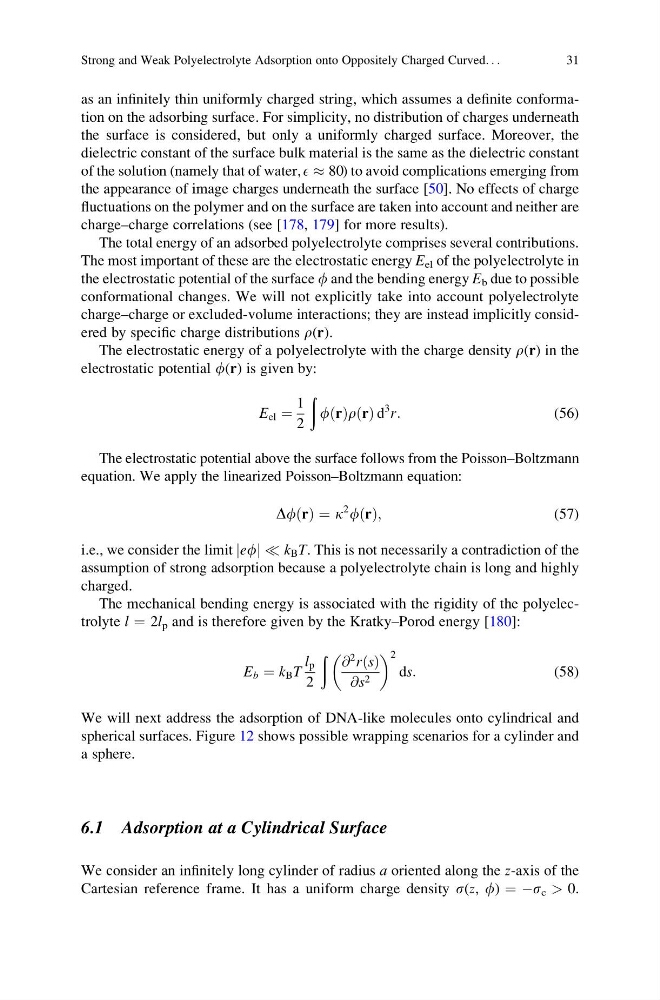
The electrostatic energy of a polyelectrolyte with the charge density r(r) in the
electrostatic potential f(r) is given by:
E el ¼
1
2
ð
fðrÞrðrÞ d
3 r:
(56)
The electrostatic potential above the surface follows from the Poisson–Boltzmann
equation. We apply the linearized Poisson–Boltzmann equation:
DfðrÞ ¼ k
2 fðrÞ;
(57)
i.e., we consider the limit jefj ( k B T. This is not necessarily a contradiction of the
assumption of strong adsorption because a polyelectrolyte chain is long and highly
charged.
The mechanical bending energy is associated with the rigidity of the polyelectrolyte l ¼ 2l p and is therefore given by the Kratky–Porod energy [180]:
E b ¼ k B T
l p
2
ð @
2 rðsÞ
@s 2
2
ds:
(58)
We will next address the adsorption of DNA-like molecules onto cylindrical and
spherical surfaces. Figure 12 shows possible wrapping scenarios for a cylinder and
a sphere.
6.1 Adsorption at a Cylindrical Surface
We consider an infinitely long cylinder of radius a oriented along the z-axis of the
Cartesian reference frame. It has a uniform charge density s(z, f) ¼ Às c > 0.
Strong and Weak Polyelectrolyte Adsorption onto Oppositely Charged Curved. . .
31
the surface is considered, but only a uniformly charged surface. Moreover, the
dielectric constant of the surface bulk material is the same as the dielectric constant
of the solution (namely that of water, E % 80) to avoid complications emerging from
the appearance of image charges underneath the surface [50]. No effects of charge
fluctuations on the polymer and on the surface are taken into account and neither are
charge–charge correlations (see [178, 179] for more results).
The total energy of an adsorbed polyelectrolyte comprises several contributions.
The most important of these are the electrostatic energy E el of the polyelectrolyte in
the electrostatic potential of the surface f and the bending energy E b due to possible
conformational changes. We will not explicitly take into account polyelectrolyte
charge–charge or excluded-volume interactions; they are instead implicitly considered by specific charge distributions r(r).
The electrostatic energy of a polyelectrolyte with the charge density r(r) in the
electrostatic potential f(r) is given by:
E el ¼
1
2
ð
fðrÞrðrÞ d
3 r:
(56)
The electrostatic potential above the surface follows from the Poisson–Boltzmann
equation. We apply the linearized Poisson–Boltzmann equation:
DfðrÞ ¼ k
2 fðrÞ;
(57)
i.e., we consider the limit jefj ( k B T. This is not necessarily a contradiction of the
assumption of strong adsorption because a polyelectrolyte chain is long and highly
charged.
The mechanical bending energy is associated with the rigidity of the polyelectrolyte l ¼ 2l p and is therefore given by the Kratky–Porod energy [180]:
E b ¼ k B T
l p
2
ð @
2 rðsÞ
@s 2
2
ds:
(58)
We will next address the adsorption of DNA-like molecules onto cylindrical and
spherical surfaces. Figure 12 shows possible wrapping scenarios for a cylinder and
a sphere.
6.1 Adsorption at a Cylindrical Surface
We consider an infinitely long cylinder of radius a oriented along the z-axis of the
Cartesian reference frame. It has a uniform charge density s(z, f) ¼ Às c > 0.
Strong and Weak Polyelectrolyte Adsorption onto Oppositely Charged Curved. . .
31