

With an increase in the cylinder radius, the corresponding electrostatic energy
decreases for fixed linear charge densities. This can lead to higher values of the
helical pitch (although E b decreases) and to a weaker charge neutralization of the
cylinder by wrapped strings. With decreasing linear charge densities of polyelectrolyte strings, the value of the helical pitch increases more rapidly with the persistence
length. Please note that in Fig. 15 such large t p and t c values are used that the linear
Poisson–Boltzmann theory is no longer strictly applicable. But, it can provide an
estimation of the features following from the full theory. With increasing salt
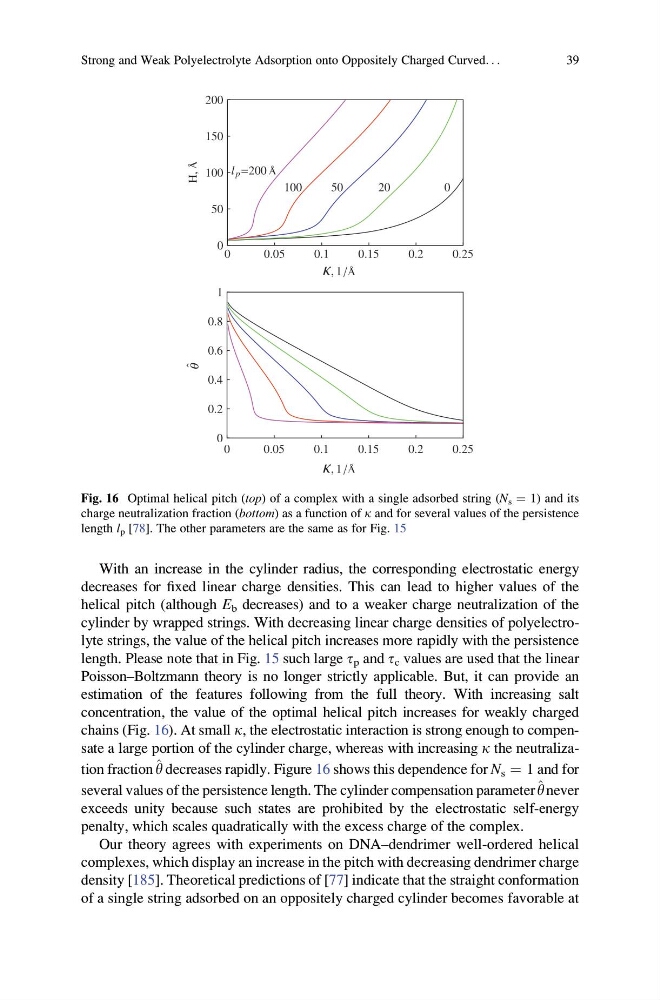
concentration, the value of the optimal helical pitch increases for weakly charged
chains (Fig. 16). At small k, the electrostatic interaction is strong enough to compensate a large portion of the cylinder charge, whereas with increasing k the neutralization fraction ^ y decreases rapidly. Figure 16 shows this dependence for N s ¼ 1 and for
several values of the persistence length. The cylinder compensation parameter ^ y never
exceeds unity because such states are prohibited by the electrostatic self-energy
penalty, which scales quadratically with the excess charge of the complex.
Our theory agrees with experiments on DNA–dendrimer well-ordered helical
complexes, which display an increase in the pitch with decreasing dendrimer charge
density [185]. Theoretical predictions of [77] indicate that the straight conformation
of a single string adsorbed on an oppositely charged cylinder becomes favorable at
l p 200
100
50
20
0
0
0.05
0.1
0.15
0.2
0.25
0
50
100
150
200
H,
0
0.05
0.1
0.15
0.2
0.25
0
0.2
0.4
0.6
0.8
1
q
1
,
1
,
Fig. 16 Optimal helical pitch (top) of a complex with a single adsorbed string (N s ¼ 1) and its
charge neutralization fraction (bottom) as a function of k and for several values of the persistence
length l p [78]. The other parameters are the same as for Fig. 15
Strong and Weak Polyelectrolyte Adsorption onto Oppositely Charged Curved. . .
39
decreases for fixed linear charge densities. This can lead to higher values of the
helical pitch (although E b decreases) and to a weaker charge neutralization of the
cylinder by wrapped strings. With decreasing linear charge densities of polyelectrolyte strings, the value of the helical pitch increases more rapidly with the persistence
length. Please note that in Fig. 15 such large t p and t c values are used that the linear
Poisson–Boltzmann theory is no longer strictly applicable. But, it can provide an
estimation of the features following from the full theory. With increasing salt
concentration, the value of the optimal helical pitch increases for weakly charged
chains (Fig. 16). At small k, the electrostatic interaction is strong enough to compensate a large portion of the cylinder charge, whereas with increasing k the neutralization fraction ^ y decreases rapidly. Figure 16 shows this dependence for N s ¼ 1 and for
several values of the persistence length. The cylinder compensation parameter ^ y never
exceeds unity because such states are prohibited by the electrostatic self-energy
penalty, which scales quadratically with the excess charge of the complex.
Our theory agrees with experiments on DNA–dendrimer well-ordered helical
complexes, which display an increase in the pitch with decreasing dendrimer charge
density [185]. Theoretical predictions of [77] indicate that the straight conformation
of a single string adsorbed on an oppositely charged cylinder becomes favorable at
l p 200
100
50
20
0
0
0.05
0.1
0.15
0.2
0.25
0
50
100
150
200
H,
0
0.05
0.1
0.15
0.2
0.25
0
0.2
0.4
0.6
0.8
1
q
1
,
1
,
Fig. 16 Optimal helical pitch (top) of a complex with a single adsorbed string (N s ¼ 1) and its
charge neutralization fraction (bottom) as a function of k and for several values of the persistence
length l p [78]. The other parameters are the same as for Fig. 15
Strong and Weak Polyelectrolyte Adsorption onto Oppositely Charged Curved. . .
39