

planar surface [8, 9, 69, 70, 166]. Our results approximately agree with this
dependence, as discussed in Sect. 5.1 (see also [59, 60]).
The conformational properties of an adsorbed polyelectrolyte differ from those
of a free polyelectrolyte [35]. To characterize the modifications, we determined its
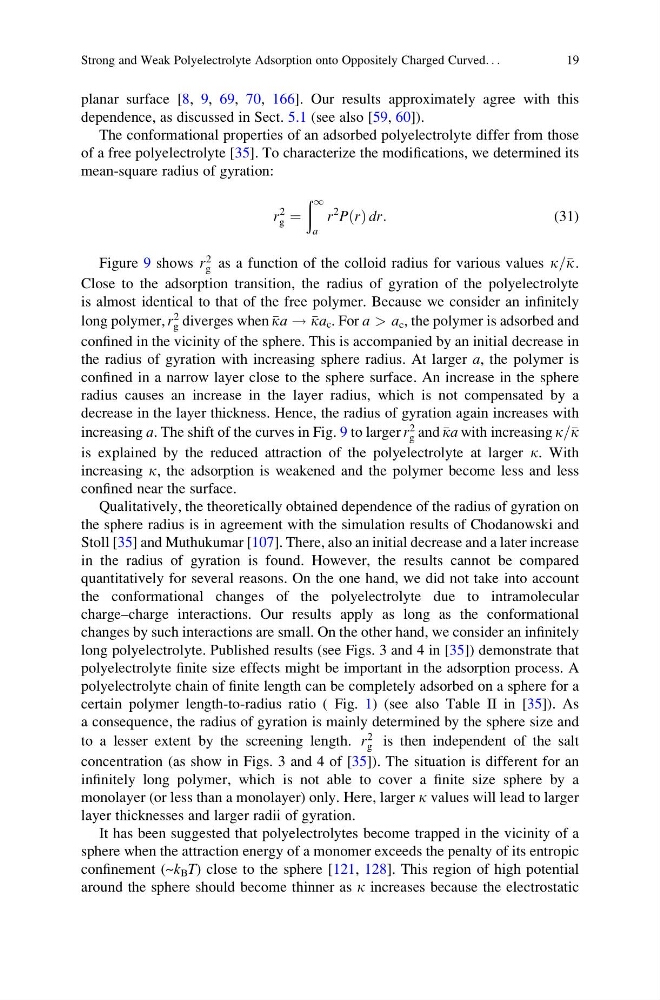
mean-square radius of gyration:
r
2
g ¼
ð 1
a
r
2 PðrÞ dr:
(31)
Figure 9 shows r
2
g as a function of the colloid radius for various values k= k.
Close to the adsorption transition, the radius of gyration of the polyelectrolyte
is almost identical to that of the free polymer. Because we consider an infinitely
long polymer, r
2
g diverges when
ka !
ka c . For a > a c , the polymer is adsorbed and
confined in the vicinity of the sphere. This is accompanied by an initial decrease in
the radius of gyration with increasing sphere radius. At larger a, the polymer is
confined in a narrow layer close to the sphere surface. An increase in the sphere
radius causes an increase in the layer radius, which is not compensated by a
decrease in the layer thickness. Hence, the radius of gyration again increases with
increasing a. The shift of the curves in Fig. 9 to larger r
2
g and
ka with increasing k= k
is explained by the reduced attraction of the polyelectrolyte at larger k. With
increasing k, the adsorption is weakened and the polymer become less and less
confined near the surface.
Qualitatively, the theoretically obtained dependence of the radius of gyration on
the sphere radius is in agreement with the simulation results of Chodanowski and
Stoll [35] and Muthukumar [107]. There, also an initial decrease and a later increase
in the radius of gyration is found. However, the results cannot be compared
quantitatively for several reasons. On the one hand, we did not take into account
the conformational changes of the polyelectrolyte due to intramolecular
charge–charge interactions. Our results apply as long as the conformational
changes by such interactions are small. On the other hand, we consider an infinitely
long polyelectrolyte. Published results (see Figs. 3 and 4 in [35]) demonstrate that
polyelectrolyte finite size effects might be important in the adsorption process. A
polyelectrolyte chain of finite length can be completely adsorbed on a sphere for a
certain polymer length-to-radius ratio ( Fig. 1) (see also Table II in [35]). As
a consequence, the radius of gyration is mainly determined by the sphere size and
to a lesser extent by the screening length. r
2
g is then independent of the salt
concentration (as show in Figs. 3 and 4 of [35]). The situation is different for an
infinitely long polymer, which is not able to cover a finite size sphere by a
monolayer (or less than a monolayer) only. Here, larger k values will lead to larger
layer thicknesses and larger radii of gyration.
It has been suggested that polyelectrolytes become trapped in the vicinity of a
sphere when the attraction energy of a monomer exceeds the penalty of its entropic
confinement (~k B T) close to the sphere [121, 128]. This region of high potential
around the sphere should become thinner as k increases because the electrostatic
Strong and Weak Polyelectrolyte Adsorption onto Oppositely Charged Curved. . .
19
dependence, as discussed in Sect. 5.1 (see also [59, 60]).
The conformational properties of an adsorbed polyelectrolyte differ from those
of a free polyelectrolyte [35]. To characterize the modifications, we determined its
mean-square radius of gyration:
r
2
g ¼
ð 1
a
r
2 PðrÞ dr:
(31)
Figure 9 shows r
2
g as a function of the colloid radius for various values k= k.
Close to the adsorption transition, the radius of gyration of the polyelectrolyte
is almost identical to that of the free polymer. Because we consider an infinitely
long polymer, r
2
g diverges when
ka !
ka c . For a > a c , the polymer is adsorbed and
confined in the vicinity of the sphere. This is accompanied by an initial decrease in
the radius of gyration with increasing sphere radius. At larger a, the polymer is
confined in a narrow layer close to the sphere surface. An increase in the sphere
radius causes an increase in the layer radius, which is not compensated by a
decrease in the layer thickness. Hence, the radius of gyration again increases with
increasing a. The shift of the curves in Fig. 9 to larger r
2
g and
ka with increasing k= k
is explained by the reduced attraction of the polyelectrolyte at larger k. With
increasing k, the adsorption is weakened and the polymer become less and less
confined near the surface.
Qualitatively, the theoretically obtained dependence of the radius of gyration on
the sphere radius is in agreement with the simulation results of Chodanowski and
Stoll [35] and Muthukumar [107]. There, also an initial decrease and a later increase
in the radius of gyration is found. However, the results cannot be compared
quantitatively for several reasons. On the one hand, we did not take into account
the conformational changes of the polyelectrolyte due to intramolecular
charge–charge interactions. Our results apply as long as the conformational
changes by such interactions are small. On the other hand, we consider an infinitely
long polyelectrolyte. Published results (see Figs. 3 and 4 in [35]) demonstrate that
polyelectrolyte finite size effects might be important in the adsorption process. A
polyelectrolyte chain of finite length can be completely adsorbed on a sphere for a
certain polymer length-to-radius ratio ( Fig. 1) (see also Table II in [35]). As
a consequence, the radius of gyration is mainly determined by the sphere size and
to a lesser extent by the screening length. r
2
g is then independent of the salt
concentration (as show in Figs. 3 and 4 of [35]). The situation is different for an
infinitely long polymer, which is not able to cover a finite size sphere by a
monolayer (or less than a monolayer) only. Here, larger k values will lead to larger
layer thicknesses and larger radii of gyration.
It has been suggested that polyelectrolytes become trapped in the vicinity of a
sphere when the attraction energy of a monomer exceeds the penalty of its entropic
confinement (~k B T) close to the sphere [121, 128]. This region of high potential
around the sphere should become thinner as k increases because the electrostatic
Strong and Weak Polyelectrolyte Adsorption onto Oppositely Charged Curved. . .
19