

decays exponentially at large distances. In both cases, a larger interaction strength
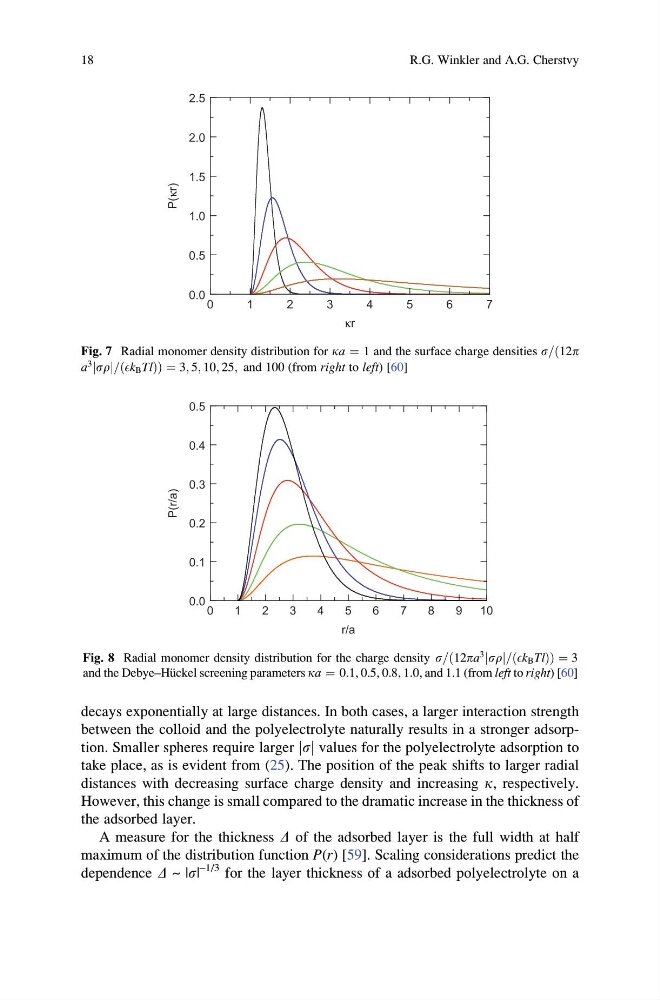
between the colloid and the polyelectrolyte naturally results in a stronger adsorption. Smaller spheres require larger jsj values for the polyelectrolyte adsorption to
take place, as is evident from (25). The position of the peak shifts to larger radial
distances with decreasing surface charge density and increasing k, respectively.
However, this change is small compared to the dramatic increase in the thickness of
the adsorbed layer.
A measure for the thickness D of the adsorbed layer is the full width at half
maximum of the distribution function P(r) [59]. Scaling considerations predict the
dependence D ~ |s|
–1/3 for the layer thickness of a adsorbed polyelectrolyte on a
Fig. 7 Radial monomer density distribution for ka ¼ 1 and the surface charge densities s=ð12p
a
3 jsrj=ðEk B TlÞÞ ¼ 3; 5; 10; 25; and 100 (from right to left) [60]
Fig. 8 Radial monomer density distribution for the charge density s=ð12pa
3 jsrj=ðEk B TlÞÞ ¼ 3
and the Debye–Hu ¨ckel screening parameters ka ¼ 0.1, 0.5, 0.8, 1.0, and 1.1 (from left to right) [60]
18
R.G. Winkler and A.G. Cherstvy
between the colloid and the polyelectrolyte naturally results in a stronger adsorption. Smaller spheres require larger jsj values for the polyelectrolyte adsorption to
take place, as is evident from (25). The position of the peak shifts to larger radial
distances with decreasing surface charge density and increasing k, respectively.
However, this change is small compared to the dramatic increase in the thickness of
the adsorbed layer.
A measure for the thickness D of the adsorbed layer is the full width at half
maximum of the distribution function P(r) [59]. Scaling considerations predict the
dependence D ~ |s|
–1/3 for the layer thickness of a adsorbed polyelectrolyte on a
Fig. 7 Radial monomer density distribution for ka ¼ 1 and the surface charge densities s=ð12p
a
3 jsrj=ðEk B TlÞÞ ¼ 3; 5; 10; 25; and 100 (from right to left) [60]
Fig. 8 Radial monomer density distribution for the charge density s=ð12pa
3 jsrj=ðEk B TlÞÞ ¼ 3
and the Debye–Hu ¨ckel screening parameters ka ¼ 0.1, 0.5, 0.8, 1.0, and 1.1 (from left to right) [60]
18
R.G. Winkler and A.G. Cherstvy