

potential decays faster away from the sphere, and the region should become larger
with increasing sphere charge density. Thus, larger |s| values would be required to
form polyelectrolyte–sphere complexes at higher salt concentrations. Clearly, this
statement is qualitatively consistent with our analytical result (25). Using the same
crude model as described by McQuigg et al. [121], however, leads to a completely
different dependence of the critical charge density on k, namely |s c | ~ (ka + 1) [60,
121]. This yields a dependence on k that is far too weak for ka ) 1 and s c is
independent of ka for ka ( 1. These differences reflect the different underlying
physical adsorption mechanisms. In the first case, it is assumed that the gain in
adsorption energy compensates for the loss in translational entropy (of either some
part of the polymer or the colloid), neglecting any conformational entropy changes.
In our approach, however, conformational entropy changes play the dominate role –
adsorption is achieved when the gain in adsorption energy compensates the loss in
conformational entropy. Even for very small colloids, the spatial distribution of
monomers is different from that of a polyelectrolyte in free space (see Figs. 4 and 5),
particularly because of the boundary condition on the colloid surface. Thus, the
presence of the colloid always affects the conformational properties of the polyelectrolyte. The adsorption process is governed by the polyelectrolyte conformational entropy rather than the translational entropy (of some segments or the
colloid), which we of course account for by using (1) as the starting point of our
considerations.
The Debye–Hu ¨ckel attraction energy per polymer length (15) depends on k. In
particular, it decreases with decreasing k because the monomer distribution
becomes narrower. Interestingly, at the transition from an adsorbed to a desorbed
state, the average energy is zero because the critical eigenfunction decays very
slowly with increasing radial distance and cannot be normalized. As a consequence,
the polyelectrolyte fraction close to the sphere becomes zero when the desorption
transition is approached.
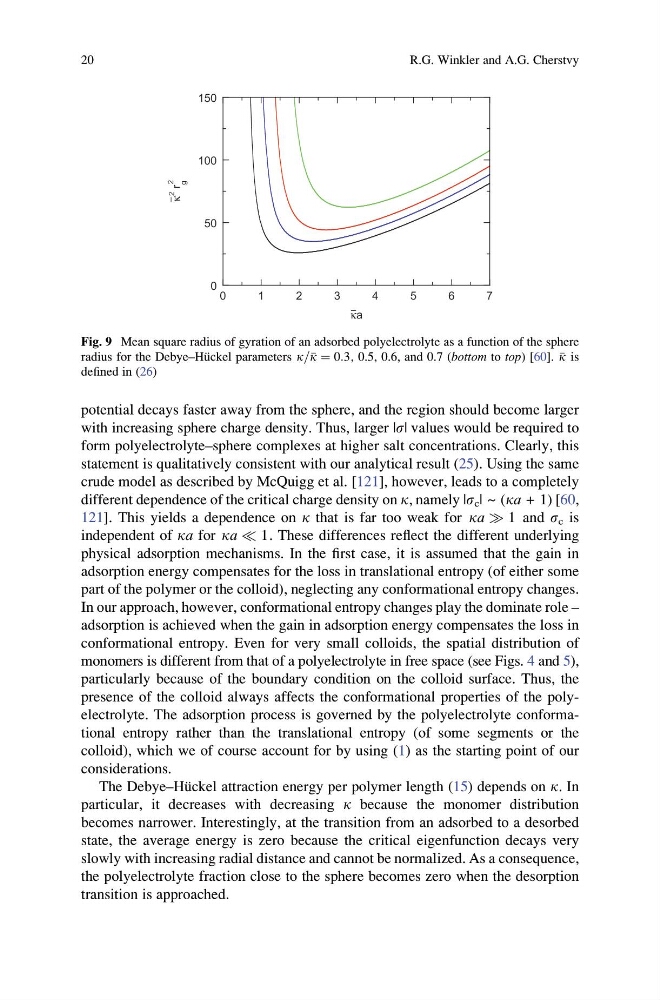
Fig. 9 Mean square radius of gyration of an adsorbed polyelectrolyte as a function of the sphere
radius for the Debye–Hu ¨ckel parameters k= k ¼ 0:3, 0.5, 0.6, and 0.7 (bottom to top) [60].
k is
defined in (26)
20
R.G. Winkler and A.G. Cherstvy
with increasing sphere charge density. Thus, larger |s| values would be required to
form polyelectrolyte–sphere complexes at higher salt concentrations. Clearly, this
statement is qualitatively consistent with our analytical result (25). Using the same
crude model as described by McQuigg et al. [121], however, leads to a completely
different dependence of the critical charge density on k, namely |s c | ~ (ka + 1) [60,
121]. This yields a dependence on k that is far too weak for ka ) 1 and s c is
independent of ka for ka ( 1. These differences reflect the different underlying
physical adsorption mechanisms. In the first case, it is assumed that the gain in
adsorption energy compensates for the loss in translational entropy (of either some
part of the polymer or the colloid), neglecting any conformational entropy changes.
In our approach, however, conformational entropy changes play the dominate role –
adsorption is achieved when the gain in adsorption energy compensates the loss in
conformational entropy. Even for very small colloids, the spatial distribution of
monomers is different from that of a polyelectrolyte in free space (see Figs. 4 and 5),
particularly because of the boundary condition on the colloid surface. Thus, the
presence of the colloid always affects the conformational properties of the polyelectrolyte. The adsorption process is governed by the polyelectrolyte conformational entropy rather than the translational entropy (of some segments or the
colloid), which we of course account for by using (1) as the starting point of our
considerations.
The Debye–Hu ¨ckel attraction energy per polymer length (15) depends on k. In
particular, it decreases with decreasing k because the monomer distribution
becomes narrower. Interestingly, at the transition from an adsorbed to a desorbed
state, the average energy is zero because the critical eigenfunction decays very
slowly with increasing radial distance and cannot be normalized. As a consequence,
the polyelectrolyte fraction close to the sphere becomes zero when the desorption
transition is approached.
Fig. 9 Mean square radius of gyration of an adsorbed polyelectrolyte as a function of the sphere
radius for the Debye–Hu ¨ckel parameters k= k ¼ 0:3, 0.5, 0.6, and 0.7 (bottom to top) [60].
k is
defined in (26)
20
R.G. Winkler and A.G. Cherstvy