

p c ðka c Þðe
ka c À 1Þ À
8k
2
j 2
0 a c
k 3 ð1 þ ka c Þ ¼ 0:
(27)
Its solution yields a universal curve for a c
k as a function of k=
k.
The numerical solution of (27) is shown in Fig. 6 together with the analytical
approximations:
a c
k ¼
ffiffiffiffiffiffiffiffiffiffiffiffiffi ffi
4k= kj 2
0
p
; k (
k
ðk= kÞ
2 =ð1 À ðk= kÞ
3 Þ; k !
k:
&
(28)
No adsorption is obtained in the region located to the right of the curve. At a
fixed k <
k, the entropy penalty due to adsorption of the chain monomers decreases
with increasing sphere radius. Beyond the critical radius, the energy gain exceeds
the entropy loss and the polymer adsorbs at the sphere surface. As is obvious from
the analytical expression,
k is the maximum value of the inverse Debye screening
length; no adsorption is obtained for larger values neither for a sphere nor for a
planar surface. Hence,
k plays a key role in critical adsorption.
This is qualitatively consistent with the variational calculations [56, 107]. These
calculations predict the same dependence of the maximum value of k on the
polymer and sphere parameters as our solution does. Quantitatively, however,
the value of the variational calculation is smaller by the factor 8=j
2
0 . In addition,
the shape of the critical curve is rather different, as shown in Fig. 6.
The adsorption of a polyelectrolyte onto a spherical particle has been studied
using Monte Carlo simulations [35]. In particular, the critical sphere radius has been
determined as a function of k. Aside from the interactions considered in our model,
10
-4
10
-3
10
-2
10
-1
10
0
10
1
10
2
10
3
10
-3
10
-2
10
-1
10
0
10
1
|σ
c
| 12πa
3
|ρ| /
εk
B
Tl
κa
adsorption
desorption
~ κ
~ κ
3
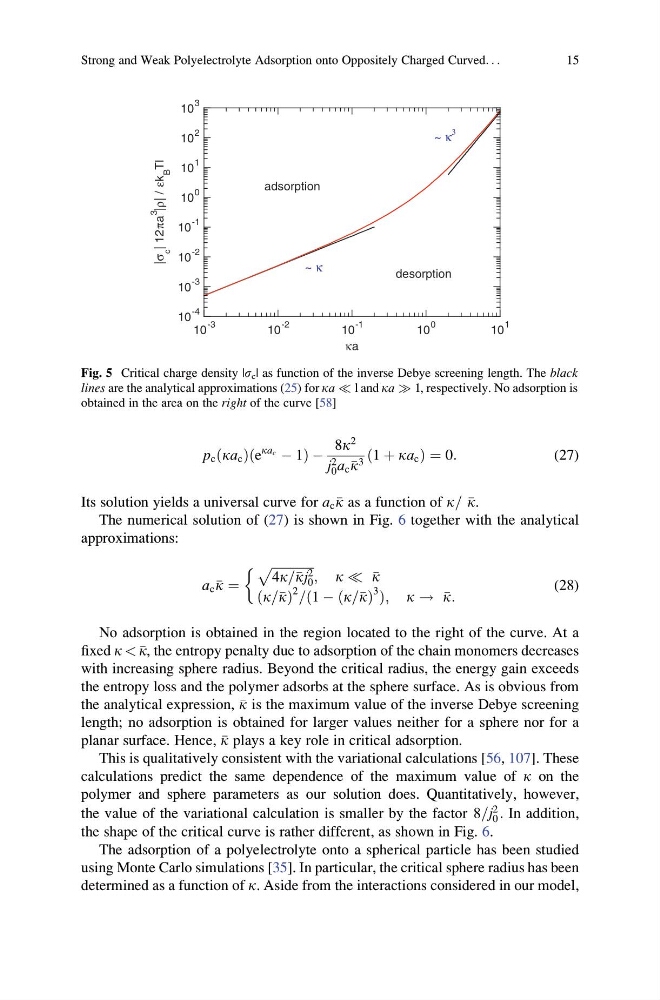
Fig. 5 Critical charge density |s c | as function of the inverse Debye screening length. The black
lines are the analytical approximations (25) for ka ( l and ka ) 1, respectively. No adsorption is
obtained in the area on the right of the curve [58]
Strong and Weak Polyelectrolyte Adsorption onto Oppositely Charged Curved. . .
15
ka c À 1Þ À
8k
2
j 2
0 a c
k 3 ð1 þ ka c Þ ¼ 0:
(27)
Its solution yields a universal curve for a c
k as a function of k=
k.
The numerical solution of (27) is shown in Fig. 6 together with the analytical
approximations:
a c
k ¼
ffiffiffiffiffiffiffiffiffiffiffiffiffi ffi
4k= kj 2
0
p
; k (
k
ðk= kÞ
2 =ð1 À ðk= kÞ
3 Þ; k !
k:
&
(28)
No adsorption is obtained in the region located to the right of the curve. At a
fixed k <
k, the entropy penalty due to adsorption of the chain monomers decreases
with increasing sphere radius. Beyond the critical radius, the energy gain exceeds
the entropy loss and the polymer adsorbs at the sphere surface. As is obvious from
the analytical expression,
k is the maximum value of the inverse Debye screening
length; no adsorption is obtained for larger values neither for a sphere nor for a
planar surface. Hence,
k plays a key role in critical adsorption.
This is qualitatively consistent with the variational calculations [56, 107]. These
calculations predict the same dependence of the maximum value of k on the
polymer and sphere parameters as our solution does. Quantitatively, however,
the value of the variational calculation is smaller by the factor 8=j
2
0 . In addition,
the shape of the critical curve is rather different, as shown in Fig. 6.
The adsorption of a polyelectrolyte onto a spherical particle has been studied
using Monte Carlo simulations [35]. In particular, the critical sphere radius has been
determined as a function of k. Aside from the interactions considered in our model,
10
-4
10
-3
10
-2
10
-1
10
0
10
1
10
2
10
3
10
-3
10
-2
10
-1
10
0
10
1
|σ
c
| 12πa
3
|ρ| /
εk
B
Tl
κa
adsorption
desorption
~ κ
~ κ
3
Fig. 5 Critical charge density |s c | as function of the inverse Debye screening length. The black
lines are the analytical approximations (25) for ka ( l and ka ) 1, respectively. No adsorption is
obtained in the area on the right of the curve [58]
Strong and Weak Polyelectrolyte Adsorption onto Oppositely Charged Curved. . .
15