

the variational calculation of van Goeler and Muthukumar [56]. However, the
variational calculation of Haronsa et al. [57] predicts the same dependence on k,
but the numerical factor is rather different. The Kuhn segment length l of the
polymer is independent of k in this limit [41]. In the opposite limit of small
curvature ( ka ) 1 ), the obtained k dependence is identical to that found by
variational calculations [56–58]. The adsorption–desorption transitions in all
these limits are of second order.
The analytical approximation for ka ( 1 [see (25)] not only predicts a critical
surface charge density but also a critical colloid charge Q c ¼ 4pa
2
js c j ~ k itself.
This implies that for sufficiently small colloids, critical adsorption is independent of
the size of the colloid; it only depends on k. In this limit, the Debye screening length
defines the region in space where the potential is large enough to capture the
dissolved polyelectrolyte and to trigger adsorption.
So far, we have assumed that the Kuhn length (or persistence length) is independent of the Debye screening length. It is, however, well known that the persistence
length of flexible polyelectrolytes exhibits a k dependence [158–160]. There exist
various power-law predictions l $ k
Àb l for such a dependence, with exponents in
the range b l ¼
4
5 to b l ¼
6
5 [41, 146–148, 161–163]. A detailed discussion of the k
dependence of the persistence length by far exceeds the focus of the current paper,
but we would like to point out that recent simulations and scaling considerations for
long flexible polyelectrolytes [146–148, 162] are in agreement with the original
prediction l ~ k
–2 by Odijk [164] and Skolnick and Fixman [165] for semiflexible
polyelectrolytes. In this limit, the polyelectrolyte can be mimicked as a linear
assembly of weakly interacting de Gennes–Pincus electrostatic blobs with the
electrostatic persistence scaling similar to that of Odijk–Skolnick–Fixman stiffness
for weakly bendable polyelectrolyte chains. For our purposes, we use the definition
of the projection length presented by Ullner [148] as a measure of persistence
length, which exhibits the exponent b l ¼ 1.2.
The complex formation of a polyelectrolyte with oppositely charged micelles
and proteins has been studied (for example, see [44, 123, 124, 126, 128]). These
experiments confirm that complexation occurs only when the surface charge density exceeds a critical value, which typically grows with the reciprocal Debye
screening length as |s c | ~ k
b with b ¼ 1À1.4 [44, 59, 124, 126, 128]. Our scaling
results agree with the experimental findings when we take the above k dependence
of l into account [58, 59].
Instead of the charge density s c , a critical sphere radius a c can be determined
[35, 56, 107] that separates adsorbed from desorbed polyelectrolyte states. By
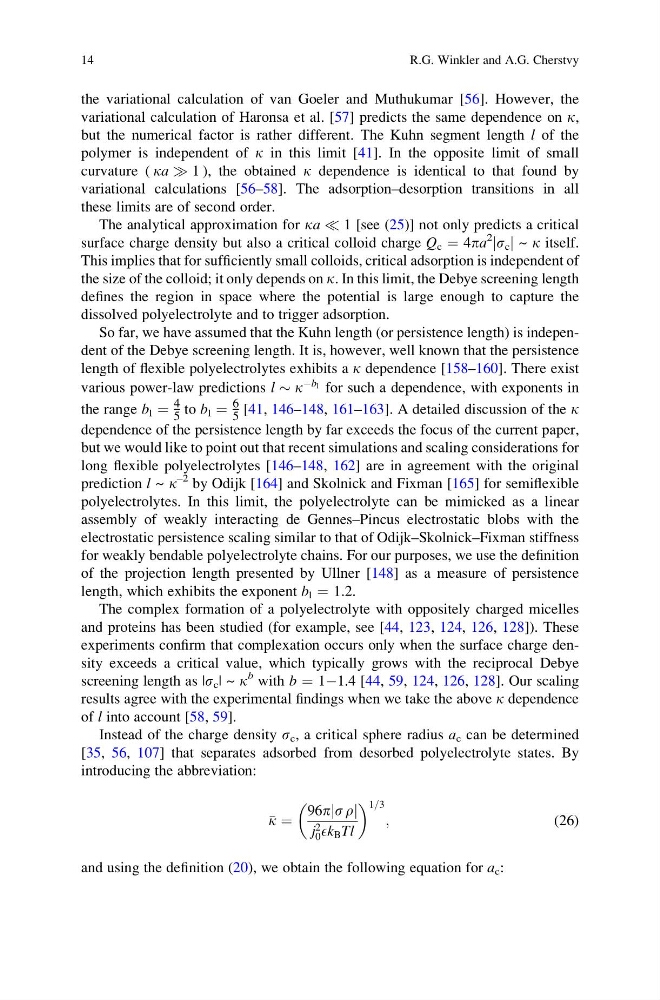
introducing the abbreviation:
k ¼
96pjs rj
j 2
0 Ek B Tl
1=3
;
(26)
and using the definition (20), we obtain the following equation for a c :
14
R.G. Winkler and A.G. Cherstvy
variational calculation of Haronsa et al. [57] predicts the same dependence on k,
but the numerical factor is rather different. The Kuhn segment length l of the
polymer is independent of k in this limit [41]. In the opposite limit of small
curvature ( ka ) 1 ), the obtained k dependence is identical to that found by
variational calculations [56–58]. The adsorption–desorption transitions in all
these limits are of second order.
The analytical approximation for ka ( 1 [see (25)] not only predicts a critical
surface charge density but also a critical colloid charge Q c ¼ 4pa
2
js c j ~ k itself.
This implies that for sufficiently small colloids, critical adsorption is independent of
the size of the colloid; it only depends on k. In this limit, the Debye screening length
defines the region in space where the potential is large enough to capture the
dissolved polyelectrolyte and to trigger adsorption.
So far, we have assumed that the Kuhn length (or persistence length) is independent of the Debye screening length. It is, however, well known that the persistence
length of flexible polyelectrolytes exhibits a k dependence [158–160]. There exist
various power-law predictions l $ k
Àb l for such a dependence, with exponents in
the range b l ¼
4
5 to b l ¼
6
5 [41, 146–148, 161–163]. A detailed discussion of the k
dependence of the persistence length by far exceeds the focus of the current paper,
but we would like to point out that recent simulations and scaling considerations for
long flexible polyelectrolytes [146–148, 162] are in agreement with the original
prediction l ~ k
–2 by Odijk [164] and Skolnick and Fixman [165] for semiflexible
polyelectrolytes. In this limit, the polyelectrolyte can be mimicked as a linear
assembly of weakly interacting de Gennes–Pincus electrostatic blobs with the
electrostatic persistence scaling similar to that of Odijk–Skolnick–Fixman stiffness
for weakly bendable polyelectrolyte chains. For our purposes, we use the definition
of the projection length presented by Ullner [148] as a measure of persistence
length, which exhibits the exponent b l ¼ 1.2.
The complex formation of a polyelectrolyte with oppositely charged micelles
and proteins has been studied (for example, see [44, 123, 124, 126, 128]). These
experiments confirm that complexation occurs only when the surface charge density exceeds a critical value, which typically grows with the reciprocal Debye
screening length as |s c | ~ k
b with b ¼ 1À1.4 [44, 59, 124, 126, 128]. Our scaling
results agree with the experimental findings when we take the above k dependence
of l into account [58, 59].
Instead of the charge density s c , a critical sphere radius a c can be determined
[35, 56, 107] that separates adsorbed from desorbed polyelectrolyte states. By
introducing the abbreviation:
k ¼
96pjs rj
j 2
0 Ek B Tl
1=3
;
(26)
and using the definition (20), we obtain the following equation for a c :
14
R.G. Winkler and A.G. Cherstvy