

also provides the appropriate critical p c for the Debye–Hu ¨ckel potential in the limit
ka kr ( 1. Using the Debye–Hu ¨ckel potential, (19) becomes:
xð1 À xÞ
d
2
dx 2 w c ðxÞ þ ð2 À 3xÞ
d
dx
w c ðxÞ À 1 þ
2akx
p c lnð1 À xÞð1 À e Àka Þ
w c ðxÞ ¼ 0
(24)
Again, the first two terms are satisfied by the function (23) and the remaining part
disappears at r ¼ a for p c ¼ 2. Hence, the critical value p c ¼ 2 is identical for the
Hulthe ´n and the Debye–Hu ¨ckel potential in the limit ka ( l and ðr À aÞ=a ( 1.
The critical value p c allows us to calculate other critical quantities for
polyelectrolyte adsorption, such as the critical temperature [41, 59], the critical
colloid surface charge density s c [58, 59], or the critical colloid radius a c via
(20). Results for the critical temperature and the critical surface charge density
have been presented and discussed [58, 59]. Thus, we summarize here our
findings for s c only. Using the above limiting values for p c , we obtain the
following approximations:
js c j ¼
Ek B Tl
24pa
2
jrj
k; ka ( 1
j
2
0 Ek B Tl
96pjrj
k
3
; ka ) 1:
8
> > <
> > :
(25)
The exact solution for the Debye–Hu ¨ckel potential predicts a linear dependence
of the critical colloid charge density on the inverse Debye screening length for
ka ( 1 (Fig. 5). This is different from the predicted dependence |s c | ~ k
2 based on
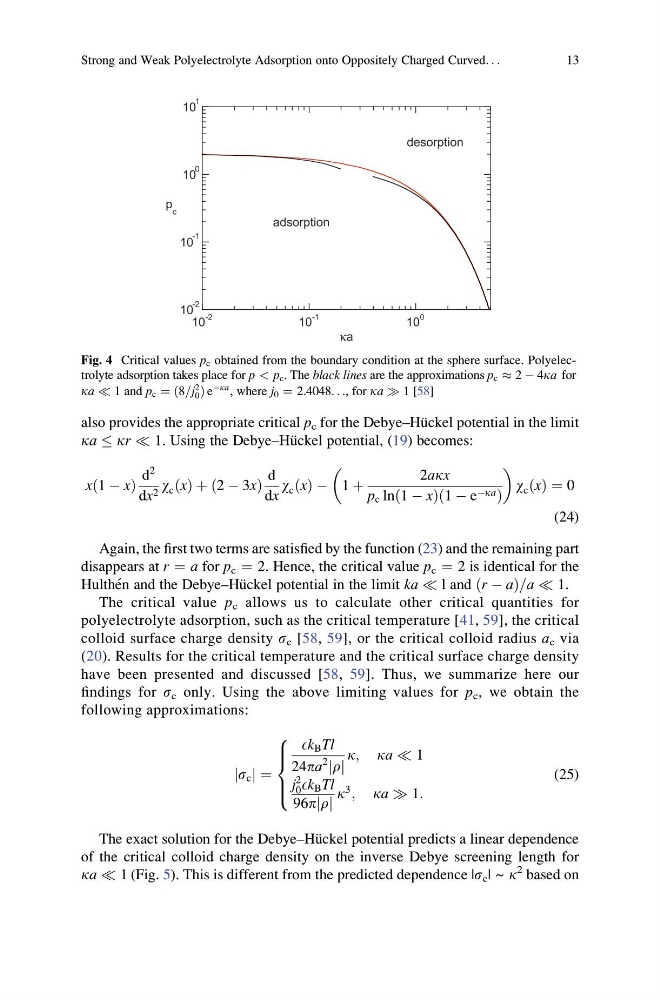
Fig. 4 Critical values p c obtained from the boundary condition at the sphere surface. Polyelectrolyte adsorption takes place for p < p c . The black lines are the approximations p c % 2 À 4ka for
ka ( 1 and p c ¼ ð8=j
2
0 Þ e
Àka , where j 0 ¼ 2.4048. . ., for ka ) 1 [58]
Strong and Weak Polyelectrolyte Adsorption onto Oppositely Charged Curved. . .
13
ka kr ( 1. Using the Debye–Hu ¨ckel potential, (19) becomes:
xð1 À xÞ
d
2
dx 2 w c ðxÞ þ ð2 À 3xÞ
d
dx
w c ðxÞ À 1 þ
2akx
p c lnð1 À xÞð1 À e Àka Þ
w c ðxÞ ¼ 0
(24)
Again, the first two terms are satisfied by the function (23) and the remaining part
disappears at r ¼ a for p c ¼ 2. Hence, the critical value p c ¼ 2 is identical for the
Hulthe ´n and the Debye–Hu ¨ckel potential in the limit ka ( l and ðr À aÞ=a ( 1.
The critical value p c allows us to calculate other critical quantities for
polyelectrolyte adsorption, such as the critical temperature [41, 59], the critical
colloid surface charge density s c [58, 59], or the critical colloid radius a c via
(20). Results for the critical temperature and the critical surface charge density
have been presented and discussed [58, 59]. Thus, we summarize here our
findings for s c only. Using the above limiting values for p c , we obtain the
following approximations:
js c j ¼
Ek B Tl
24pa
2
jrj
k; ka ( 1
j
2
0 Ek B Tl
96pjrj
k
3
; ka ) 1:
8
> > <
> > :
(25)
The exact solution for the Debye–Hu ¨ckel potential predicts a linear dependence
of the critical colloid charge density on the inverse Debye screening length for
ka ( 1 (Fig. 5). This is different from the predicted dependence |s c | ~ k
2 based on
Fig. 4 Critical values p c obtained from the boundary condition at the sphere surface. Polyelectrolyte adsorption takes place for p < p c . The black lines are the approximations p c % 2 À 4ka for
ka ( 1 and p c ¼ ð8=j
2
0 Þ e
Àka , where j 0 ¼ 2.4048. . ., for ka ) 1 [58]
Strong and Weak Polyelectrolyte Adsorption onto Oppositely Charged Curved. . .
13