

indicating a location within both the PMAA corona and the intramicellar IPEC
domains (Fig. 26b). At the same time, the situation is different for palladium NPs
in the PB-b-P2VPQ-b-PMANa micelles (Fig. 26d–f). Here, the palladium NPs are
located in the IPEC patches distributed along the cylindrical PB core. Thus, the
experiments with templates based on micelles of ionic amphiphilic triblock
terpolymers have demonstrated that both hydrophilic (PMAA corona) and rather
hydrophobic (IPEC domains) compartments present in such self-assembled
structures can be used for deposition of NPs.
5 Conclusions and Perspective
Recent advances in controlled synthesis of macromolecules, in particular in controlled radical polymerization, have allowed the construction of polymers with
various topologies and compositions. Successful design of star-shaped polymers,
molecular polymer brushes, and amphiphilic block copolymers and terpolymers has
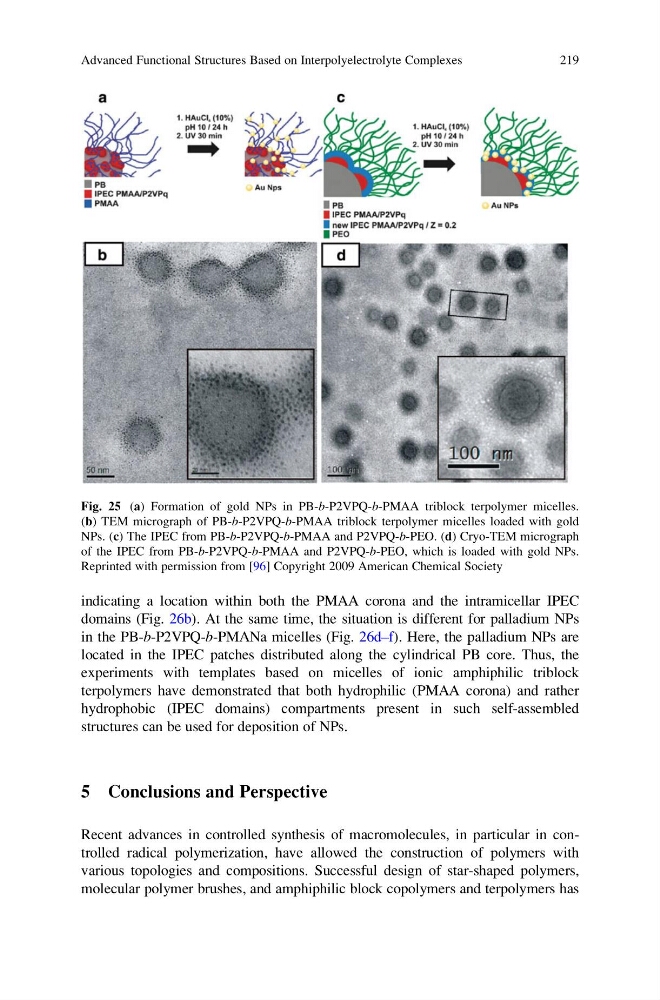
Fig. 25 (a) Formation of gold NPs in PB-b-P2VPQ-b-PMAA triblock terpolymer micelles.
(b) TEM micrograph of PB-b-P2VPQ-b-PMAA triblock terpolymer micelles loaded with gold
NPs. (c) The IPEC from PB-b-P2VPQ-b-PMAA and P2VPQ-b-PEO. (d) Cryo-TEM micrograph
of the IPEC from PB-b-P2VPQ-b-PMAA and P2VPQ-b-PEO, which is loaded with gold NPs.
Reprinted with permission from [96] Copyright 2009 American Chemical Society
Advanced Functional Structures Based on Interpolyelectrolyte Complexes
219
domains (Fig. 26b). At the same time, the situation is different for palladium NPs
in the PB-b-P2VPQ-b-PMANa micelles (Fig. 26d–f). Here, the palladium NPs are
located in the IPEC patches distributed along the cylindrical PB core. Thus, the
experiments with templates based on micelles of ionic amphiphilic triblock
terpolymers have demonstrated that both hydrophilic (PMAA corona) and rather
hydrophobic (IPEC domains) compartments present in such self-assembled
structures can be used for deposition of NPs.
5 Conclusions and Perspective
Recent advances in controlled synthesis of macromolecules, in particular in controlled radical polymerization, have allowed the construction of polymers with
various topologies and compositions. Successful design of star-shaped polymers,
molecular polymer brushes, and amphiphilic block copolymers and terpolymers has
Fig. 25 (a) Formation of gold NPs in PB-b-P2VPQ-b-PMAA triblock terpolymer micelles.
(b) TEM micrograph of PB-b-P2VPQ-b-PMAA triblock terpolymer micelles loaded with gold
NPs. (c) The IPEC from PB-b-P2VPQ-b-PMAA and P2VPQ-b-PEO. (d) Cryo-TEM micrograph
of the IPEC from PB-b-P2VPQ-b-PMAA and P2VPQ-b-PEO, which is loaded with gold NPs.
Reprinted with permission from [96] Copyright 2009 American Chemical Society
Advanced Functional Structures Based on Interpolyelectrolyte Complexes
219