

stimulated extensive studies of self-organization phenomena in multicomponent
macromolecular systems. Electrostatically driven co-assembly in such systems
provides a simple route towards micelle-like polymeric structures with spatially
separated domains (compartments) having different functionalities. An outer domain
grants solubility in solution to the macromolecular co-assemblies while an inner
domain (or domains) can accumulate from or release into the environment various
compounds in response to variations in environmental conditions. Variations in the
pH or in the ionic strength are an effective way to change the structure and properties
of the formed IPECs. During the last few years, various advanced functional IPEC
structures based on polyions (or polyionic species) with nonlinear (branched)
topologies have been successfully prepared and thoroughly examined.
IPECs are proved to effectively bind metal ions. Such hybrid macromolecular
co-assemblies containing noble and transition metal ions can be considered, therefore, as universal matrices for further preparation of polymer–metal nanocomposites
with controlled and variable NP size as well as various spatial distributions of NPs in
such polymer systems. In this context, the use of polyions (or polyionic species) with
nonlinear (branched) topologies can be, beyond all doubt, advantageous and very
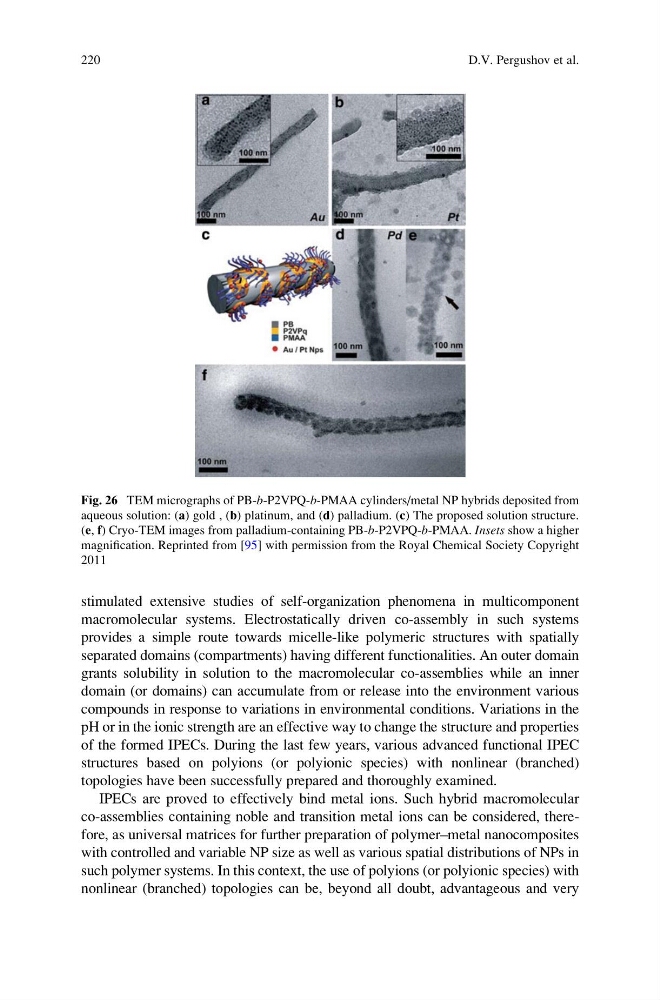
Fig. 26 TEM micrographs of PB-b-P2VPQ-b-PMAA cylinders/metal NP hybrids deposited from
aqueous solution: (a) gold , (b) platinum, and (d) palladium. (c) The proposed solution structure.
(e, f) Cryo-TEM images from palladium-containing PB-b-P2VPQ-b-PMAA. Insets show a higher
magnification. Reprinted from [95] with permission from the Royal Chemical Society Copyright
2011
220
D.V. Pergushov et al.
macromolecular systems. Electrostatically driven co-assembly in such systems
provides a simple route towards micelle-like polymeric structures with spatially
separated domains (compartments) having different functionalities. An outer domain
grants solubility in solution to the macromolecular co-assemblies while an inner
domain (or domains) can accumulate from or release into the environment various
compounds in response to variations in environmental conditions. Variations in the
pH or in the ionic strength are an effective way to change the structure and properties
of the formed IPECs. During the last few years, various advanced functional IPEC
structures based on polyions (or polyionic species) with nonlinear (branched)
topologies have been successfully prepared and thoroughly examined.
IPECs are proved to effectively bind metal ions. Such hybrid macromolecular
co-assemblies containing noble and transition metal ions can be considered, therefore, as universal matrices for further preparation of polymer–metal nanocomposites
with controlled and variable NP size as well as various spatial distributions of NPs in
such polymer systems. In this context, the use of polyions (or polyionic species) with
nonlinear (branched) topologies can be, beyond all doubt, advantageous and very
Fig. 26 TEM micrographs of PB-b-P2VPQ-b-PMAA cylinders/metal NP hybrids deposited from
aqueous solution: (a) gold , (b) platinum, and (d) palladium. (c) The proposed solution structure.
(e, f) Cryo-TEM images from palladium-containing PB-b-P2VPQ-b-PMAA. Insets show a higher
magnification. Reprinted from [95] with permission from the Royal Chemical Society Copyright
2011
220
D.V. Pergushov et al.