

Both active species and stable radiolysis products can act as reducing species. The
penetrating ability and dose rate are important parameters of ionizing irradiation.
They influence the localization of the formation of reducing species as well as
determine the contributions of processes related to generation and growth of NPs
[111, 120].
The high penetrating ability of g-irradiation and the EU-4 accelerator
(Skobeltsyn Institute of Nuclear Physics, M.V. Lomonosov Moscow State University) [115, 133] provide a uniform generation of reducing species in the irradiated
polymer system. The use of isotopic
60 Co sources for a reduction of Cu
2+ and Ni
2+
embedded into the IPEC {PAA-PEI} allows one preparation of a material containing
rather small NPs (2–5 nm) [81, 115] that are uniformly distributed throughout
the IPEC films (Fig. 20a). This accelerator offers an exceptionally high dose rate
(more than 800 Gy/s). Under these conditions, the high rate of formation of metal
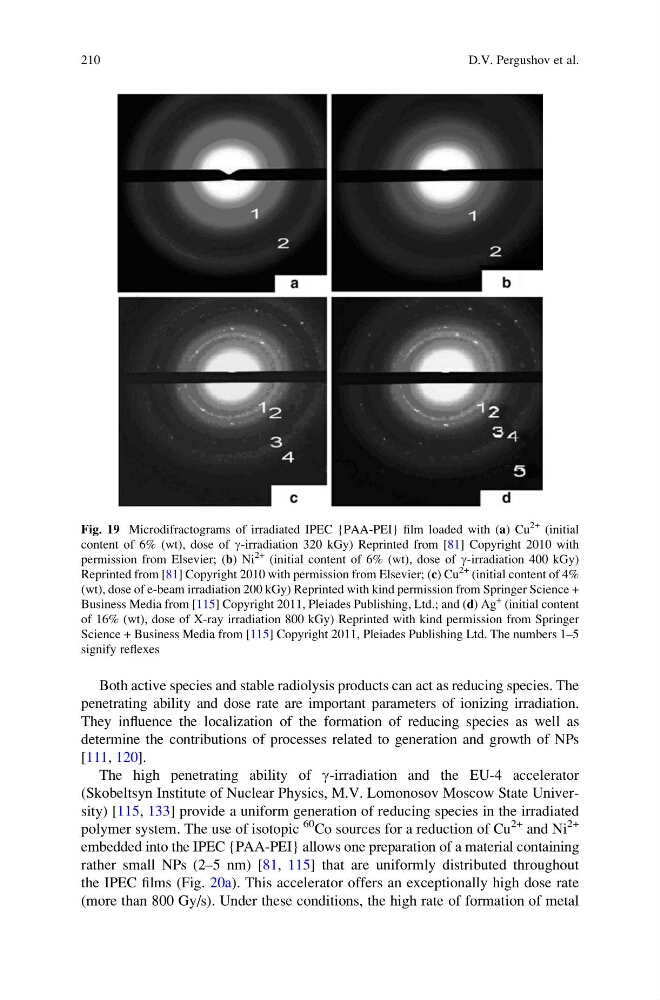
Fig. 19 Microdifractograms of irradiated IPEC {PAA-PEI} film loaded with (a) Cu
2+ (initial
content of 6% (wt), dose of g-irradiation 320 kGy) Reprinted from [81] Copyright 2010 with
permission from Elsevier; (b) Ni
2+ (initial content of 6% (wt), dose of g-irradiation 400 kGy)
Reprinted from [81] Copyright 2010 with permission from Elsevier; (c) Cu
2+ (initial content of 4%
(wt), dose of e-beam irradiation 200 kGy) Reprinted with kind permission from Springer Science +
Business Media from [115] Copyright 2011, Pleiades Publishing, Ltd.; and (d) Ag
+ (initial content
of 16% (wt), dose of X-ray irradiation 800 kGy) Reprinted with kind permission from Springer
Science + Business Media from [115] Copyright 2011, Pleiades Publishing Ltd. The numbers 1–5
signify reflexes
210
D.V. Pergushov et al.
penetrating ability and dose rate are important parameters of ionizing irradiation.
They influence the localization of the formation of reducing species as well as
determine the contributions of processes related to generation and growth of NPs
[111, 120].
The high penetrating ability of g-irradiation and the EU-4 accelerator
(Skobeltsyn Institute of Nuclear Physics, M.V. Lomonosov Moscow State University) [115, 133] provide a uniform generation of reducing species in the irradiated
polymer system. The use of isotopic
60 Co sources for a reduction of Cu
2+ and Ni
2+
embedded into the IPEC {PAA-PEI} allows one preparation of a material containing
rather small NPs (2–5 nm) [81, 115] that are uniformly distributed throughout
the IPEC films (Fig. 20a). This accelerator offers an exceptionally high dose rate
(more than 800 Gy/s). Under these conditions, the high rate of formation of metal
Fig. 19 Microdifractograms of irradiated IPEC {PAA-PEI} film loaded with (a) Cu
2+ (initial
content of 6% (wt), dose of g-irradiation 320 kGy) Reprinted from [81] Copyright 2010 with
permission from Elsevier; (b) Ni
2+ (initial content of 6% (wt), dose of g-irradiation 400 kGy)
Reprinted from [81] Copyright 2010 with permission from Elsevier; (c) Cu
2+ (initial content of 4%
(wt), dose of e-beam irradiation 200 kGy) Reprinted with kind permission from Springer Science +
Business Media from [115] Copyright 2011, Pleiades Publishing, Ltd.; and (d) Ag
+ (initial content
of 16% (wt), dose of X-ray irradiation 800 kGy) Reprinted with kind permission from Springer
Science + Business Media from [115] Copyright 2011, Pleiades Publishing Ltd. The numbers 1–5
signify reflexes
210
D.V. Pergushov et al.