

clusters inside an IPEC film proceeds mainly via active particles formed in the
swollen polymer matrix. The probability of cluster formation is high, and, in this
case, the ratio between the rate of NP nucleation and the rate of NP growth
determines the appearance of ultrafine NPs (less than 1.5 nm in size).
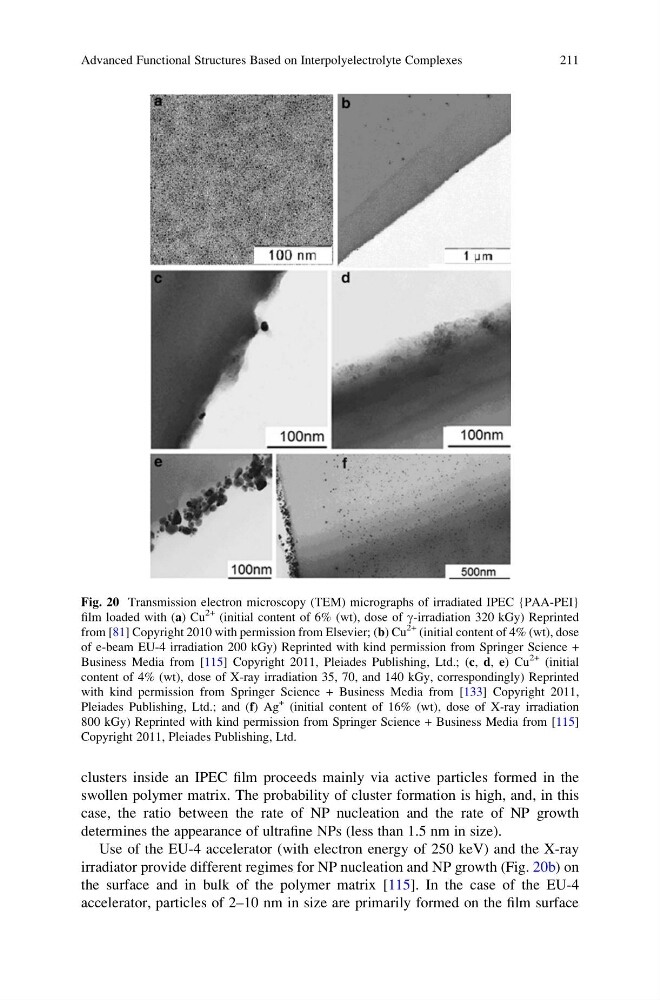
Use of the EU-4 accelerator (with electron energy of 250 keV) and the X-ray
irradiator provide different regimes for NP nucleation and NP growth (Fig. 20b) on
the surface and in bulk of the polymer matrix [115]. In the case of the EU-4
accelerator, particles of 2–10 nm in size are primarily formed on the film surface
Fig. 20 Transmission electron microscopy (TEM) micrographs of irradiated IPEC {PAA-PEI}
film loaded with (a) Cu
2+ (initial content of 6% (wt), dose of g-irradiation 320 kGy) Reprinted
from [81] Copyright 2010 with permission from Elsevier; (b) Cu
2+ (initial content of 4% (wt), dose
of e-beam EU-4 irradiation 200 kGy) Reprinted with kind permission from Springer Science +
Business Media from [115] Copyright 2011, Pleiades Publishing, Ltd.; (c, d, e) Cu
2+ (initial
content of 4% (wt), dose of X-ray irradiation 35, 70, and 140 kGy, correspondingly) Reprinted
with kind permission from Springer Science + Business Media from [133] Copyright 2011,
Pleiades Publishing, Ltd.; and (f) Ag
+ (initial content of 16% (wt), dose of X-ray irradiation
800 kGy) Reprinted with kind permission from Springer Science + Business Media from [115]
Copyright 2011, Pleiades Publishing, Ltd.
Advanced Functional Structures Based on Interpolyelectrolyte Complexes
211
swollen polymer matrix. The probability of cluster formation is high, and, in this
case, the ratio between the rate of NP nucleation and the rate of NP growth
determines the appearance of ultrafine NPs (less than 1.5 nm in size).
Use of the EU-4 accelerator (with electron energy of 250 keV) and the X-ray
irradiator provide different regimes for NP nucleation and NP growth (Fig. 20b) on
the surface and in bulk of the polymer matrix [115]. In the case of the EU-4
accelerator, particles of 2–10 nm in size are primarily formed on the film surface
Fig. 20 Transmission electron microscopy (TEM) micrographs of irradiated IPEC {PAA-PEI}
film loaded with (a) Cu
2+ (initial content of 6% (wt), dose of g-irradiation 320 kGy) Reprinted
from [81] Copyright 2010 with permission from Elsevier; (b) Cu
2+ (initial content of 4% (wt), dose
of e-beam EU-4 irradiation 200 kGy) Reprinted with kind permission from Springer Science +
Business Media from [115] Copyright 2011, Pleiades Publishing, Ltd.; (c, d, e) Cu
2+ (initial
content of 4% (wt), dose of X-ray irradiation 35, 70, and 140 kGy, correspondingly) Reprinted
with kind permission from Springer Science + Business Media from [133] Copyright 2011,
Pleiades Publishing, Ltd.; and (f) Ag
+ (initial content of 16% (wt), dose of X-ray irradiation
800 kGy) Reprinted with kind permission from Springer Science + Business Media from [115]
Copyright 2011, Pleiades Publishing, Ltd.
Advanced Functional Structures Based on Interpolyelectrolyte Complexes
211