

4.2 IPEC Hybrids Containing Metal Nanoparticles
A development of methods for preparation of polymer composites containing
inorganic NPs is one of the hottest topics in nanoscience because of the unique
electrophysical behavior, antibacterial and catalytic activity of such composites.
During recent years, attention has been focused on elaboration of a simple singlestage method for production of polymer–metal hybrid materials directly in swollen
polymer matrices via a reduction of metal ions incorporated into hydrogels
[110–112] or bound to polyelectrolytes [81–85, 103–105, 113–117].
Due to simplicity, the chemical reduction of metal ions in a liquid phase is
the most commonly applied approach for the preparation of NPs in aqueous and
nonaqueous media. A number of compounds (aluminum hydrides, borohydride,
hypophosphites, formaldehyde, salts of oxalic and tartaric acids, hydroquinone,
hydrogen, hydrazine, etc. [77, 78]) can be used as reducing agents. A complete
reduction usually requires multiple excess of a reducing agent. Generally, this
approach is applicable for the synthesis of NPs of silver and noble metals. The NPs
obtained through chemical reduction often contain impurities [78, 79]. A typical
drawback of this approach is a broad size distribution of the generated NPs. However,
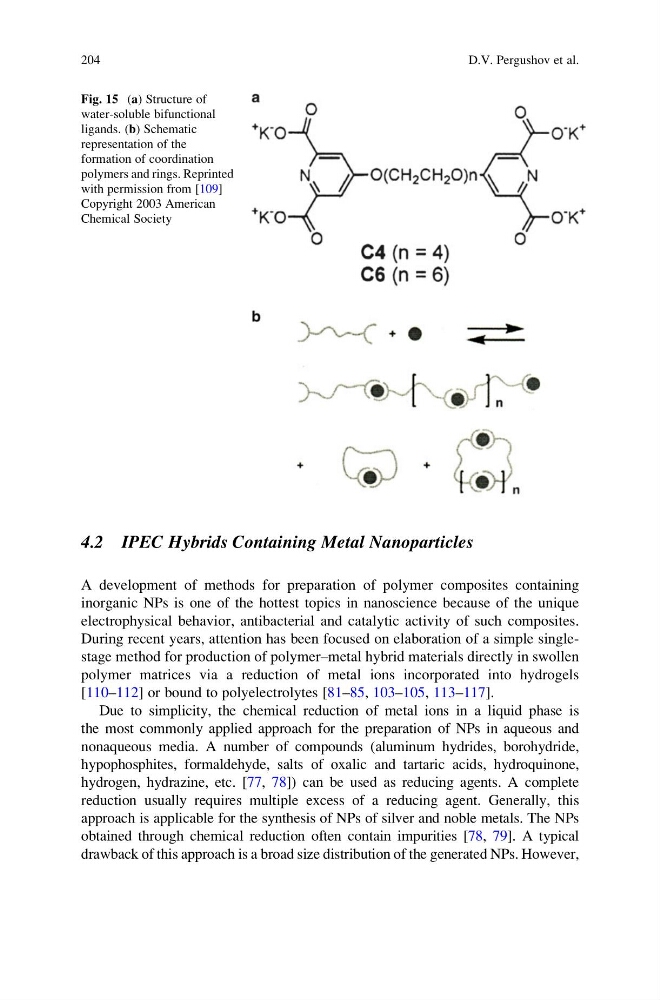
Fig. 15 (a) Structure of
water-soluble bifunctional
ligands. (b) Schematic
representation of the
formation of coordination
polymers and rings. Reprinted
with permission from [109]
Copyright 2003 American
Chemical Society
204
D.V. Pergushov et al.
A development of methods for preparation of polymer composites containing
inorganic NPs is one of the hottest topics in nanoscience because of the unique
electrophysical behavior, antibacterial and catalytic activity of such composites.
During recent years, attention has been focused on elaboration of a simple singlestage method for production of polymer–metal hybrid materials directly in swollen
polymer matrices via a reduction of metal ions incorporated into hydrogels
[110–112] or bound to polyelectrolytes [81–85, 103–105, 113–117].
Due to simplicity, the chemical reduction of metal ions in a liquid phase is
the most commonly applied approach for the preparation of NPs in aqueous and
nonaqueous media. A number of compounds (aluminum hydrides, borohydride,
hypophosphites, formaldehyde, salts of oxalic and tartaric acids, hydroquinone,
hydrogen, hydrazine, etc. [77, 78]) can be used as reducing agents. A complete
reduction usually requires multiple excess of a reducing agent. Generally, this
approach is applicable for the synthesis of NPs of silver and noble metals. The NPs
obtained through chemical reduction often contain impurities [78, 79]. A typical
drawback of this approach is a broad size distribution of the generated NPs. However,
Fig. 15 (a) Structure of
water-soluble bifunctional
ligands. (b) Schematic
representation of the
formation of coordination
polymers and rings. Reprinted
with permission from [109]
Copyright 2003 American
Chemical Society
204
D.V. Pergushov et al.