

chemical reduction in the presence of polymers may yield NPs of controlled
sizes [78, 82–85, 103–105, 115, 116]. In this context, a specific technique [97, 112,
118, 119], whereby the polymers are used both as reducing agents of metal ions and
for effective stabilization of the prepared NPs, should be mentioned.
Radiation–chemical approaches for the preparation of NPs were also found to
be exceptionally useful, both for studying the processes that underlie the formation
of NPs and for preparation of nanocomposites [81, 89, 90, 111, 114, 115, 120].
The main advantages of ionizing radiation for the preparation of NPs are control
over the formation of reducing radiolysis products and controlled changes in the
rate of reduction of metal ions in a broad interval [111, 120]. This method does
not require any specific chemicals (reducing agents), thereby leading to NPs
with high purity [78, 79, 111, 120]. Ionizing irradiation allows one to obtain NPs
with a desired average size and a narrow size distribution [111, 120]. Due to
high reduction potentials [121, 122] of radiolysis products, the radiation-induced
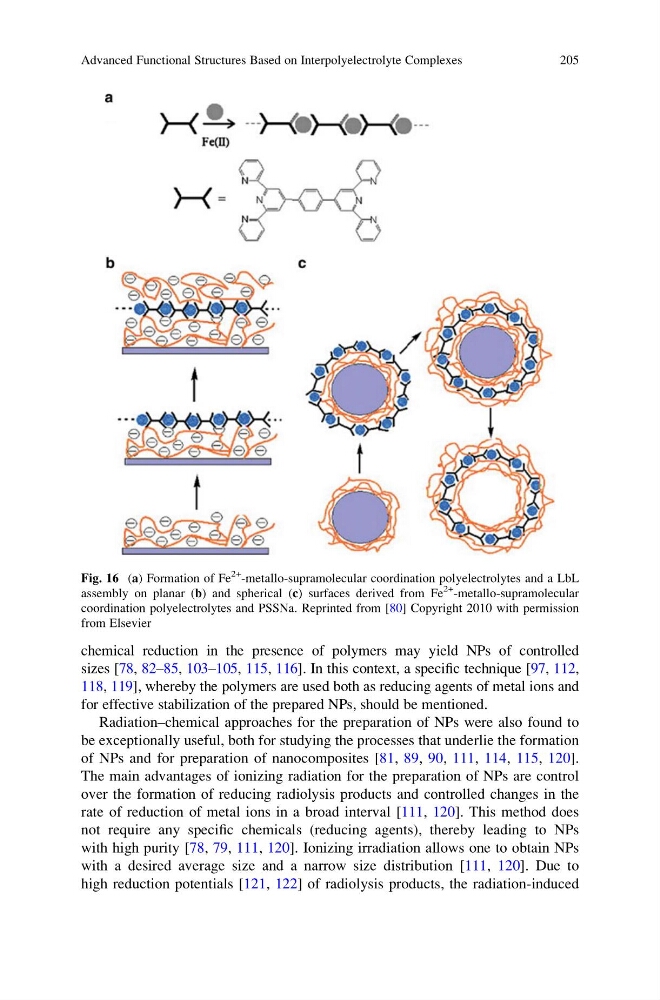
Fig. 16 (a) Formation of Fe
2+ -metallo-supramolecular coordination polyelectrolytes and a LbL
assembly on planar (b) and spherical (c) surfaces derived from Fe
2+ -metallo-supramolecular
coordination polyelectrolytes and PSSNa. Reprinted from [80] Copyright 2010 with permission
from Elsevier
Advanced Functional Structures Based on Interpolyelectrolyte Complexes
205
sizes [78, 82–85, 103–105, 115, 116]. In this context, a specific technique [97, 112,
118, 119], whereby the polymers are used both as reducing agents of metal ions and
for effective stabilization of the prepared NPs, should be mentioned.
Radiation–chemical approaches for the preparation of NPs were also found to
be exceptionally useful, both for studying the processes that underlie the formation
of NPs and for preparation of nanocomposites [81, 89, 90, 111, 114, 115, 120].
The main advantages of ionizing radiation for the preparation of NPs are control
over the formation of reducing radiolysis products and controlled changes in the
rate of reduction of metal ions in a broad interval [111, 120]. This method does
not require any specific chemicals (reducing agents), thereby leading to NPs
with high purity [78, 79, 111, 120]. Ionizing irradiation allows one to obtain NPs
with a desired average size and a narrow size distribution [111, 120]. Due to
high reduction potentials [121, 122] of radiolysis products, the radiation-induced
Fig. 16 (a) Formation of Fe
2+ -metallo-supramolecular coordination polyelectrolytes and a LbL
assembly on planar (b) and spherical (c) surfaces derived from Fe
2+ -metallo-supramolecular
coordination polyelectrolytes and PSSNa. Reprinted from [80] Copyright 2010 with permission
from Elsevier
Advanced Functional Structures Based on Interpolyelectrolyte Complexes
205