

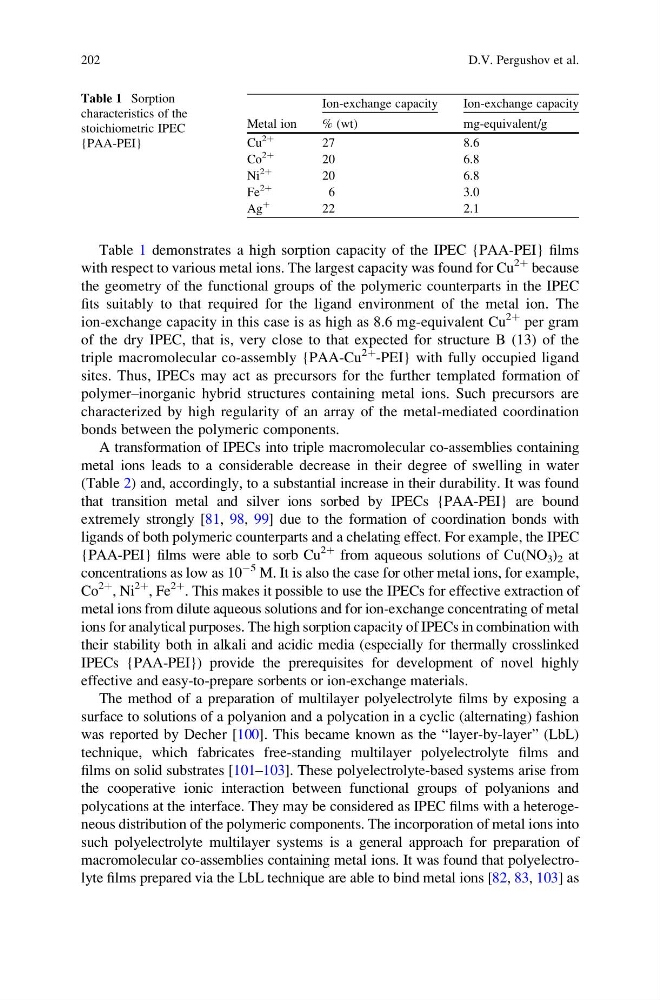
Table 1 demonstrates a high sorption capacity of the IPEC {PAA-PEI} films
with respect to various metal ions. The largest capacity was found for Cu
2þ because
the geometry of the functional groups of the polymeric counterparts in the IPEC
fits suitably to that required for the ligand environment of the metal ion. The
ion-exchange capacity in this case is as high as 8.6 mg-equivalent Cu
2þ per gram
of the dry IPEC, that is, very close to that expected for structure B (13) of the
triple macromolecular co-assembly {PAA-Cu
2þ
-PEI} with fully occupied ligand
sites. Thus, IPECs may act as precursors for the further templated formation of
polymer–inorganic hybrid structures containing metal ions. Such precursors are
characterized by high regularity of an array of the metal-mediated coordination
bonds between the polymeric components.
A transformation of IPECs into triple macromolecular co-assemblies containing
metal ions leads to a considerable decrease in their degree of swelling in water
(Table 2) and, accordingly, to a substantial increase in their durability. It was found
that transition metal and silver ions sorbed by IPECs {PAA-PEI} are bound
extremely strongly [81, 98, 99] due to the formation of coordination bonds with
ligands of both polymeric counterparts and a chelating effect. For example, the IPEC
{PAA-PEI} films were able to sorb Cu
2þ from aqueous solutions of Сu(NO 3 ) 2 at
concentrations as low as 10
À5 M. It is also the case for other metal ions, for example,
Co
2þ , Ni
2þ
, Fe
2þ . This makes it possible to use the IPECs for effective extraction of
metal ions from dilute aqueous solutions and for ion-exchange concentrating of metal
ions for analytical purposes. The high sorption capacity of IPECs in combination with
their stability both in alkali and acidic media (especially for thermally crosslinked
IPECs {PAA-PEI}) provide the prerequisites for development of novel highly
effective and easy-to-prepare sorbents or ion-exchange materials.
The method of a preparation of multilayer polyelectrolyte films by exposing a
surface to solutions of a polyanion and a polycation in a cyclic (alternating) fashion
was reported by Decher [100]. This became known as the “layer-by-layer” (LbL)
technique, which fabricates free-standing multilayer polyelectrolyte films and
films on solid substrates [101–103]. These polyelectrolyte-based systems arise from
the cooperative ionic interaction between functional groups of polyanions and
polycations at the interface. They may be considered as IPEC films with a heterogeneous distribution of the polymeric components. The incorporation of metal ions into
such polyelectrolyte multilayer systems is a general approach for preparation of
macromolecular co-assemblies containing metal ions. It was found that polyelectrolyte films prepared via the LbL technique are able to bind metal ions [82, 83, 103] as
Table 1 Sorption
characteristics of the
stoichiometric IPEC
{PAA-PEI}
Metal ion
Ion-exchange capacity
Ion-exchange capacity
% (wt)
mg-equivalent/g
Cu
2þ
27
8.6
Co
2þ
20
6.8
Ni
2þ
20
6.8
Fe
2þ
6
3.0
Ag
þ
22
2.1
202
D.V. Pergushov et al.
with respect to various metal ions. The largest capacity was found for Cu
2þ because
the geometry of the functional groups of the polymeric counterparts in the IPEC
fits suitably to that required for the ligand environment of the metal ion. The
ion-exchange capacity in this case is as high as 8.6 mg-equivalent Cu
2þ per gram
of the dry IPEC, that is, very close to that expected for structure B (13) of the
triple macromolecular co-assembly {PAA-Cu
2þ
-PEI} with fully occupied ligand
sites. Thus, IPECs may act as precursors for the further templated formation of
polymer–inorganic hybrid structures containing metal ions. Such precursors are
characterized by high regularity of an array of the metal-mediated coordination
bonds between the polymeric components.
A transformation of IPECs into triple macromolecular co-assemblies containing
metal ions leads to a considerable decrease in their degree of swelling in water
(Table 2) and, accordingly, to a substantial increase in their durability. It was found
that transition metal and silver ions sorbed by IPECs {PAA-PEI} are bound
extremely strongly [81, 98, 99] due to the formation of coordination bonds with
ligands of both polymeric counterparts and a chelating effect. For example, the IPEC
{PAA-PEI} films were able to sorb Cu
2þ from aqueous solutions of Сu(NO 3 ) 2 at
concentrations as low as 10
À5 M. It is also the case for other metal ions, for example,
Co
2þ , Ni
2þ
, Fe
2þ . This makes it possible to use the IPECs for effective extraction of
metal ions from dilute aqueous solutions and for ion-exchange concentrating of metal
ions for analytical purposes. The high sorption capacity of IPECs in combination with
their stability both in alkali and acidic media (especially for thermally crosslinked
IPECs {PAA-PEI}) provide the prerequisites for development of novel highly
effective and easy-to-prepare sorbents or ion-exchange materials.
The method of a preparation of multilayer polyelectrolyte films by exposing a
surface to solutions of a polyanion and a polycation in a cyclic (alternating) fashion
was reported by Decher [100]. This became known as the “layer-by-layer” (LbL)
technique, which fabricates free-standing multilayer polyelectrolyte films and
films on solid substrates [101–103]. These polyelectrolyte-based systems arise from
the cooperative ionic interaction between functional groups of polyanions and
polycations at the interface. They may be considered as IPEC films with a heterogeneous distribution of the polymeric components. The incorporation of metal ions into
such polyelectrolyte multilayer systems is a general approach for preparation of
macromolecular co-assemblies containing metal ions. It was found that polyelectrolyte films prepared via the LbL technique are able to bind metal ions [82, 83, 103] as
Table 1 Sorption
characteristics of the
stoichiometric IPEC
{PAA-PEI}
Metal ion
Ion-exchange capacity
Ion-exchange capacity
% (wt)
mg-equivalent/g
Cu
2þ
27
8.6
Co
2þ
20
6.8
Ni
2þ
20
6.8
Fe
2þ
6
3.0
Ag
þ
22
2.1
202
D.V. Pergushov et al.