

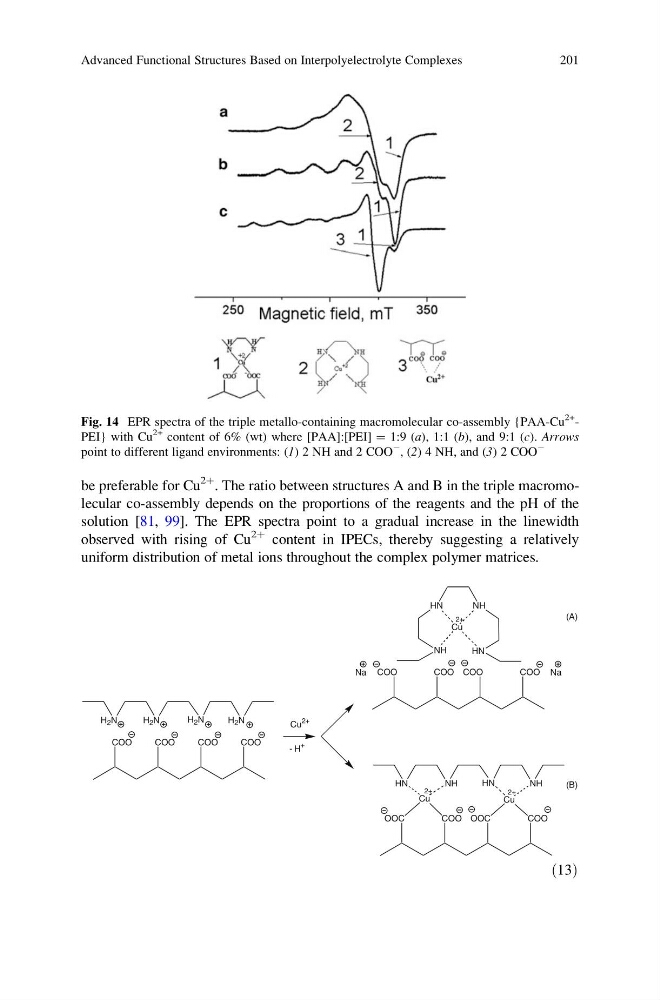
be preferable for Cu
2þ . The ratio between structures A and B in the triple macromolecular co-assembly depends on the proportions of the reagents and the pH of the
solution [81, 99]. The EPR spectra point to a gradual increase in the linewidth
observed with rising of Cu
2þ content in IPECs, thereby suggesting a relatively
uniform distribution of metal ions throughout the complex polymer matrices.
H 2 N
H 2 N
H 2 N
H 2 N
COO
COO
COO
COO
Cu
2+
Na
- H
+
HN
NH
HN
Cu
NH
COO
COO COO
COO
(A)
Na
HN
NH
HN
NH
OOC
COO OOC
COO
Cu
Cu
(B)
2+
2+
2+
ð13Þ
Fig. 14 EPR spectra of the triple metallo-containing macromolecular co-assembly {PAA-Cu
2+ -
PEI} with Cu
2+ content of 6% (wt) where [PAA]:[PEI] ¼ 1:9 (a), 1:1 (b), and 9:1 (c). Arrows
point to different ligand environments: (1) 2 NH and 2 COO
À , (2) 4 NH, and (3) 2 COO
À
Advanced Functional Structures Based on Interpolyelectrolyte Complexes
201
2þ . The ratio between structures A and B in the triple macromolecular co-assembly depends on the proportions of the reagents and the pH of the
solution [81, 99]. The EPR spectra point to a gradual increase in the linewidth
observed with rising of Cu
2þ content in IPECs, thereby suggesting a relatively
uniform distribution of metal ions throughout the complex polymer matrices.
H 2 N
H 2 N
H 2 N
H 2 N
COO
COO
COO
COO
Cu
2+
Na
- H
+
HN
NH
HN
Cu
NH
COO
COO COO
COO
(A)
Na
HN
NH
HN
NH
OOC
COO OOC
COO
Cu
Cu
(B)
2+
2+
2+
ð13Þ
Fig. 14 EPR spectra of the triple metallo-containing macromolecular co-assembly {PAA-Cu
2+ -
PEI} with Cu
2+ content of 6% (wt) where [PAA]:[PEI] ¼ 1:9 (a), 1:1 (b), and 9:1 (c). Arrows
point to different ligand environments: (1) 2 NH and 2 COO
À , (2) 4 NH, and (3) 2 COO
À
Advanced Functional Structures Based on Interpolyelectrolyte Complexes
201