

4.1 IPECs Containing Metal Ions
The high dialysis permeability of IPECs allows transport of metal ions through
the complex polymer matrix. An attractive possibility for an application of IPECs
as sorbents or ion-exchange materials has stimulated considerable interest in the
process of embedding metal ions into such macromolecular co-assemblies, distribution of metal ions throughout the complex polymer matrices, and their complexation
with functional groups on the polymeric components. The preparation of
nanocomposites in polyelectrolyte systems is another important stimulus for preparation of IPECs with a controlled content and regulated distribution of metal ions [81].
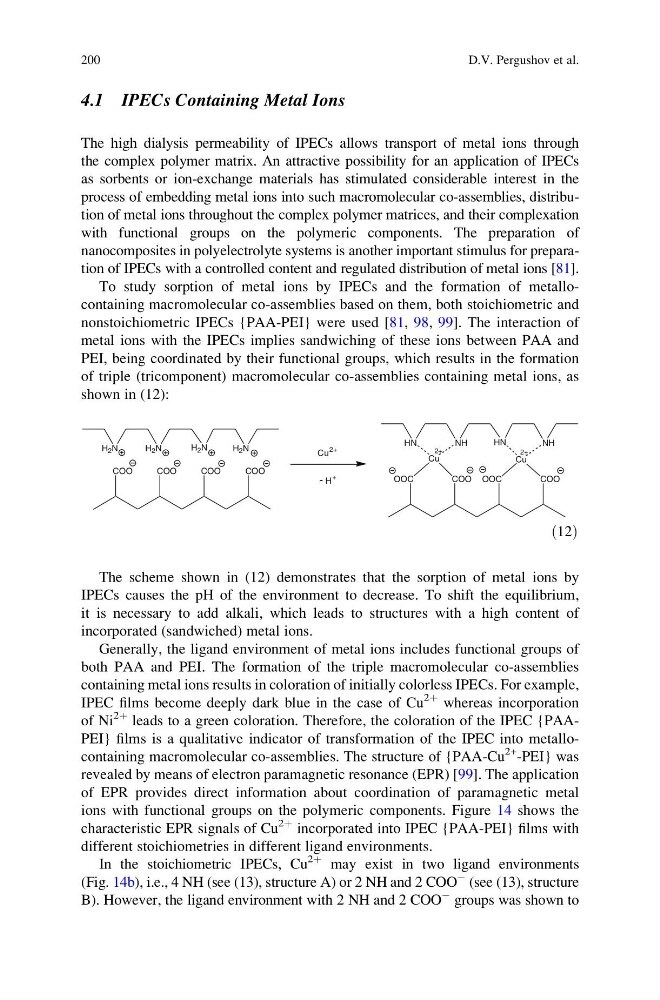
To study sorption of metal ions by IPECs and the formation of metallocontaining macromolecular co-assemblies based on them, both stoichiometric and
nonstoichiometric IPECs {PAA-PEI} were used [81, 98, 99]. The interaction of
metal ions with the IPECs implies sandwiching of these ions between PAA and
PEI, being coordinated by their functional groups, which results in the formation
of triple (tricomponent) macromolecular co-assemblies containing metal ions, as
shown in (12):
H 2 N
H 2 N
H 2 N
H 2 N
COO
COO
COO
COO
Cu
2+
- H
+
HN
NH
HN
NH
OOC
COO OOC
COO
Cu
Cu
2+
2+
ð12Þ
The scheme shown in (12) demonstrates that the sorption of metal ions by
IPECs causes the pH of the environment to decrease. To shift the equilibrium,
it is necessary to add alkali, which leads to structures with a high content of
incorporated (sandwiched) metal ions.
Generally, the ligand environment of metal ions includes functional groups of
both PAA and PEI. The formation of the triple macromolecular co-assemblies
containing metal ions results in coloration of initially colorless IPECs. For example,
IPEC films become deeply dark blue in the case of Cu
2þ whereas incorporation
of Ni
2þ leads to a green coloration. Therefore, the coloration of the IPEC {PAAPEI} films is a qualitative indicator of transformation of the IPEC into metallocontaining macromolecular co-assemblies. The structure of {PAA-Cu
2+ -PEI} was
revealed by means of electron paramagnetic resonance (EPR) [99]. The application
of EPR provides direct information about coordination of paramagnetic metal
ions with functional groups on the polymeric components. Figure 14 shows the
characteristic EPR signals of Cu
2þ incorporated into IPEC {PAA-PEI} films with
different stoichiometries in different ligand environments.
In the stoichiometric IPECs, Cu
2þ may exist in two ligand environments
(Fig. 14b), i.e., 4 NH (see (13), structure A) or 2 NH and 2 COO
À (see (13), structure
B). However, the ligand environment with 2 NH and 2 COO
À groups was shown to
200
D.V. Pergushov et al.
The high dialysis permeability of IPECs allows transport of metal ions through
the complex polymer matrix. An attractive possibility for an application of IPECs
as sorbents or ion-exchange materials has stimulated considerable interest in the
process of embedding metal ions into such macromolecular co-assemblies, distribution of metal ions throughout the complex polymer matrices, and their complexation
with functional groups on the polymeric components. The preparation of
nanocomposites in polyelectrolyte systems is another important stimulus for preparation of IPECs with a controlled content and regulated distribution of metal ions [81].
To study sorption of metal ions by IPECs and the formation of metallocontaining macromolecular co-assemblies based on them, both stoichiometric and
nonstoichiometric IPECs {PAA-PEI} were used [81, 98, 99]. The interaction of
metal ions with the IPECs implies sandwiching of these ions between PAA and
PEI, being coordinated by their functional groups, which results in the formation
of triple (tricomponent) macromolecular co-assemblies containing metal ions, as
shown in (12):
H 2 N
H 2 N
H 2 N
H 2 N
COO
COO
COO
COO
Cu
2+
- H
+
HN
NH
HN
NH
OOC
COO OOC
COO
Cu
Cu
2+
2+
ð12Þ
The scheme shown in (12) demonstrates that the sorption of metal ions by
IPECs causes the pH of the environment to decrease. To shift the equilibrium,
it is necessary to add alkali, which leads to structures with a high content of
incorporated (sandwiched) metal ions.
Generally, the ligand environment of metal ions includes functional groups of
both PAA and PEI. The formation of the triple macromolecular co-assemblies
containing metal ions results in coloration of initially colorless IPECs. For example,
IPEC films become deeply dark blue in the case of Cu
2þ whereas incorporation
of Ni
2þ leads to a green coloration. Therefore, the coloration of the IPEC {PAAPEI} films is a qualitative indicator of transformation of the IPEC into metallocontaining macromolecular co-assemblies. The structure of {PAA-Cu
2+ -PEI} was
revealed by means of electron paramagnetic resonance (EPR) [99]. The application
of EPR provides direct information about coordination of paramagnetic metal
ions with functional groups on the polymeric components. Figure 14 shows the
characteristic EPR signals of Cu
2þ incorporated into IPEC {PAA-PEI} films with
different stoichiometries in different ligand environments.
In the stoichiometric IPECs, Cu
2þ may exist in two ligand environments
(Fig. 14b), i.e., 4 NH (see (13), structure A) or 2 NH and 2 COO
À (see (13), structure
B). However, the ligand environment with 2 NH and 2 COO
À groups was shown to
200
D.V. Pergushov et al.