

IPEC 1 HPE 1 ÀGPE
f
gþ HPE 2 ! IPEC 2 HPE 2 ÀGPE
f
gþ HPE 1
(9)
Such reactions are described in terms similar to those that have been applied for
consideration of polyion exchange reactions (6). A reaction with a participation of
water-soluble nonstoichiometric IPECs comprising fluorescently labeled PMA
À
anions as HPE* and P4VPQ
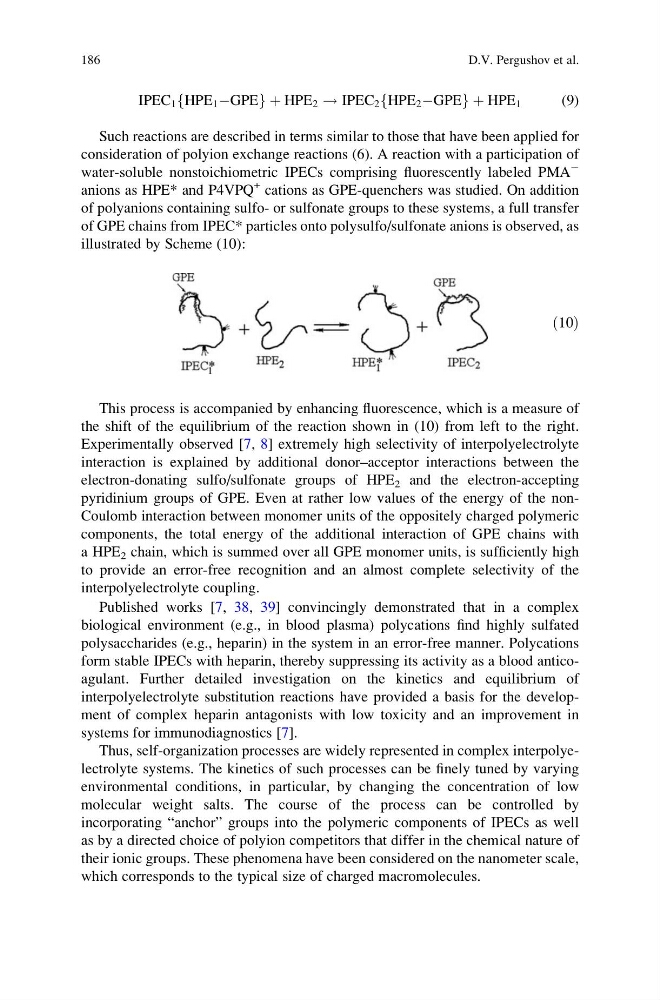
+ cations as GPE-quenchers was studied. On addition
of polyanions containing sulfo- or sulfonate groups to these systems, a full transfer
of GPE chains from IPEC* particles onto polysulfo/sulfonate anions is observed, as
illustrated by Scheme (10):
ð10Þ
This process is accompanied by enhancing fluorescence, which is a measure of
the shift of the equilibrium of the reaction shown in (10) from left to the right.
Experimentally observed [7, 8] extremely high selectivity of interpolyelectrolyte
interaction is explained by additional donor–acceptor interactions between the
electron-donating sulfo/sulfonate groups of HPE 2 and the electron-accepting
pyridinium groups of GPE. Even at rather low values of the energy of the nonCoulomb interaction between monomer units of the oppositely charged polymeric
components, the total energy of the additional interaction of GPE chains with
a HPE 2 chain, which is summed over all GPE monomer units, is sufficiently high
to provide an error-free recognition and an almost complete selectivity of the
interpolyelectrolyte coupling.
Published works [7, 38, 39] convincingly demonstrated that in a complex
biological environment (e.g., in blood plasma) polycations find highly sulfated
polysaccharides (e.g., heparin) in the system in an error-free manner. Polycations
form stable IPECs with heparin, thereby suppressing its activity as a blood anticoagulant. Further detailed investigation on the kinetics and equilibrium of
interpolyelectrolyte substitution reactions have provided a basis for the development of complex heparin antagonists with low toxicity and an improvement in
systems for immunodiagnostics [7].
Thus, self-organization processes are widely represented in complex interpolyelectrolyte systems. The kinetics of such processes can be finely tuned by varying
environmental conditions, in particular, by changing the concentration of low
molecular weight salts. The course of the process can be controlled by
incorporating “anchor” groups into the polymeric components of IPECs as well
as by a directed choice of polyion competitors that differ in the chemical nature of
their ionic groups. These phenomena have been considered on the nanometer scale,
which corresponds to the typical size of charged macromolecules.
186
D.V. Pergushov et al.
f
gþ HPE 2 ! IPEC 2 HPE 2 ÀGPE
f
gþ HPE 1
(9)
Such reactions are described in terms similar to those that have been applied for
consideration of polyion exchange reactions (6). A reaction with a participation of
water-soluble nonstoichiometric IPECs comprising fluorescently labeled PMA
À
anions as HPE* and P4VPQ
+ cations as GPE-quenchers was studied. On addition
of polyanions containing sulfo- or sulfonate groups to these systems, a full transfer
of GPE chains from IPEC* particles onto polysulfo/sulfonate anions is observed, as
illustrated by Scheme (10):
ð10Þ
This process is accompanied by enhancing fluorescence, which is a measure of
the shift of the equilibrium of the reaction shown in (10) from left to the right.
Experimentally observed [7, 8] extremely high selectivity of interpolyelectrolyte
interaction is explained by additional donor–acceptor interactions between the
electron-donating sulfo/sulfonate groups of HPE 2 and the electron-accepting
pyridinium groups of GPE. Even at rather low values of the energy of the nonCoulomb interaction between monomer units of the oppositely charged polymeric
components, the total energy of the additional interaction of GPE chains with
a HPE 2 chain, which is summed over all GPE monomer units, is sufficiently high
to provide an error-free recognition and an almost complete selectivity of the
interpolyelectrolyte coupling.
Published works [7, 38, 39] convincingly demonstrated that in a complex
biological environment (e.g., in blood plasma) polycations find highly sulfated
polysaccharides (e.g., heparin) in the system in an error-free manner. Polycations
form stable IPECs with heparin, thereby suppressing its activity as a blood anticoagulant. Further detailed investigation on the kinetics and equilibrium of
interpolyelectrolyte substitution reactions have provided a basis for the development of complex heparin antagonists with low toxicity and an improvement in
systems for immunodiagnostics [7].
Thus, self-organization processes are widely represented in complex interpolyelectrolyte systems. The kinetics of such processes can be finely tuned by varying
environmental conditions, in particular, by changing the concentration of low
molecular weight salts. The course of the process can be controlled by
incorporating “anchor” groups into the polymeric components of IPECs as well
as by a directed choice of polyion competitors that differ in the chemical nature of
their ionic groups. These phenomena have been considered on the nanometer scale,
which corresponds to the typical size of charged macromolecules.
186
D.V. Pergushov et al.