

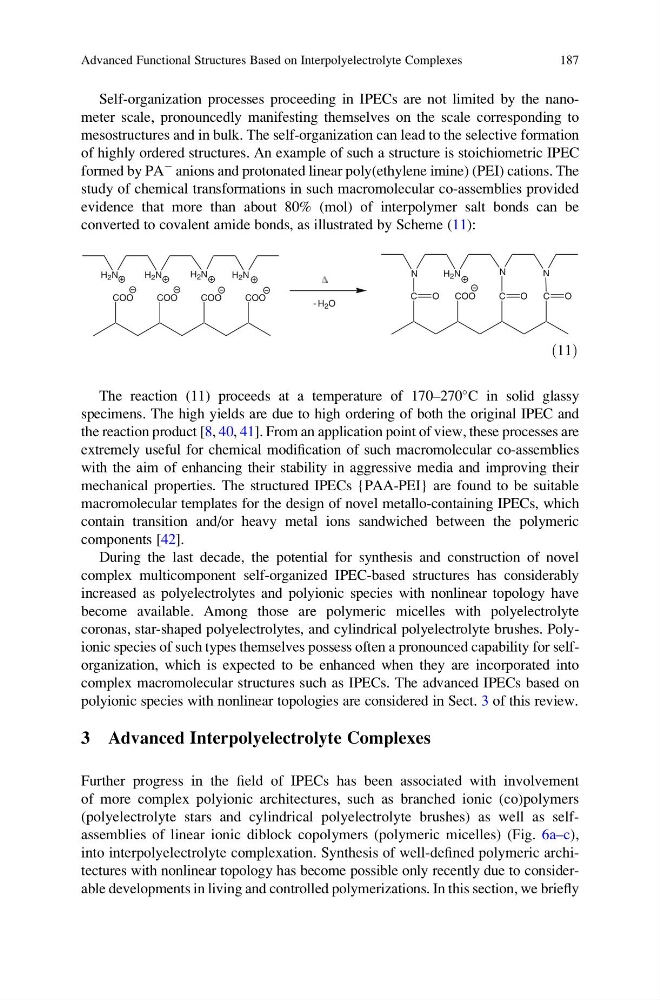
Self-organization processes proceeding in IPECs are not limited by the nanometer scale, pronouncedly manifesting themselves on the scale corresponding to
mesostructures and in bulk. The self-organization can lead to the selective formation
of highly ordered structures. An example of such a structure is stoichiometric IPEC
formed by PA
À anions and protonated linear poly(ethylene imine) (PEI) cations. The
study of chemical transformations in such macromolecular co-assemblies provided
evidence that more than about 80% (mol) of interpolymer salt bonds can be
converted to covalent amide bonds, as illustrated by Scheme (11):
H 2 N
H 2 N
H 2 N
H 2 N
COO
COO
COO
COO
- H 2 O
N
H 2 N
N
N
C
C O O
C
C
O
O
O
ð11Þ
The reaction (11) proceeds at a temperature of 170–270
C in solid glassy
specimens. The high yields are due to high ordering of both the original IPEC and
the reaction product [8, 40, 41]. From an application point of view, these processes are
extremely useful for chemical modification of such macromolecular co-assemblies
with the aim of enhancing their stability in aggressive media and improving their
mechanical properties. The structured IPECs {PAA-PEI} are found to be suitable
macromolecular templates for the design of novel metallo-containing IPECs, which
contain transition and/or heavy metal ions sandwiched between the polymeric
components [42].
During the last decade, the potential for synthesis and construction of novel
complex multicomponent self-organized IPEC-based structures has considerably
increased as polyelectrolytes and polyionic species with nonlinear topology have
become available. Among those are polymeric micelles with polyelectrolyte
coronas, star-shaped polyelectrolytes, and cylindrical polyelectrolyte brushes. Polyionic species of such types themselves possess often a pronounced capability for selforganization, which is expected to be enhanced when they are incorporated into
complex macromolecular structures such as IPECs. The advanced IPECs based on
polyionic species with nonlinear topologies are considered in Sect. 3 of this review.
3 Advanced Interpolyelectrolyte Complexes
Further progress in the field of IPECs has been associated with involvement
of more complex polyionic architectures, such as branched ionic (co)polymers
(polyelectrolyte stars and cylindrical polyelectrolyte brushes) as well as selfassemblies of linear ionic diblock copolymers (polymeric micelles) (Fig. 6a–c),
into interpolyelectrolyte complexation. Synthesis of well-defined polymeric architectures with nonlinear topology has become possible only recently due to considerable developments in living and controlled polymerizations. In this section, we briefly
Advanced Functional Structures Based on Interpolyelectrolyte Complexes
187
mesostructures and in bulk. The self-organization can lead to the selective formation
of highly ordered structures. An example of such a structure is stoichiometric IPEC
formed by PA
À anions and protonated linear poly(ethylene imine) (PEI) cations. The
study of chemical transformations in such macromolecular co-assemblies provided
evidence that more than about 80% (mol) of interpolymer salt bonds can be
converted to covalent amide bonds, as illustrated by Scheme (11):
H 2 N
H 2 N
H 2 N
H 2 N
COO
COO
COO
COO
- H 2 O
N
H 2 N
N
N
C
C O O
C
C
O
O
O
ð11Þ
The reaction (11) proceeds at a temperature of 170–270
C in solid glassy
specimens. The high yields are due to high ordering of both the original IPEC and
the reaction product [8, 40, 41]. From an application point of view, these processes are
extremely useful for chemical modification of such macromolecular co-assemblies
with the aim of enhancing their stability in aggressive media and improving their
mechanical properties. The structured IPECs {PAA-PEI} are found to be suitable
macromolecular templates for the design of novel metallo-containing IPECs, which
contain transition and/or heavy metal ions sandwiched between the polymeric
components [42].
During the last decade, the potential for synthesis and construction of novel
complex multicomponent self-organized IPEC-based structures has considerably
increased as polyelectrolytes and polyionic species with nonlinear topology have
become available. Among those are polymeric micelles with polyelectrolyte
coronas, star-shaped polyelectrolytes, and cylindrical polyelectrolyte brushes. Polyionic species of such types themselves possess often a pronounced capability for selforganization, which is expected to be enhanced when they are incorporated into
complex macromolecular structures such as IPECs. The advanced IPECs based on
polyionic species with nonlinear topologies are considered in Sect. 3 of this review.
3 Advanced Interpolyelectrolyte Complexes
Further progress in the field of IPECs has been associated with involvement
of more complex polyionic architectures, such as branched ionic (co)polymers
(polyelectrolyte stars and cylindrical polyelectrolyte brushes) as well as selfassemblies of linear ionic diblock copolymers (polymeric micelles) (Fig. 6a–c),
into interpolyelectrolyte complexation. Synthesis of well-defined polymeric architectures with nonlinear topology has become possible only recently due to considerable developments in living and controlled polymerizations. In this section, we briefly
Advanced Functional Structures Based on Interpolyelectrolyte Complexes
187