

Z lim , turbidity appears and then linearly increases with increasing Z (in the range
Z lim < Z < 1). This is schematically illustrated by the turbidimetric titration curves
given in Fig. 4.
These results undoubtedly point to the formation of a water-soluble nostoichiometric IPEC at low Z-values (Z < Z lim ), followed by the formation and the
subsequent concentration of an insoluble stoichiometric IPEC at Z > Z lim . This
completely corresponds to the transformations of IPECs, which are described
above (Fig. 3).
2.3 Polyion Transfer in IPEC Systems
The dynamic properties of IPECs have been considered in more detail by Kabanov
and colleagues [7, 8, 35], who reported on the kinetics of interpolyelectrolyte
exchange reactions. These reactions comprise a transfer of GPEs from some
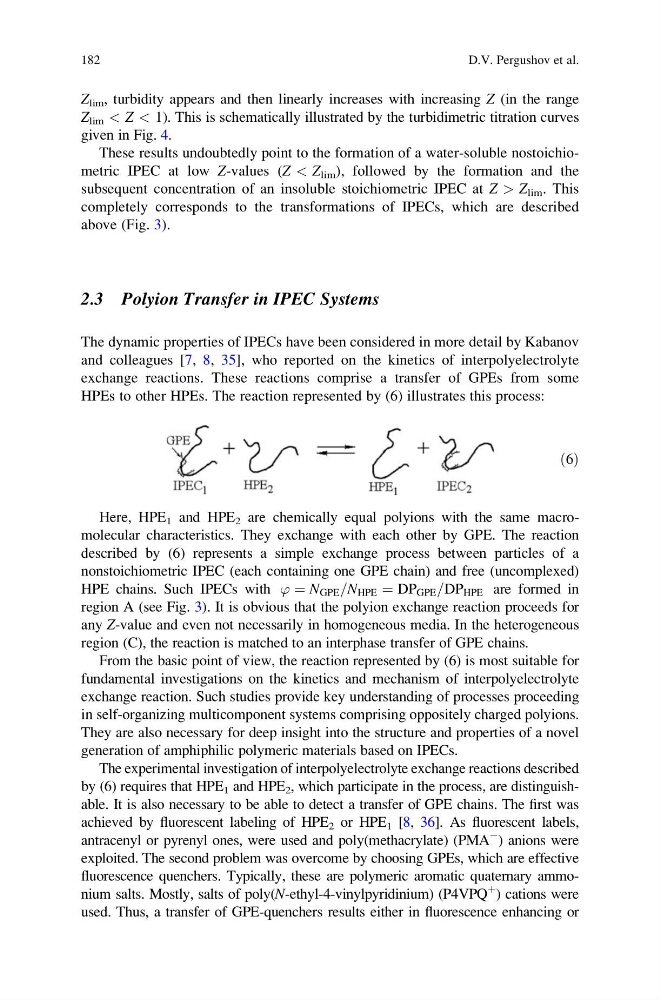
HPEs to other HPEs. The reaction represented by (6) illustrates this process:
ð6Þ
Here, HPE 1 and HPE 2 are chemically equal polyions with the same macromolecular characteristics. They exchange with each other by GPE. The reaction
described by (6) represents a simple exchange process between particles of a
nonstoichiometric IPEC (each containing one GPE chain) and free (uncomplexed)
HPE chains. Such IPECs with ’ ¼ N GPE =N HPE ¼ DP GPE =DP HPE are formed in
region A (see Fig. 3). It is obvious that the polyion exchange reaction proceeds for
any Z-value and even not necessarily in homogeneous media. In the heterogeneous
region (C), the reaction is matched to an interphase transfer of GPE chains.
From the basic point of view, the reaction represented by (6) is most suitable for
fundamental investigations on the kinetics and mechanism of interpolyelectrolyte
exchange reaction. Such studies provide key understanding of processes proceeding
in self-organizing multicomponent systems comprising oppositely charged polyions.
They are also necessary for deep insight into the structure and properties of a novel
generation of amphiphilic polymeric materials based on IPECs.
The experimental investigation of interpolyelectrolyte exchange reactions described
by (6) requires that HPE 1 and HPE 2 , which participate in the process, are distinguishable. It is also necessary to be able to detect a transfer of GPE chains. The first was
achieved by fluorescent labeling of HPE 2 or HPE 1 [8, 36]. As fluorescent labels,
antracenyl or pyrenyl ones, were used and poly(methacrylate) (PMA
À ) anions were
exploited. The second problem was overcome by choosing GPEs, which are effective
fluorescence quenchers. Typically, these are polymeric aromatic quaternary ammonium salts. Mostly, salts of poly(N-ethyl-4-vinylpyridinium) (P4VPQ
þ
) cations were
used. Thus, a transfer of GPE-quenchers results either in fluorescence enhancing or
182
D.V. Pergushov et al.
Z lim < Z < 1). This is schematically illustrated by the turbidimetric titration curves
given in Fig. 4.
These results undoubtedly point to the formation of a water-soluble nostoichiometric IPEC at low Z-values (Z < Z lim ), followed by the formation and the
subsequent concentration of an insoluble stoichiometric IPEC at Z > Z lim . This
completely corresponds to the transformations of IPECs, which are described
above (Fig. 3).
2.3 Polyion Transfer in IPEC Systems
The dynamic properties of IPECs have been considered in more detail by Kabanov
and colleagues [7, 8, 35], who reported on the kinetics of interpolyelectrolyte
exchange reactions. These reactions comprise a transfer of GPEs from some
HPEs to other HPEs. The reaction represented by (6) illustrates this process:
ð6Þ
Here, HPE 1 and HPE 2 are chemically equal polyions with the same macromolecular characteristics. They exchange with each other by GPE. The reaction
described by (6) represents a simple exchange process between particles of a
nonstoichiometric IPEC (each containing one GPE chain) and free (uncomplexed)
HPE chains. Such IPECs with ’ ¼ N GPE =N HPE ¼ DP GPE =DP HPE are formed in
region A (see Fig. 3). It is obvious that the polyion exchange reaction proceeds for
any Z-value and even not necessarily in homogeneous media. In the heterogeneous
region (C), the reaction is matched to an interphase transfer of GPE chains.
From the basic point of view, the reaction represented by (6) is most suitable for
fundamental investigations on the kinetics and mechanism of interpolyelectrolyte
exchange reaction. Such studies provide key understanding of processes proceeding
in self-organizing multicomponent systems comprising oppositely charged polyions.
They are also necessary for deep insight into the structure and properties of a novel
generation of amphiphilic polymeric materials based on IPECs.
The experimental investigation of interpolyelectrolyte exchange reactions described
by (6) requires that HPE 1 and HPE 2 , which participate in the process, are distinguishable. It is also necessary to be able to detect a transfer of GPE chains. The first was
achieved by fluorescent labeling of HPE 2 or HPE 1 [8, 36]. As fluorescent labels,
antracenyl or pyrenyl ones, were used and poly(methacrylate) (PMA
À ) anions were
exploited. The second problem was overcome by choosing GPEs, which are effective
fluorescence quenchers. Typically, these are polymeric aromatic quaternary ammonium salts. Mostly, salts of poly(N-ethyl-4-vinylpyridinium) (P4VPQ
þ
) cations were
used. Thus, a transfer of GPE-quenchers results either in fluorescence enhancing or
182
D.V. Pergushov et al.