

Addition of low molecular weight salts into mixtures of oppositely charged
polyelectrolytes has a pronounced influence on the behavior of water-soluble
nonstoichiometric IPECs. In particular, this manifests itself in a shift of the boundary
between the regions A and B, that is, Z cr , to lower values. The low molecular weight
salts induce conformational transformations of particles of nonstoichiometric IPECs,
(i.e., a coil–globule transition) followed by phase separation of the solution and
macroscopic precipitation of a stoichiometric IPEC [31, 34].
The above phenomena, which are to be investigated for understanding of selforganization in multicomponent systems containing oppositely charged polyions,
imply that IPEC species can exchange their polymeric components with each
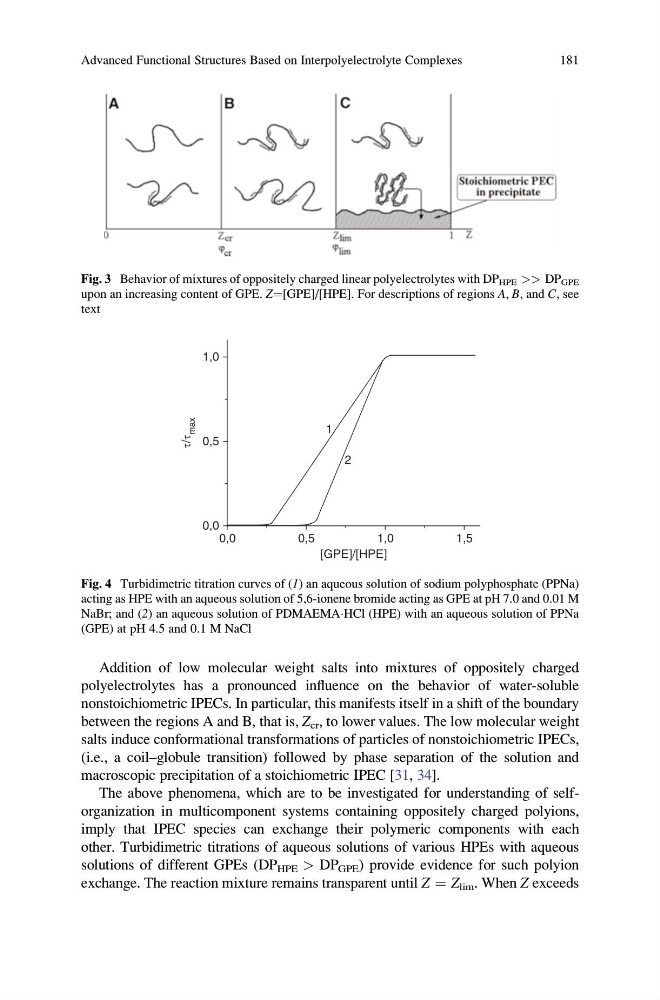
other. Turbidimetric titrations of aqueous solutions of various HPEs with aqueous
solutions of different GPEs (DP HPE > DP GPE ) provide evidence for such polyion
exchange. The reaction mixture remains transparent until Z ¼ Z lim . When Z exceeds
0,0
0,5
1,0
1,5
0,0
0,5
1,0
2
1
τ/τ
max
[GPE]/[HPE]
Fig. 4 Turbidimetric titration curves of (1) an aqueous solution of sodium polyphosphate (PPNa)
acting as HPE with an aqueous solution of 5,6-ionene bromide acting as GPE at pH 7.0 and 0.01 M
NaBr; and (2) an aqueous solution of PDMAEMAÁHCl (HPE) with an aqueous solution of PPNa
(GPE) at pH 4.5 and 0.1 M NaCl
Fig. 3 Behavior of mixtures of oppositely charged linear polyelectrolytes with DP HPE >> DP GPE
upon an increasing content of GPE. Z¼[GPE]/[HPE]. For descriptions of regions A, B, and C, see
text
Advanced Functional Structures Based on Interpolyelectrolyte Complexes
181
polyelectrolytes has a pronounced influence on the behavior of water-soluble
nonstoichiometric IPECs. In particular, this manifests itself in a shift of the boundary
between the regions A and B, that is, Z cr , to lower values. The low molecular weight
salts induce conformational transformations of particles of nonstoichiometric IPECs,
(i.e., a coil–globule transition) followed by phase separation of the solution and
macroscopic precipitation of a stoichiometric IPEC [31, 34].
The above phenomena, which are to be investigated for understanding of selforganization in multicomponent systems containing oppositely charged polyions,
imply that IPEC species can exchange their polymeric components with each
other. Turbidimetric titrations of aqueous solutions of various HPEs with aqueous
solutions of different GPEs (DP HPE > DP GPE ) provide evidence for such polyion
exchange. The reaction mixture remains transparent until Z ¼ Z lim . When Z exceeds
0,0
0,5
1,0
1,5
0,0
0,5
1,0
2
1
τ/τ
max
[GPE]/[HPE]
Fig. 4 Turbidimetric titration curves of (1) an aqueous solution of sodium polyphosphate (PPNa)
acting as HPE with an aqueous solution of 5,6-ionene bromide acting as GPE at pH 7.0 and 0.01 M
NaBr; and (2) an aqueous solution of PDMAEMAÁHCl (HPE) with an aqueous solution of PPNa
(GPE) at pH 4.5 and 0.1 M NaCl
Fig. 3 Behavior of mixtures of oppositely charged linear polyelectrolytes with DP HPE >> DP GPE
upon an increasing content of GPE. Z¼[GPE]/[HPE]. For descriptions of regions A, B, and C, see
text
Advanced Functional Structures Based on Interpolyelectrolyte Complexes
181