

fluorescence quenching in the system, depending on which HPE (i.e., HPE 2 or HPE 1 )
is fluorescently labeled.
The kinetics of a single chain transfer, which is represented by (6), was studied
more completely. In the simplest case, equal amounts of IPEC species, each
containing only one HPE chain and one GPE chain, and free fluorescently labeled
HPE (HPE*) are taken so that [HPE] ¼ [HPE*]. Conversion (q) of the transfer was
defined as the fraction of HPE* chains complexed with GPE chains. It was found
that the kinetics of the transfer are well described in terms of a second-order
reaction with respect to the concentrations of macromolecular reagents, i.e., IPEC
{HPE-GPE} and HPE*. Accordingly, experimentally obtained kinetic curves were
fitted as linear functions using Eq. (7):
q
1 À q
¼ k 2 Â HPE
Ã
½
0 t:
(7)
Here, k 2 is the rate constant for the transfer of a GPE chain from one HPE
chain onto another, [HPE*] 0 ¼ [HPE] 0 is the initial basemolar concentration of
the reacting species in the system, and t is time. It turned out that the measured
values of k 2 are three to five orders of magnitude less than the calculated values
for the rate constant, which is determined by diffusion-driven collisions [36]. This
finding implies that indeed only one transfer of a GPE chain from an IPEC onto a
HPE* chain takes place per 10
3 –10
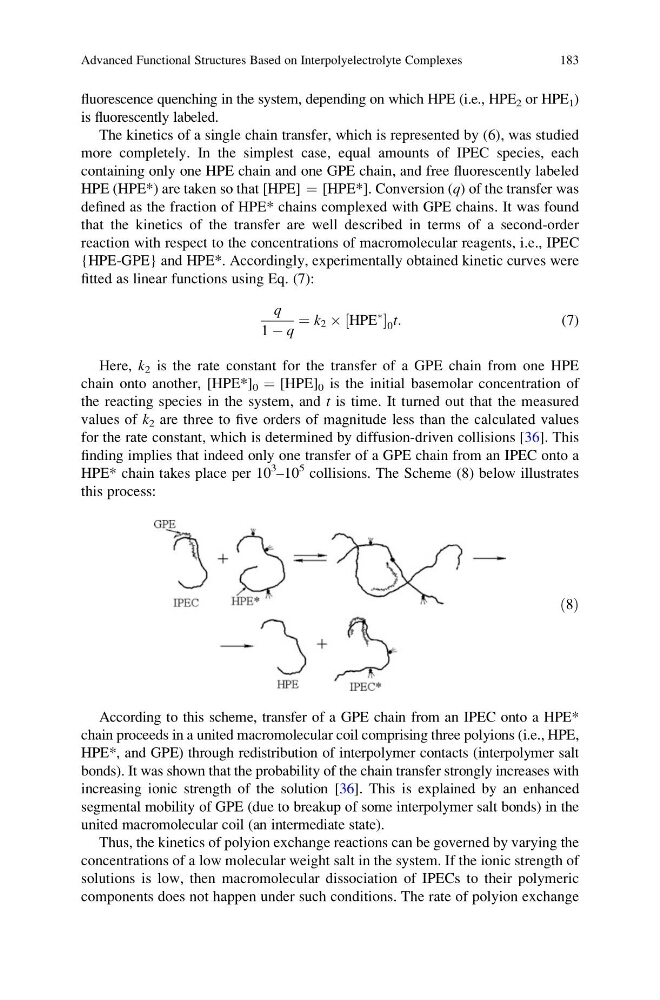
5 collisions. The Scheme (8) below illustrates
this process:
ð8Þ
According to this scheme, transfer of a GPE chain from an IPEC onto a HPE*
chain proceeds in a united macromolecular coil comprising three polyions (i.e., HPE,
HPE*, and GPE) through redistribution of interpolymer contacts (interpolymer salt
bonds). It was shown that the probability of the chain transfer strongly increases with
increasing ionic strength of the solution [36]. This is explained by an enhanced
segmental mobility of GPE (due to breakup of some interpolymer salt bonds) in the
united macromolecular coil (an intermediate state).
Thus, the kinetics of polyion exchange reactions can be governed by varying the
concentrations of a low molecular weight salt in the system. If the ionic strength of
solutions is low, then macromolecular dissociation of IPECs to their polymeric
components does not happen under such conditions. The rate of polyion exchange
Advanced Functional Structures Based on Interpolyelectrolyte Complexes
183
is fluorescently labeled.
The kinetics of a single chain transfer, which is represented by (6), was studied
more completely. In the simplest case, equal amounts of IPEC species, each
containing only one HPE chain and one GPE chain, and free fluorescently labeled
HPE (HPE*) are taken so that [HPE] ¼ [HPE*]. Conversion (q) of the transfer was
defined as the fraction of HPE* chains complexed with GPE chains. It was found
that the kinetics of the transfer are well described in terms of a second-order
reaction with respect to the concentrations of macromolecular reagents, i.e., IPEC
{HPE-GPE} and HPE*. Accordingly, experimentally obtained kinetic curves were
fitted as linear functions using Eq. (7):
q
1 À q
¼ k 2 Â HPE
Ã
½
0 t:
(7)
Here, k 2 is the rate constant for the transfer of a GPE chain from one HPE
chain onto another, [HPE*] 0 ¼ [HPE] 0 is the initial basemolar concentration of
the reacting species in the system, and t is time. It turned out that the measured
values of k 2 are three to five orders of magnitude less than the calculated values
for the rate constant, which is determined by diffusion-driven collisions [36]. This
finding implies that indeed only one transfer of a GPE chain from an IPEC onto a
HPE* chain takes place per 10
3 –10
5 collisions. The Scheme (8) below illustrates
this process:
ð8Þ
According to this scheme, transfer of a GPE chain from an IPEC onto a HPE*
chain proceeds in a united macromolecular coil comprising three polyions (i.e., HPE,
HPE*, and GPE) through redistribution of interpolymer contacts (interpolymer salt
bonds). It was shown that the probability of the chain transfer strongly increases with
increasing ionic strength of the solution [36]. This is explained by an enhanced
segmental mobility of GPE (due to breakup of some interpolymer salt bonds) in the
united macromolecular coil (an intermediate state).
Thus, the kinetics of polyion exchange reactions can be governed by varying the
concentrations of a low molecular weight salt in the system. If the ionic strength of
solutions is low, then macromolecular dissociation of IPECs to their polymeric
components does not happen under such conditions. The rate of polyion exchange
Advanced Functional Structures Based on Interpolyelectrolyte Complexes
183