

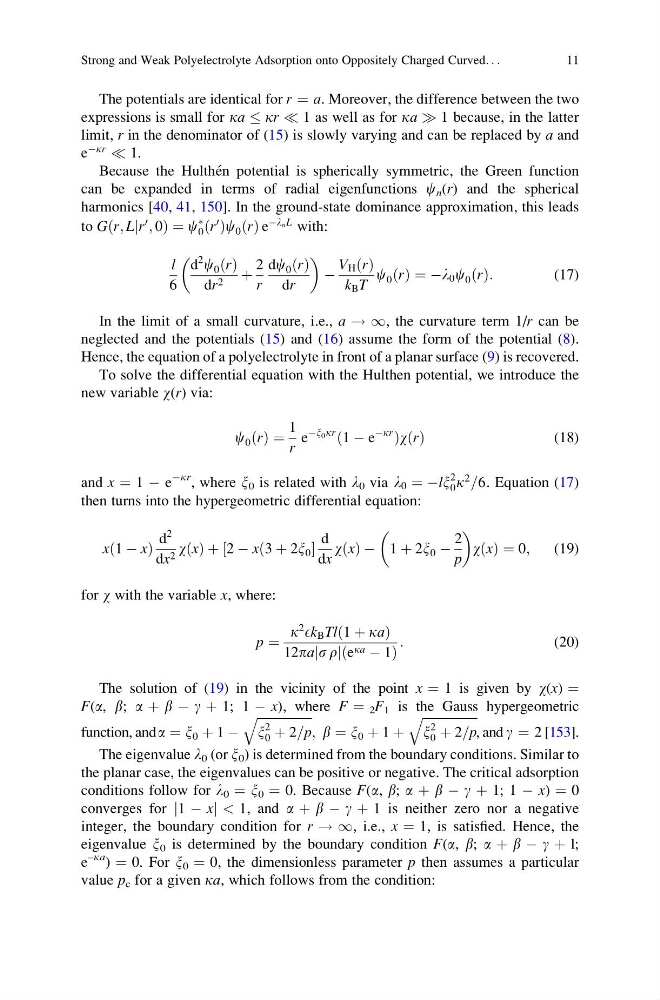
The potentials are identical for r ¼ a. Moreover, the difference between the two
expressions is small for ka kr ( 1 as well as for ka ) 1 because, in the latter
limit, r in the denominator of (15) is slowly varying and can be replaced by a and
e
Àkr
( 1.
Because the Hulthe ´n potential is spherically symmetric, the Green function
can be expanded in terms of radial eigenfunctions c n (r) and the spherical
harmonics [40, 41, 150]. In the ground-state dominance approximation, this leads
to Gðr; Ljr
0
; 0Þ ¼ c
Ã
0 ðr
0
Þc 0 ðrÞ e
Àl n L with:
l
6
d
2 c 0 ðrÞ
dr 2 þ
2
r
dc 0 ðrÞ
dr
À
V H ðrÞ
k B T
c 0 ðrÞ ¼ Àl 0 c 0 ðrÞ:
(17)
In the limit of a small curvature, i.e., a ! 1, the curvature term 1/r can be
neglected and the potentials (15) and (16) assume the form of the potential (8).
Hence, the equation of a polyelectrolyte in front of a planar surface (9) is recovered.
To solve the differential equation with the Hulthen potential, we introduce the
new variable w(r) via:
c 0 ðrÞ ¼
1
r
e
Àx 0 kr
ð1 À e
Àkr
ÞwðrÞ
(18)
and x ¼ 1 À e
Àkr , where x 0 is related with l 0 via l 0 ¼ Àlx
2
0 k
2
=6. Equation (17)
then turns into the hypergeometric differential equation:
xð1 À xÞ
d
2
dx 2 wðxÞ þ ½2 À xð3 þ 2x 0
d
dx
wðxÞ À 1 þ 2x 0 À
2
p
wðxÞ ¼ 0;
(19)
for w with the variable x, where:
p ¼
k
2 Ek B Tlð1 þ kaÞ
12pajs rjðe ka À 1Þ
:
(20)
The solution of (19) in the vicinity of the point x ¼ 1 is given by w(x) ¼
F(a, b; a þ b À g þ 1; 1 À x), where F ¼ 2 F 1 is the Gauss hypergeometric
function, and a ¼ x 0 þ 1 À
ffiffiffiffiffiffiffiffiffiffiffiffiffiffiffiffiffi ffi
x
2
0 þ 2=p
q
; b ¼ x 0 þ 1 þ
ffiffiffiffiffiffiffiffiffiffiffiffiffiffiffiffiffi ffi
x
2
0 þ 2=p
q
, and g ¼ 2 [153].
The eigenvalue l 0 (or x 0 ) is determined from the boundary conditions. Similar to
the planar case, the eigenvalues can be positive or negative. The critical adsorption
conditions follow for l 0 ¼ x 0 ¼ 0. Because F(a, b; a þ b À g þ 1; 1 À x) ¼ 0
converges for j1 À xj < 1, and a þ b À g þ 1 is neither zero nor a negative
integer, the boundary condition for r ! 1, i.e., x ¼ 1, is satisfied. Hence, the
eigenvalue x 0 is determined by the boundary condition F(a, b; a þ b À g þ l;
e
–ka ) ¼ 0. For x 0 ¼ 0, the dimensionless parameter p then assumes a particular
value p c for a given ka, which follows from the condition:
Strong and Weak Polyelectrolyte Adsorption onto Oppositely Charged Curved. . .
11
expressions is small for ka kr ( 1 as well as for ka ) 1 because, in the latter
limit, r in the denominator of (15) is slowly varying and can be replaced by a and
e
Àkr
( 1.
Because the Hulthe ´n potential is spherically symmetric, the Green function
can be expanded in terms of radial eigenfunctions c n (r) and the spherical
harmonics [40, 41, 150]. In the ground-state dominance approximation, this leads
to Gðr; Ljr
0
; 0Þ ¼ c
Ã
0 ðr
0
Þc 0 ðrÞ e
Àl n L with:
l
6
d
2 c 0 ðrÞ
dr 2 þ
2
r
dc 0 ðrÞ
dr
À
V H ðrÞ
k B T
c 0 ðrÞ ¼ Àl 0 c 0 ðrÞ:
(17)
In the limit of a small curvature, i.e., a ! 1, the curvature term 1/r can be
neglected and the potentials (15) and (16) assume the form of the potential (8).
Hence, the equation of a polyelectrolyte in front of a planar surface (9) is recovered.
To solve the differential equation with the Hulthen potential, we introduce the
new variable w(r) via:
c 0 ðrÞ ¼
1
r
e
Àx 0 kr
ð1 À e
Àkr
ÞwðrÞ
(18)
and x ¼ 1 À e
Àkr , where x 0 is related with l 0 via l 0 ¼ Àlx
2
0 k
2
=6. Equation (17)
then turns into the hypergeometric differential equation:
xð1 À xÞ
d
2
dx 2 wðxÞ þ ½2 À xð3 þ 2x 0
d
dx
wðxÞ À 1 þ 2x 0 À
2
p
wðxÞ ¼ 0;
(19)
for w with the variable x, where:
p ¼
k
2 Ek B Tlð1 þ kaÞ
12pajs rjðe ka À 1Þ
:
(20)
The solution of (19) in the vicinity of the point x ¼ 1 is given by w(x) ¼
F(a, b; a þ b À g þ 1; 1 À x), where F ¼ 2 F 1 is the Gauss hypergeometric
function, and a ¼ x 0 þ 1 À
ffiffiffiffiffiffiffiffiffiffiffiffiffiffiffiffiffi ffi
x
2
0 þ 2=p
q
; b ¼ x 0 þ 1 þ
ffiffiffiffiffiffiffiffiffiffiffiffiffiffiffiffiffi ffi
x
2
0 þ 2=p
q
, and g ¼ 2 [153].
The eigenvalue l 0 (or x 0 ) is determined from the boundary conditions. Similar to
the planar case, the eigenvalues can be positive or negative. The critical adsorption
conditions follow for l 0 ¼ x 0 ¼ 0. Because F(a, b; a þ b À g þ 1; 1 À x) ¼ 0
converges for j1 À xj < 1, and a þ b À g þ 1 is neither zero nor a negative
integer, the boundary condition for r ! 1, i.e., x ¼ 1, is satisfied. Hence, the
eigenvalue x 0 is determined by the boundary condition F(a, b; a þ b À g þ l;
e
–ka ) ¼ 0. For x 0 ¼ 0, the dimensionless parameter p then assumes a particular
value p c for a given ka, which follows from the condition:
Strong and Weak Polyelectrolyte Adsorption onto Oppositely Charged Curved. . .
11