

js c j ¼
j
2
0 E k B Tl
96 pjrj
k
3
;
(13)
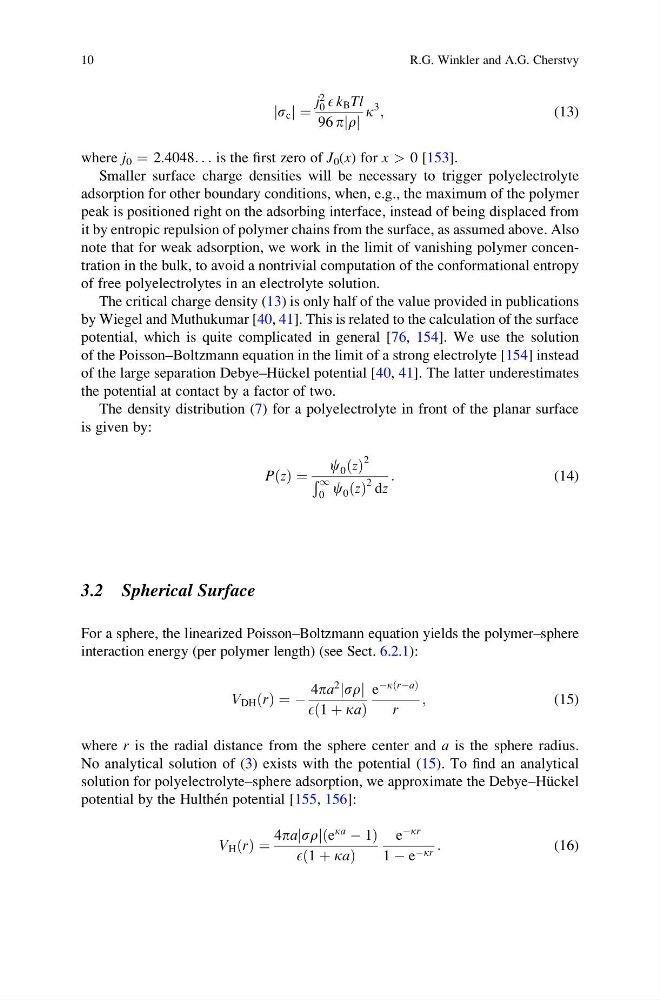
where j 0 ¼ 2.4048. . . is the first zero of J 0 (x) for x > 0 [153].
Smaller surface charge densities will be necessary to trigger polyelectrolyte
adsorption for other boundary conditions, when, e.g., the maximum of the polymer
peak is positioned right on the adsorbing interface, instead of being displaced from
it by entropic repulsion of polymer chains from the surface, as assumed above. Also
note that for weak adsorption, we work in the limit of vanishing polymer concentration in the bulk, to avoid a nontrivial computation of the conformational entropy
of free polyelectrolytes in an electrolyte solution.
The critical charge density (13) is only half of the value provided in publications
by Wiegel and Muthukumar [40, 41]. This is related to the calculation of the surface
potential, which is quite complicated in general [76, 154]. We use the solution
of the Poisson–Boltzmann equation in the limit of a strong electrolyte [154] instead
of the large separation Debye–Hu ¨ckel potential [40, 41]. The latter underestimates
the potential at contact by a factor of two.
The density distribution (7) for a polyelectrolyte in front of the planar surface
is given by:
PðzÞ ¼
c 0 ðzÞ
2
Ð 1
0 c 0 ðzÞ
2 dz
:
(14)
3.2 Spherical Surface
For a sphere, the linearized Poisson–Boltzmann equation yields the polymer–sphere
interaction energy (per polymer length) (see Sect. 6.2.1):
V DH ðrÞ ¼ À
4pa
2
jsrj
Eð1 þ kaÞ
e
ÀkðrÀaÞ
r
;
(15)
where r is the radial distance from the sphere center and a is the sphere radius.
No analytical solution of (3) exists with the potential (15). To find an analytical
solution for polyelectrolyte–sphere adsorption, we approximate the Debye–Hu ¨ckel
potential by the Hulthe ´n potential [155, 156]:
V H ðrÞ ¼
4pajsrjðe
ka
À 1Þ
Eð1 þ kaÞ
e
Àkr
1 À e Àkr :
(16)
10
R.G. Winkler and A.G. Cherstvy
j
2
0 E k B Tl
96 pjrj
k
3
;
(13)
where j 0 ¼ 2.4048. . . is the first zero of J 0 (x) for x > 0 [153].
Smaller surface charge densities will be necessary to trigger polyelectrolyte
adsorption for other boundary conditions, when, e.g., the maximum of the polymer
peak is positioned right on the adsorbing interface, instead of being displaced from
it by entropic repulsion of polymer chains from the surface, as assumed above. Also
note that for weak adsorption, we work in the limit of vanishing polymer concentration in the bulk, to avoid a nontrivial computation of the conformational entropy
of free polyelectrolytes in an electrolyte solution.
The critical charge density (13) is only half of the value provided in publications
by Wiegel and Muthukumar [40, 41]. This is related to the calculation of the surface
potential, which is quite complicated in general [76, 154]. We use the solution
of the Poisson–Boltzmann equation in the limit of a strong electrolyte [154] instead
of the large separation Debye–Hu ¨ckel potential [40, 41]. The latter underestimates
the potential at contact by a factor of two.
The density distribution (7) for a polyelectrolyte in front of the planar surface
is given by:
PðzÞ ¼
c 0 ðzÞ
2
Ð 1
0 c 0 ðzÞ
2 dz
:
(14)
3.2 Spherical Surface
For a sphere, the linearized Poisson–Boltzmann equation yields the polymer–sphere
interaction energy (per polymer length) (see Sect. 6.2.1):
V DH ðrÞ ¼ À
4pa
2
jsrj
Eð1 þ kaÞ
e
ÀkðrÀaÞ
r
;
(15)
where r is the radial distance from the sphere center and a is the sphere radius.
No analytical solution of (3) exists with the potential (15). To find an analytical
solution for polyelectrolyte–sphere adsorption, we approximate the Debye–Hu ¨ckel
potential by the Hulthe ´n potential [155, 156]:
V H ðrÞ ¼
4pajsrjðe
ka
À 1Þ
Eð1 þ kaÞ
e
Àkr
1 À e Àkr :
(16)
10
R.G. Winkler and A.G. Cherstvy