

V DH ðzÞ ¼
4pjrsj
Ek
e
Àkz
;
(8)
when the z-axis is normal to the surface. Parallel to the surface, the polymer
conformations are unperturbed and the corresponding Green function is give by a
Gaussian [40]. The ground-state eigenvalue equation for the Green function (3)
normal to the surface becomes:
À
l
6
@
2
@z 2 À y e
Àkz
c 0 ðzÞ ¼ l 0 c 0 ðzÞ;
(9)
where we introduced the abbreviation:
y ¼
4pjrsj
Ekk B T
:
(10)
The eigenvalue l 0 can be positive or negative, corresponding to free and bound
states, respectively [40]. The transition between free and bound states appears for
l 0 ¼ 0. As discussed [40, 41], the bound states are given by:
c 0 ðzÞ $ J n
ffiffiffiffiffiffiffi ffi
24y
p
=ðklÞ e
Àkz=2
;
(11)
with J n being the Bessel functions of the first kind [153]. The critical values for
adsorption follow for l 0 ¼ 0 and the boundary condition at the surface:
c 0 ð0Þ ¼ J 0
ffiffiffiffiffiffiffi ffi
24y
p
=ðklÞ
¼ 0:
(12)
This yields the critical surface charge density:
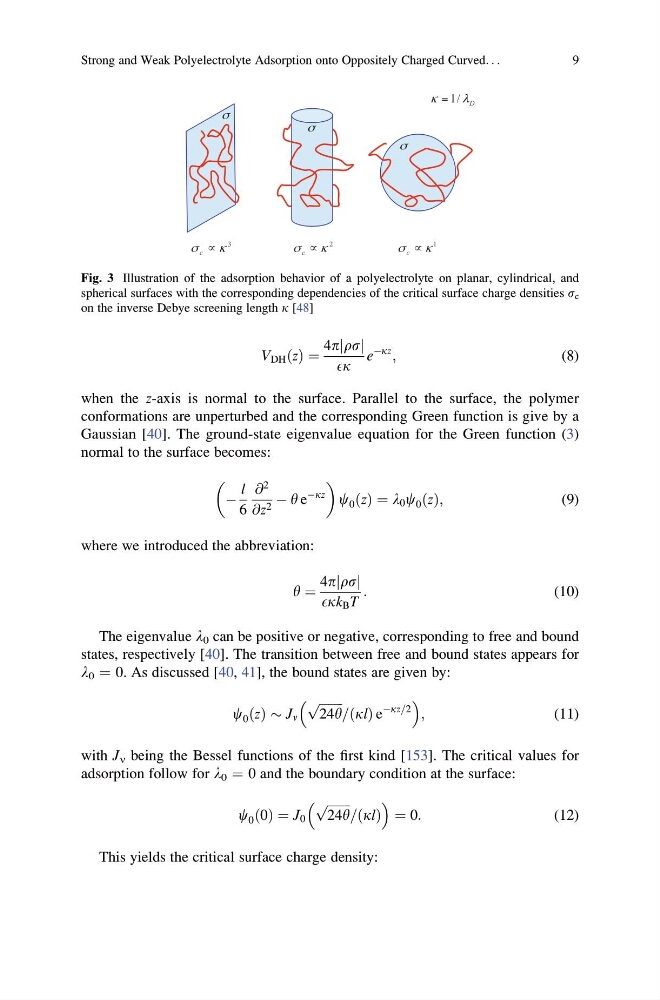
Fig. 3 Illustration of the adsorption behavior of a polyelectrolyte on planar, cylindrical, and
spherical surfaces with the corresponding dependencies of the critical surface charge densities s c
on the inverse Debye screening length k [48]
Strong and Weak Polyelectrolyte Adsorption onto Oppositely Charged Curved. . .
9
4pjrsj
Ek
e
Àkz
;
(8)
when the z-axis is normal to the surface. Parallel to the surface, the polymer
conformations are unperturbed and the corresponding Green function is give by a
Gaussian [40]. The ground-state eigenvalue equation for the Green function (3)
normal to the surface becomes:
À
l
6
@
2
@z 2 À y e
Àkz
c 0 ðzÞ ¼ l 0 c 0 ðzÞ;
(9)
where we introduced the abbreviation:
y ¼
4pjrsj
Ekk B T
:
(10)
The eigenvalue l 0 can be positive or negative, corresponding to free and bound
states, respectively [40]. The transition between free and bound states appears for
l 0 ¼ 0. As discussed [40, 41], the bound states are given by:
c 0 ðzÞ $ J n
ffiffiffiffiffiffiffi ffi
24y
p
=ðklÞ e
Àkz=2
;
(11)
with J n being the Bessel functions of the first kind [153]. The critical values for
adsorption follow for l 0 ¼ 0 and the boundary condition at the surface:
c 0 ð0Þ ¼ J 0
ffiffiffiffiffiffiffi ffi
24y
p
=ðklÞ
¼ 0:
(12)
This yields the critical surface charge density:
Fig. 3 Illustration of the adsorption behavior of a polyelectrolyte on planar, cylindrical, and
spherical surfaces with the corresponding dependencies of the critical surface charge densities s c
on the inverse Debye screening length k [48]
Strong and Weak Polyelectrolyte Adsorption onto Oppositely Charged Curved. . .
9