

simplicity and availability of experimental techniques for study of interpolyelectrolyte
reactions by means of potentiometric titration. As an illustration, one can consider
equilibria (4) and (5):
a
H, a
+
+
COOH
B
COO
B
ð4Þ
H 2 O
OH, b
+
+
A
b
NH 2
NH 3 A
ð5Þ
where (4) describes a reversible charging of a weak polyacid in the presence of
polycations and (5) represents a reversible charging of a weak polybase in the
presence of polyanions. Both charging reactions lead to the formation of IPECs.
A detailed analysis of these equilibria in terms of Y against the pH has been
published [27]. A number of experimental Y versus pH dependences for various
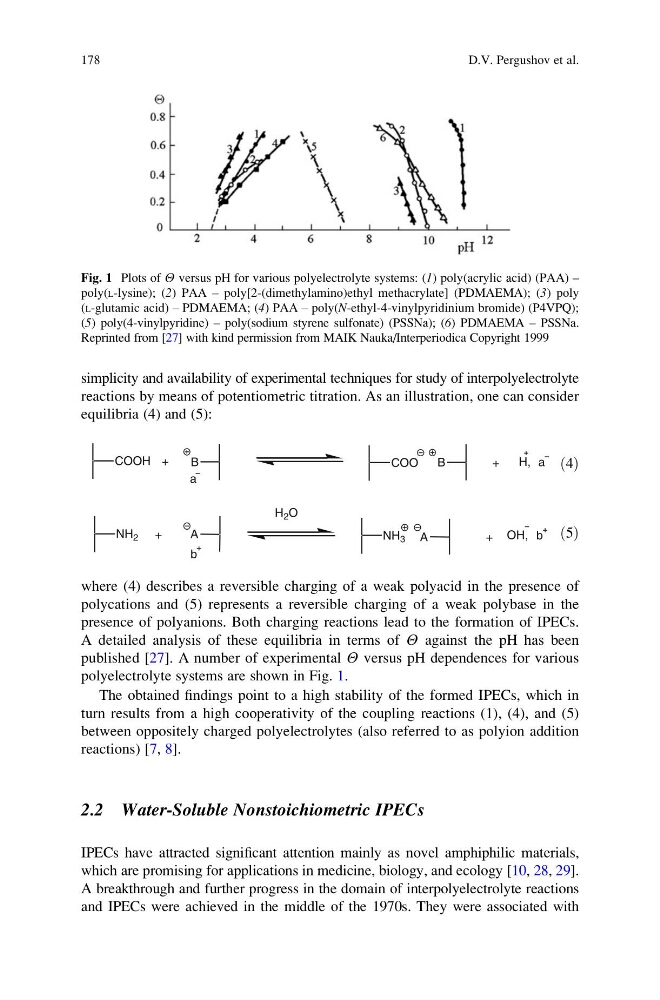
polyelectrolyte systems are shown in Fig. 1.
The obtained findings point to a high stability of the formed IPECs, which in
turn results from a high cooperativity of the coupling reactions (1), (4), and (5)
between oppositely charged polyelectrolytes (also referred to as polyion addition
reactions) [7, 8].
2.2 Water-Soluble Nonstoichiometric IPECs
IPECs have attracted significant attention mainly as novel amphiphilic materials,
which are promising for applications in medicine, biology, and ecology [10, 28, 29].
A breakthrough and further progress in the domain of interpolyelectrolyte reactions
and IPECs were achieved in the middle of the 1970s. They were associated with
Fig. 1 Plots of Y versus pH for various polyelectrolyte systems: (1) poly(acrylic acid) (PAA) –
poly(L-lysine); (2) PAA – poly[2-(dimethylamino)ethyl methacrylate] (PDMAEMA); (3) poly
(L-glutamic acid) – PDMAEMA; (4) PAA – poly(N-ethyl-4-vinylpyridinium bromide) (P4VPQ);
(5) poly(4-vinylpyridine) – poly(sodium styrene sulfonate) (PSSNa); (6) PDMAEMA – PSSNa.
Reprinted from [27] with kind permission from MAIK Nauka/Interperiodica Copyright 1999
178
D.V. Pergushov et al.
reactions by means of potentiometric titration. As an illustration, one can consider
equilibria (4) and (5):
a
H, a
+
+
COOH
B
COO
B
ð4Þ
H 2 O
OH, b
+
+
A
b
NH 2
NH 3 A
ð5Þ
where (4) describes a reversible charging of a weak polyacid in the presence of
polycations and (5) represents a reversible charging of a weak polybase in the
presence of polyanions. Both charging reactions lead to the formation of IPECs.
A detailed analysis of these equilibria in terms of Y against the pH has been
published [27]. A number of experimental Y versus pH dependences for various
polyelectrolyte systems are shown in Fig. 1.
The obtained findings point to a high stability of the formed IPECs, which in
turn results from a high cooperativity of the coupling reactions (1), (4), and (5)
between oppositely charged polyelectrolytes (also referred to as polyion addition
reactions) [7, 8].
2.2 Water-Soluble Nonstoichiometric IPECs
IPECs have attracted significant attention mainly as novel amphiphilic materials,
which are promising for applications in medicine, biology, and ecology [10, 28, 29].
A breakthrough and further progress in the domain of interpolyelectrolyte reactions
and IPECs were achieved in the middle of the 1970s. They were associated with
Fig. 1 Plots of Y versus pH for various polyelectrolyte systems: (1) poly(acrylic acid) (PAA) –
poly(L-lysine); (2) PAA – poly[2-(dimethylamino)ethyl methacrylate] (PDMAEMA); (3) poly
(L-glutamic acid) – PDMAEMA; (4) PAA – poly(N-ethyl-4-vinylpyridinium bromide) (P4VPQ);
(5) poly(4-vinylpyridine) – poly(sodium styrene sulfonate) (PSSNa); (6) PDMAEMA – PSSNa.
Reprinted from [27] with kind permission from MAIK Nauka/Interperiodica Copyright 1999
178
D.V. Pergushov et al.