

the discovery of so-called water-soluble nonstoichiometric IPECs, which contain
charged groups of the polymeric components in a nonequivalent ratio. For the
first time, such macromolecular co-assemblies were reported [30]. Extensive studies
of the water-soluble nonstoichiometric IPECs considerably advanced knowledge
about the structure of these extremely interesting and promising macromolecular
co-assemblies and their self-organization. It was found that the solution behavior of
such IPECs decisively depends on their charge-to-charge stoichiometry. In particular,
it was shown that IPEC species become compact if the ratio of oppositely charged
groups of their polymeric components approaches 1:1 (i.e., stoichiometric).
These and other results allow one to consider water-soluble nonstoichiometric
IPECs as peculiar amphiphilic block copolymers comprising a number of complex
blocks assembled from the electrostatically coupled polymeric components. Such
complex blocks are rather hydrophobic, thereby manifesting a tendency to a mutual
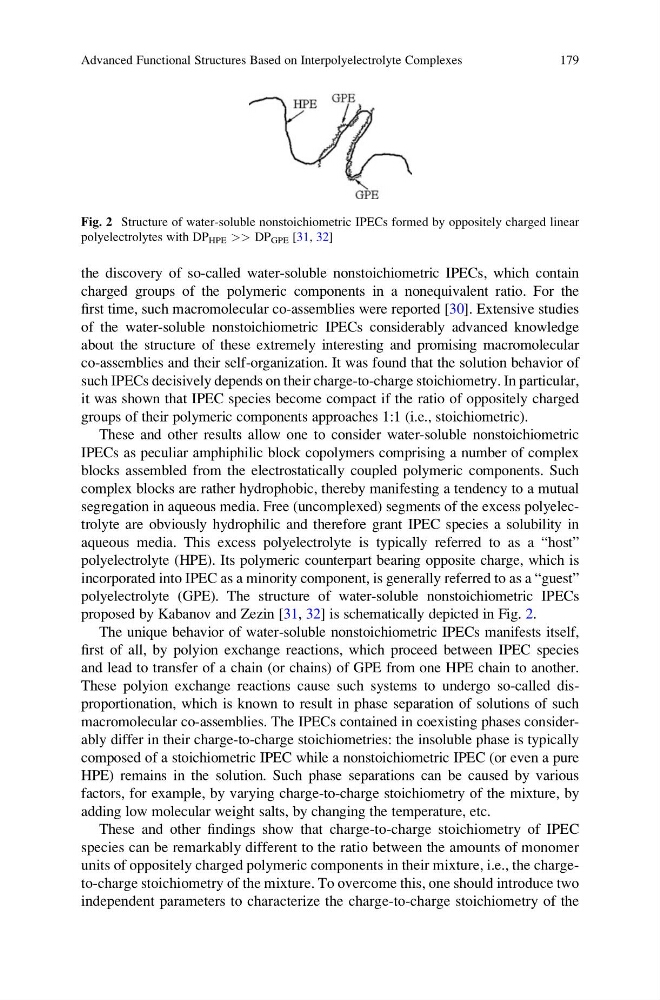
segregation in aqueous media. Free (uncomplexed) segments of the excess polyelectrolyte are obviously hydrophilic and therefore grant IPEC species a solubility in
aqueous media. This excess polyelectrolyte is typically referred to as a “host”
polyelectrolyte (HPE). Its polymeric counterpart bearing opposite charge, which is
incorporated into IPEC as a minority component, is generally referred to as a “guest”
polyelectrolyte (GPE). The structure of water-soluble nonstoichiometric IPECs
proposed by Kabanov and Zezin [31, 32] is schematically depicted in Fig. 2.
The unique behavior of water-soluble nonstoichiometric IPECs manifests itself,
first of all, by polyion exchange reactions, which proceed between IPEC species
and lead to transfer of a chain (or chains) of GPE from one HPE chain to another.
These polyion exchange reactions cause such systems to undergo so-called disproportionation, which is known to result in phase separation of solutions of such
macromolecular co-assemblies. The IPECs contained in coexisting phases considerably differ in their charge-to-charge stoichiometries: the insoluble phase is typically
composed of a stoichiometric IPEC while a nonstoichiometric IPEC (or even a pure
HPE) remains in the solution. Such phase separations can be caused by various
factors, for example, by varying charge-to-charge stoichiometry of the mixture, by
adding low molecular weight salts, by changing the temperature, etc.
These and other findings show that charge-to-charge stoichiometry of IPEC
species can be remarkably different to the ratio between the amounts of monomer
units of oppositely charged polymeric components in their mixture, i.e., the chargeto-charge stoichiometry of the mixture. To overcome this, one should introduce two
independent parameters to characterize the charge-to-charge stoichiometry of the
Fig. 2 Structure of water-soluble nonstoichiometric IPECs formed by oppositely charged linear
polyelectrolytes with DP HPE >> DP GPE [31, 32]
Advanced Functional Structures Based on Interpolyelectrolyte Complexes
179
charged groups of the polymeric components in a nonequivalent ratio. For the
first time, such macromolecular co-assemblies were reported [30]. Extensive studies
of the water-soluble nonstoichiometric IPECs considerably advanced knowledge
about the structure of these extremely interesting and promising macromolecular
co-assemblies and their self-organization. It was found that the solution behavior of
such IPECs decisively depends on their charge-to-charge stoichiometry. In particular,
it was shown that IPEC species become compact if the ratio of oppositely charged
groups of their polymeric components approaches 1:1 (i.e., stoichiometric).
These and other results allow one to consider water-soluble nonstoichiometric
IPECs as peculiar amphiphilic block copolymers comprising a number of complex
blocks assembled from the electrostatically coupled polymeric components. Such
complex blocks are rather hydrophobic, thereby manifesting a tendency to a mutual
segregation in aqueous media. Free (uncomplexed) segments of the excess polyelectrolyte are obviously hydrophilic and therefore grant IPEC species a solubility in
aqueous media. This excess polyelectrolyte is typically referred to as a “host”
polyelectrolyte (HPE). Its polymeric counterpart bearing opposite charge, which is
incorporated into IPEC as a minority component, is generally referred to as a “guest”
polyelectrolyte (GPE). The structure of water-soluble nonstoichiometric IPECs
proposed by Kabanov and Zezin [31, 32] is schematically depicted in Fig. 2.
The unique behavior of water-soluble nonstoichiometric IPECs manifests itself,
first of all, by polyion exchange reactions, which proceed between IPEC species
and lead to transfer of a chain (or chains) of GPE from one HPE chain to another.
These polyion exchange reactions cause such systems to undergo so-called disproportionation, which is known to result in phase separation of solutions of such
macromolecular co-assemblies. The IPECs contained in coexisting phases considerably differ in their charge-to-charge stoichiometries: the insoluble phase is typically
composed of a stoichiometric IPEC while a nonstoichiometric IPEC (or even a pure
HPE) remains in the solution. Such phase separations can be caused by various
factors, for example, by varying charge-to-charge stoichiometry of the mixture, by
adding low molecular weight salts, by changing the temperature, etc.
These and other findings show that charge-to-charge stoichiometry of IPEC
species can be remarkably different to the ratio between the amounts of monomer
units of oppositely charged polymeric components in their mixture, i.e., the chargeto-charge stoichiometry of the mixture. To overcome this, one should introduce two
independent parameters to characterize the charge-to-charge stoichiometry of the
Fig. 2 Structure of water-soluble nonstoichiometric IPECs formed by oppositely charged linear
polyelectrolytes with DP HPE >> DP GPE [31, 32]
Advanced Functional Structures Based on Interpolyelectrolyte Complexes
179